Will Menopause Hormone Therapy Stop Your Periods?
Whether bleeding stops depends partly on the regimen: one may include a planned monthly bleed, while another aims for no regular bleeding.
Menopause hormone therapy doesn’t always stop bleeding. Sequential therapy includes a scheduled monthly withdrawal bleed; continuous-combined therapy is intended to be bleed-free, though unscheduled bleeding can happen. If you’re still in perimenopause, natural periods may also be irregular. After 12 months without a period, bleeding that isn’t part of a planned regimen deserves discussion with the clinician managing your therapy. 23
A treatment bleed isn’t necessarily a natural period
Menopause is defined as 12 months without a period. During perimenopause, periods may become irregular or change in length and flow. Hormone therapy can add another source of bleeding, so the pattern needs to be understood in the context of both your cycle and your treatment schedule. 23
For someone who still has a uterus, menopause hormone therapy may pair estrogen with progesterone or a similar hormone. The regimen affects what bleeding pattern is expected. 1
Sequential therapy: a planned monthly bleed
Sequential therapy has a scheduled monthly withdrawal bleed. Bleeding at the expected time is part of the regimen; bleeding in addition to that scheduled bleed is considered unscheduled. 3
If you’re still having periods, natural cycle changes can make the picture less straightforward. Perimenopause itself can bring irregular or changing periods, so compare bleeding with the schedule you were given rather than assuming every bleed is either a treatment effect or a return to your old cycle. 23
Continuous-combined therapy: aiming for no regular bleed
Continuous-combined therapy is intended to be bleed-free, but spotting or other unscheduled bleeding can occur. In a systematic review of studies in postmenopausal women, bleeding patterns differed among products and by route. The review reported that the proportion with no bleeding over a year ranged from 18% to 61% for oral therapies and from 9% to 27% for transdermal therapies. These came from studies that did not directly compare the products, so the ranges aren’t a personal prediction. The review also found that no-bleeding rates improved and average bleeding or spotting days decreased over time. 35
That means “continuous” describes the treatment schedule, not a guarantee that bleeding will stop immediately or never happen. If bleeding occurs, its timing and whether it fits the pattern you were told to expect still matter. 35
When bleeding falls outside the plan
The distinction is simple: a planned monthly withdrawal bleed on sequential therapy is different from bleeding between those scheduled bleeds; on continuous-combined therapy, bleeding is considered unscheduled because the regimen is intended to be bleed-free. 3
A 2025 paper on bleeding with hormone therapy describes further assessment when unscheduled bleeding occurs more than six months after starting therapy or more than three months after a dose or formulation change. Those time points appear in the paper’s introduction; they were not established by its case series. They’re not a substitute for individualized advice, and they don’t apply to a scheduled withdrawal bleed. If bleeding is outside your expected pattern, ask the clinician managing your therapy how its timing applies to you. 3
If you’ve gone 12 months without a period, bleeding that isn’t part of a planned sequential withdrawal bleed shouldn’t simply be assumed to be a returning period or dismissed because you use hormone therapy. Discuss it with your clinician so they can decide whether assessment is needed. 23
The case series in that paper included 235 postmenopausal women with unscheduled bleeding who used transdermal estradiol plus micronised progesterone at one private menopause clinic. Its findings describe that group, not everyone using hormone therapy or every bleeding pattern. A review of abnormal bleeding also notes that evidence-based data on managing unscheduled bleeding specifically on hormone therapy are limited. 34
A practical way to make sense of your pattern
Check whether your regimen is sequential or continuous, then compare the timing of bleeding with the schedule you were given. Note whether it’s a planned withdrawal bleed, bleeding between scheduled bleeds, or bleeding on a continuous-combined regimen. If the pattern is new or doesn’t fit the plan, share when it started and whether it followed a treatment change. These details help frame the question without assuming the cause.
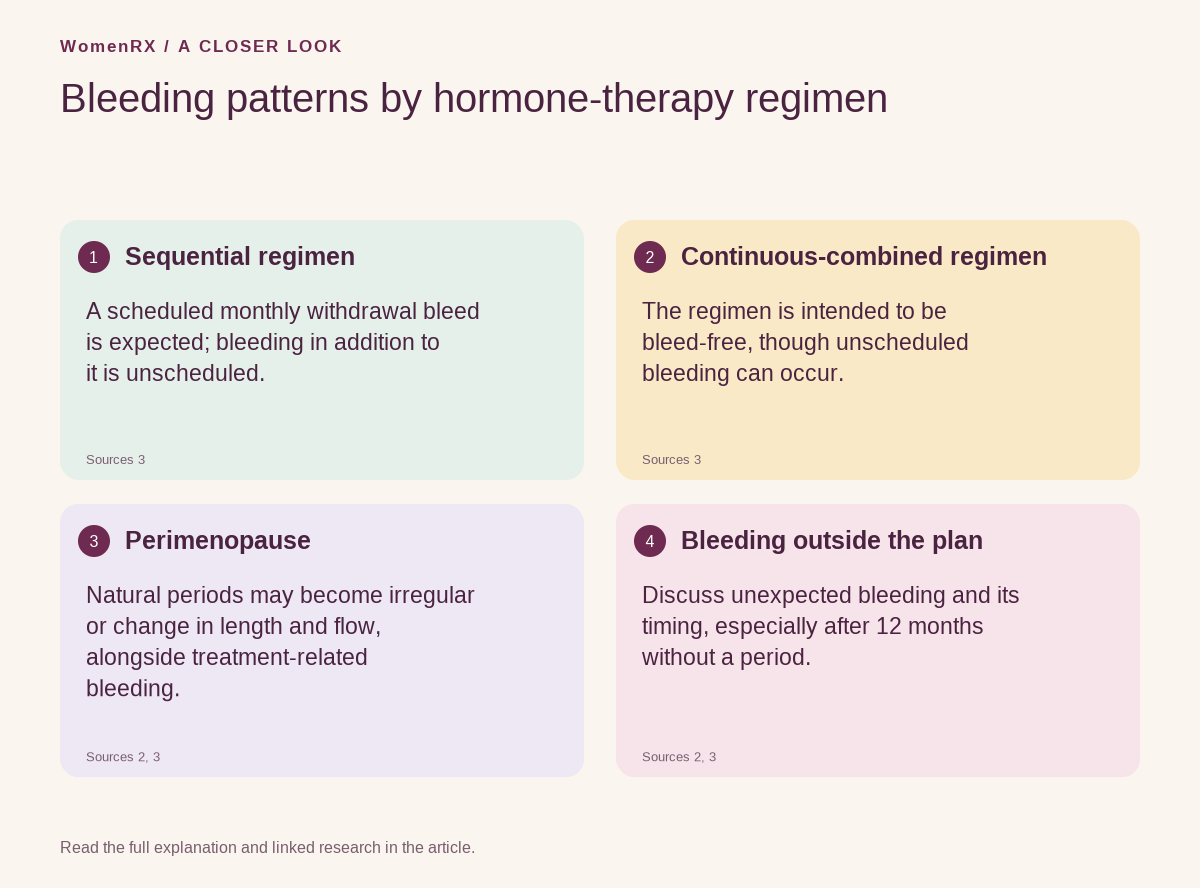
Bleeding patterns by hormone-therapy regimen
Sequential regimen: A scheduled monthly withdrawal bleed is expected; bleeding in addition to it is unscheduled.3
Continuous-combined regimen: The regimen is intended to be bleed-free, though unscheduled bleeding can occur.3
Perimenopause: Natural periods may become irregular or change in length and flow, alongside treatment-related bleeding.23
Bleeding outside the plan: Discuss unexpected bleeding and its timing, especially after 12 months without a period.23
Read the figure as text
Compare the planned pattern for each regimen with bleeding that falls outside it, and see why timing matters.- Sequential regimen: A scheduled monthly withdrawal bleed is expected; bleeding in addition to it is unscheduled.3
- Continuous-combined regimen: The regimen is intended to be bleed-free, though unscheduled bleeding can occur.3
- Perimenopause: Natural periods may become irregular or change in length and flow, alongside treatment-related bleeding.23
- Bleeding outside the plan: Discuss unexpected bleeding and its timing, especially after 12 months without a period.23
Sources you can check
- Hormone Therapy for Menopause | MedlinePlusAccessed 2026-09-25Return to first citation
- Menopause | Menopause Symptoms | MedlinePlusAccessed 2026-09-25Return to first citation
- Endometrial thickness and pathology in postmenopausal women with bleeding on transdermal 17β-estradiol plus body-identical progesterone.Glynne S, Kamal A, Neville A, McColl L, Naji O, Newson L, Reisel D. · Archives of gynecology and obstetrics · 2025Return to first citation
- Diagnosis and medical management of abnormal premenopausal and postmenopausal bleeding.Black D. · Climacteric : the journal of the International Menopause Society · 2023Return to first citation
- Uterine bleeding with hormone therapies in menopausal women: a systematic review.Pickar JH, Archer DF, Goldstein SR, Kagan R, Bernick B, Mirkin S. · Climacteric : the journal of the International Menopause Society · 2020Return to first citation