Considering Menopause HRT Online? How to Assess Telehealth Care
A useful online menopause visit should make room for your symptoms, health history, treatment choices, and a plan to revisit the decision.
An online visit can be a convenient way to discuss menopause symptoms, but it shouldn’t be a shortcut to a guaranteed prescription. Look for a clinician who asks about your symptoms and health history, explains why a treatment may or may not fit, discusses benefits and risks, and sets up follow-up. Hormone therapy decisions are individualized and should be periodically reevaluated. 1 2
Start with the care, not the promise of a prescription
Telehealth can include video or phone visits, as well as secure messages. Prescriptions may be part of telehealth, but that doesn’t mean every online service or every visit is appropriate for starting hormone therapy. 1 A responsible service should be able to explain who evaluates you, how the clinician makes a recommendation, and what happens if your situation needs an exam or other in-person care.
Be cautious of a service that promises HRT before a clinician has learned what’s bothering you and considered your health history. Menopause hormone therapy can be effective for symptoms such as hot flashes and night sweats, but its benefits and risks depend on factors including the type of therapy, dose, route, duration, timing, and whether a progestogen is used. 2 The decision should fit you, not a standard package.
What a thoughtful assessment should cover
Your symptoms and what you want help with
A useful conversation starts with the symptoms affecting you and what you hope will improve. For example, you might want help with hot flashes that interrupt sleep, or with vaginal and urinary symptoms that are affecting comfort. Be wary if the clinician focuses only on a symptom quiz and doesn’t invite you to explain how symptoms affect daily life.
Ask whether the proposed treatment matches your main concern. Menopause hormone therapy is not one single approach: guidance distinguishes systemic treatment from options such as low-dose vaginal estrogen for certain genitourinary symptoms. 2 It’s reasonable to ask why a clinician is suggesting one approach rather than another, or whether a nonhormonal option is worth discussing.
Your health history and the tradeoffs
The clinician should have a real conversation with you about your medical history and how it affects the decision, rather than treating an online form as the whole assessment. Ask which parts of your history matter to the recommendation and what benefits and risks apply to your circumstances.
Age and time since menopause are part of the discussion, not a pass-or-fail rule. The North American Menopause Society’s 2022 statement says the benefit-risk balance is generally favorable for treating bothersome vasomotor symptoms in women younger than 60 or within 10 years of menopause onset who have no contraindications. It appears less favorable when therapy is started later, in part because absolute risks of coronary heart disease, stroke, blood clots, and dementia are greater. 2 Your clinician should explain how this guidance relates to you, without reducing the decision to a slogan or a single number.
A clear recommendation, including when the answer is no
Ask what the clinician recommends, what alternatives you could consider, and what would make them change that recommendation. If hormone therapy isn’t a fit, nonhormonal options may still be available for hot flashes and night sweats. The Menopause Society’s 2023 statement lists evidence-supported options, including certain prescription medicines and cognitive behavioral therapy. 3
You can also ask whether the proposed plan includes estradiol, progesterone, or another treatment, and what role each has in the recommendation. The goal isn’t to choose a medication based on a name on a website. It’s to understand the reasoning and have room to ask questions before deciding.
Follow-up that doesn’t end at checkout
Before you agree to a plan, find out how and when the service will check whether it’s helping, how you can report a concern, and who handles follow-up. Hormone therapy guidance recommends individualizing treatment and periodically reevaluating its benefits and risks. 2 A service should be able to tell you how that reevaluation happens, rather than leaving you to figure it out after a prescription is issued.
Ask what the visit and follow-up cost, what is included, and whether you can get help if symptoms aren’t improving. MedlinePlus notes that some insurance plans may not cover telehealth visits. 1 A low advertised price may not tell you what follow-up or other parts of care will cost.
What remote care can and can’t tell you
Remote care may work well for a conversation about symptoms and treatment preferences. In one cross-sectional study of a single menopause clinic in Toronto during the first wave of the COVID-19 pandemic, 214 women had 246 visits, mostly by telephone. Among 118 women who had also attended in person, 24 (20%) preferred in-person visits. The study reflects one clinic and a particular period, so it doesn’t show that online HRT care works equally well for everyone or compare treatment outcomes across online and in-person care. 4
Some questions may call for an in-person examination, testing, or another kind of care. The point isn’t that remote care is inadequate; it’s that the service should be clear about when it can help remotely and how it will arrange the next step when it can’t. You can ask this before signing up.
Questions to ask before you book
- Who will evaluate me, and how can I ask follow-up questions?
- How will you consider my symptoms and medical history before recommending treatment?
- What are the likely benefits, risks, and alternatives for my situation?
- If you recommend HRT, what is the reasoning for the specific approach?
- How will we review whether it’s helping and revisit the benefits and risks?
- What happens if you decide I need in-person care or additional evaluation?
- What do the visit, follow-up, and any other required services cost?
A good online visit should leave you with a clearer understanding of your options, whether or not the outcome is a prescription.
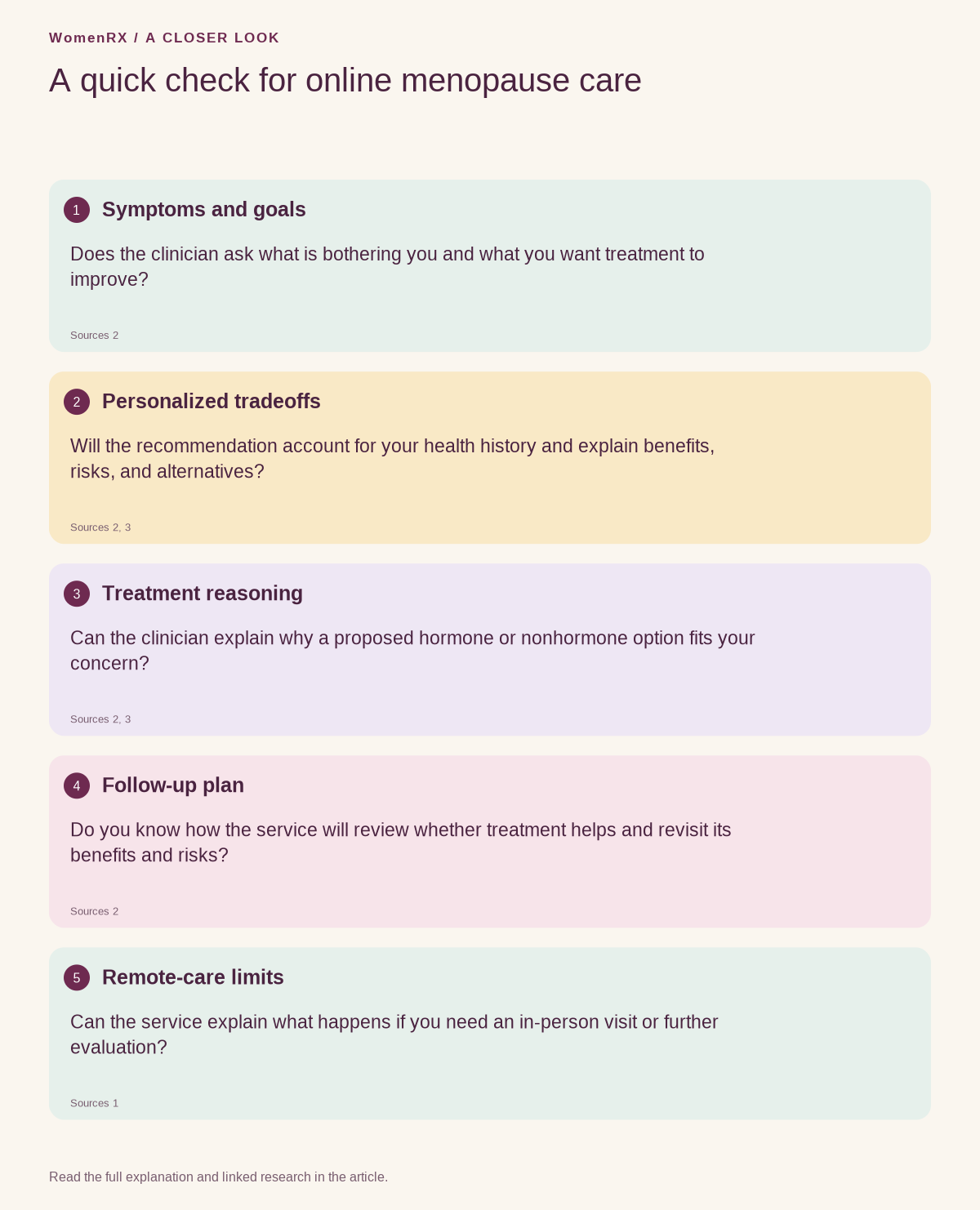
A quick check for online menopause care
Symptoms and goals: Does the clinician ask what is bothering you and what you want treatment to improve?2
Personalized tradeoffs: Will the recommendation account for your health history and explain benefits, risks, and alternatives?23
Treatment reasoning: Can the clinician explain why a proposed hormone or nonhormone option fits your concern?23
Follow-up plan: Do you know how the service will review whether treatment helps and revisit its benefits and risks?2
Remote-care limits: Can the service explain what happens if you need an in-person visit or further evaluation?1
Read the figure as text
Use these questions to see whether a service explains its assessment, treatment reasoning, follow-up, and limits of remote care.- Symptoms and goals: Does the clinician ask what is bothering you and what you want treatment to improve?2
- Personalized tradeoffs: Will the recommendation account for your health history and explain benefits, risks, and alternatives?23
- Treatment reasoning: Can the clinician explain why a proposed hormone or nonhormone option fits your concern?23
- Follow-up plan: Do you know how the service will review whether treatment helps and revisit its benefits and risks?2
- Remote-care limits: Can the service explain what happens if you need an in-person visit or further evaluation?1
More questions, answered
Does an online menopause visit mean I’ll get an HRT prescription?
No. Telehealth can include prescription care, but whether HRT is appropriate depends on an individualized assessment. A clinician may recommend another approach or decide that you need further evaluation before making a treatment plan. 1 2
Can I use an online visit for symptoms after menopause?
You can use a telehealth visit to discuss symptoms in perimenopause or after menopause, but the right evaluation and treatment depend on the symptoms and your health history. Hormone therapy guidance emphasizes individualized decisions and periodic reevaluation. 2
Sources you can check
- Telehealth: MedlinePlusAccessed 2026-09-25Return to first citation
- The 2022 hormone therapy position statement of The North American Menopause Society.“The 2022 Hormone Therapy Position Statement of The North American Menopause Society” Advisory Panel. · Menopause (New York, N.Y.) · 2022Return to first citation
- The 2023 nonhormone therapy position statement of The North American Menopause Society.Menopause (New York, N.Y.) · 2023Return to first citation
- Delivery of menopause care during a pandemic: an evaluation of patient satisfaction with telephone visits.Wright E, Shaltout O, Zokvic MA, Shirreff L. · Menopause (New York, N.Y.) · 2021Return to first citation