How to assess an online menopause HRT service
Look for a real, individualized clinical assessment and a clear plan for follow-up, not a promise that you’ll receive a prescription.
A good online HRT service should make it clear who evaluates you, how they consider your menstrual and medical history and treatment goals, and how you’ll revisit the decision over time. Ask who prescribes, what happens if HRT isn’t a good fit, and which pharmacy fills prescriptions. Menopause hormone therapy’s benefits and risks vary with the treatment and the person, so a guaranteed or one-size-fits-all offer deserves questions. 1
Online care can make it easier to start a menopause conversation, but a polished website doesn’t tell you how carefully a service makes treatment decisions. Use these questions to assess the care process before you sign up. They’re prompts for evaluating a service, not a guarantee that every service follows the same model.
Start with who is providing care
Look for the name and professional credentials of the person who will assess you. Ask whether that clinician will review your information and make the prescribing decision, or whether another person or process is involved. You can also ask what menopause experience or training the clinician has.
A service should explain how you can ask follow-up questions and whom to contact if your symptoms or concerns change. If it’s difficult to find out who is responsible for your care, pause before sharing payment or health information.
Check whether the assessment is about you
Before a treatment decision, the questions should leave room for your own history and priorities. Ask whether the assessment covers:
- Your menstrual history and where you may be in the menopause transition
- The symptoms you want help with and how they affect your life
- Your medical and personal risk factors, including anything that might change whether hormone therapy is appropriate
- Your treatment goals, preferences, and questions about benefits and risks
Timing matters: the North American Menopause Society’s position statement says the balance of benefits and risks varies with factors including age and time since menopause, and also with hormone type, dose, route, duration, and whether a progestogen is used. It recommends individualizing treatment and periodically revisiting its benefits and risks. 1
That doesn’t mean an online questionnaire alone can settle every clinical question. Ask how the clinician handles information that needs clarification and what happens if your history suggests that another evaluation or treatment approach may be more suitable.
Look for a conversation, not a guaranteed prescription
Ask how the clinician will explain why a particular option may fit your symptoms and goals, what its important tradeoffs are, and what alternatives are available. Hormone therapy is an effective treatment for bothersome hot flashes and other vasomotor symptoms, but it isn’t the only option: the Menopause Society also identifies several evidence-supported nonhormonal treatments for vasomotor symptoms. 12
A service can’t determine in advance that every person who signs up should receive HRT. Be cautious if marketing promises a particular hormone or prescription before a clinician has assessed your situation. Ask whether you’ll have a chance to discuss the reasoning and decline or reconsider a recommendation.
Understand what happens after a prescription
Before starting, find out how the service arranges follow-up and how you’ll reach the care team between appointments. Ask what the plan is for checking whether treatment is helping, discussing side effects or concerns, and reconsidering the balance of benefits and risks over time. Periodic reevaluation is part of the Menopause Society’s guidance on continuing hormone therapy. 1
Ask which pharmacy would fill a prescription, how you’ll receive the pharmacy’s name and contact information, and whom to contact with a question about a dispensed medication. The service should be able to explain its process clearly. Don’t assume that a company’s online checkout, prescribing service, and pharmacy are the same organization.
A short service-check conversation
You might ask: “Who reviews my history and makes the prescribing decision? How will my menstrual history, risk factors, and goals affect the options we discuss? If HRT isn’t right for me, what happens next? How do follow-up and pharmacy dispensing work?”
Clear, specific answers help you compare services on the care they describe, rather than on a brand name or a promise of quick access. If an answer is vague, ask for clarification before deciding whether the service meets your needs.
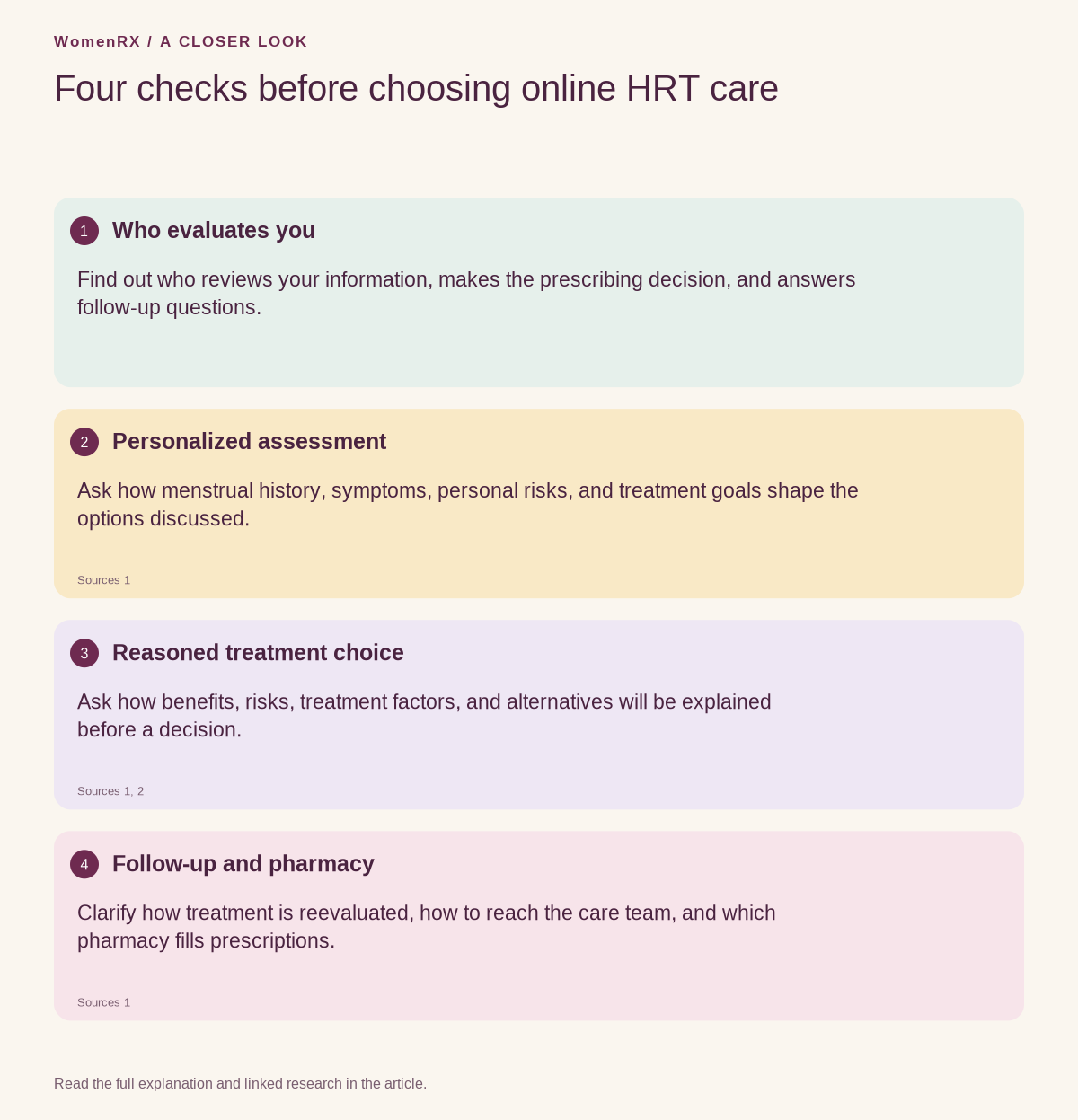
Four checks before choosing online HRT care
Who evaluates you: Find out who reviews your information, makes the prescribing decision, and answers follow-up questions.
Personalized assessment: Ask how menstrual history, symptoms, personal risks, and treatment goals shape the options discussed.1
Reasoned treatment choice: Ask how benefits, risks, treatment factors, and alternatives will be explained before a decision.12
Follow-up and pharmacy: Clarify how treatment is reevaluated, how to reach the care team, and which pharmacy fills prescriptions.1
Read the figure as text
Use these prompts to assess the care process, rather than assuming that online access means a prescription or ongoing care is included.- Who evaluates you: Find out who reviews your information, makes the prescribing decision, and answers follow-up questions.
- Personalized assessment: Ask how menstrual history, symptoms, personal risks, and treatment goals shape the options discussed.1
- Reasoned treatment choice: Ask how benefits, risks, treatment factors, and alternatives will be explained before a decision.12
- Follow-up and pharmacy: Clarify how treatment is reevaluated, how to reach the care team, and which pharmacy fills prescriptions.1
More questions, answered
Should an online service promise that I’ll receive HRT?
A promise made before an individualized assessment is a reason to ask more questions. Hormone therapy’s benefit-risk balance varies among people and depends on treatment factors as well as timing. 1
Does an online menopause service have to offer hormone therapy?
No single treatment suits everyone. For vasomotor symptoms, the Menopause Society identifies evidence-supported nonhormonal options as well as hormone therapy, so it’s reasonable to ask what alternatives the clinician discusses if HRT isn’t appropriate or isn’t your preference. 12
Sources you can check
- The 2022 hormone therapy position statement of The North American Menopause Society.“The 2022 Hormone Therapy Position Statement of The North American Menopause Society” Advisory Panel. · Menopause (New York, N.Y.) · 2022Return to first citation
- The 2023 nonhormone therapy position statement of The North American Menopause Society.Menopause (New York, N.Y.) · 2023Return to first citation