How Is a Progesterone Dose Chosen With Menopause HRT?
There isn’t one progesterone dose that fits every estrogen regimen; the choice depends on your uterus, the exact medicines, and how they’re prescribed.
When progesterone is prescribed with estrogen, the aim may include protecting the uterine lining, so the dose can’t be chosen in isolation. Your prescriber considers whether you have a uterus, the estrogen product and dose, the progesterone formulation, and whether the regimen is continuous or cyclical. Menopause guidance recommends individualizing hormone therapy by its type, dose, route, duration, and use of a progestogen. 1
Why progesterone is paired with estrogen
For someone with a uterus using systemic estrogen, a progestogen may be included to protect the uterine lining. That’s a different job from treating hot flashes or other symptoms: the estrogen regimen may be chosen with symptom relief in mind, while the progesterone plan also needs to fit the goal of endometrial protection. 34
That’s why searching for a universal “lowest dose” can be misleading. A number that appears in one prescription or study doesn’t automatically apply to a different estrogen product, progesterone formulation, or schedule. Menopause guidance emphasizes that hormone therapy decisions depend on the type, dose, and route of treatment, its duration, and whether a progestogen is used. 1
What your prescriber is matching
Whether you have a uterus. This is a useful first detail to confirm. If you’ve had a hysterectomy, ask why progesterone is part of your particular plan rather than assuming the reason is endometrial protection. If you have a uterus, ask how the prescribed regimen is intended to protect its lining while you use estrogen. The answer may depend on the entire regimen, not progesterone alone. 34
The estrogen product and dose. Bring the exact name and strength of your estrogen, along with how you take or use it. A progesterone plan studied alongside one estrogen formulation can’t be treated as proof that the same plan suits every estrogen product or dose. Menopause guidance identifies estrogen type, dose, and route as part of an individualized decision. 1
The progesterone formulation and schedule. “Progesterone” can refer to a particular medicine and formulation, while other regimens use different progestogens. Ask whether yours is intended to be taken continuously or on a schedule that includes progesterone for part of a cycle. Don’t compare doses by number alone if the medicine or schedule differs.
This product-specific point matters in the research, too. One review described a clinical trial of a combined oral estradiol-progesterone product in people with a uterus. The study’s findings applied to the combinations tested in that product, not to every estrogen and progesterone pairing. 2
Your reason for taking hormone therapy. Treatment may be intended to address symptoms such as hot flashes, and the hormone plan should be considered as a whole. Menopause guidance recommends periodic reevaluation of the benefits and risks, rather than treating a dose as a permanent, stand-alone choice. 1
Check the instructions before asking about a change
Look at the prescription label and any package instructions, and make a note of:
- The exact estrogen and progesterone names and strengths
- How each medicine is used and how often
- Whether the progesterone schedule is continuous or cyclical
- What you’re taking the regimen for, and what has changed for you
If the label and what you remember being told don’t seem to match, ask the prescriber or pharmacist to clarify the directions. Don’t change, stop, or combine hormone medicines on your own. A dose change can affect the balance of the full regimen, and the right question is whether the prescribed combination still fits your circumstances.
Questions that make the conversation specific
Instead of asking only, “What’s the lowest dose?”, try:
- “Is progesterone included to protect my uterine lining, or for another reason?”
- “Does my uterus status change what you recommend?”
- “How does this progesterone formulation and schedule fit with my exact estrogen product and dose?”
- “Are these instructions continuous or cyclical, and what should I do if I’m unsure how to follow them?”
- “What would make us revisit the regimen?”
These questions help connect a dose to its purpose and to the instructions you actually have. They’re also more useful than comparing your prescription with a dose someone else takes, because the medicines and schedules may not be the same.
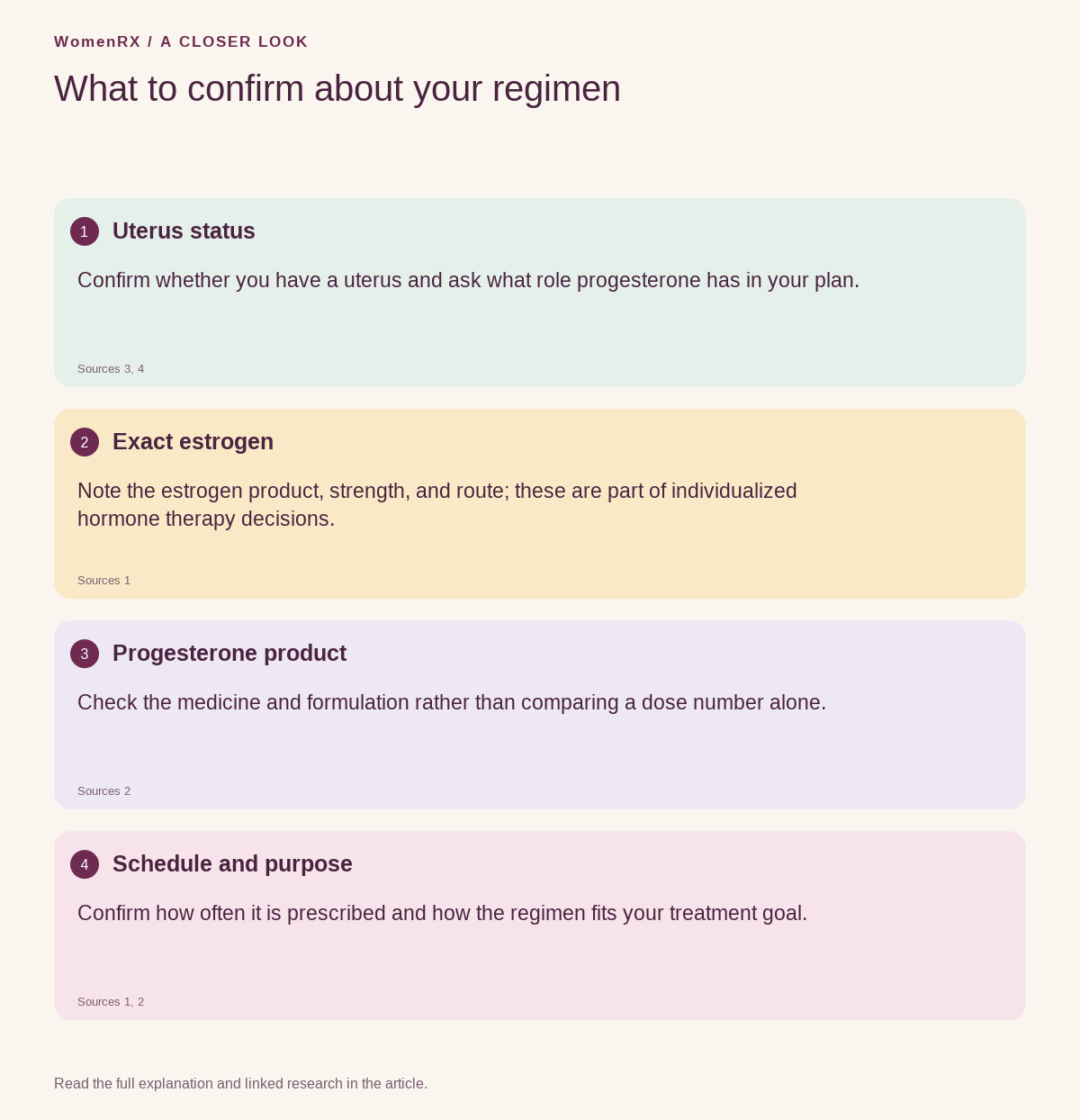
What to confirm about your regimen
Uterus status: Confirm whether you have a uterus and ask what role progesterone has in your plan.34
Exact estrogen: Note the estrogen product, strength, and route; these are part of individualized hormone therapy decisions.1
Progesterone product: Check the medicine and formulation rather than comparing a dose number alone.2
Schedule and purpose: Confirm how often it is prescribed and how the regimen fits your treatment goal.12
Read the figure as text
These are the details that help make a progesterone dose discussion specific to your prescription.- Uterus status: Confirm whether you have a uterus and ask what role progesterone has in your plan.34
- Exact estrogen: Note the estrogen product, strength, and route; these are part of individualized hormone therapy decisions.1
- Progesterone product: Check the medicine and formulation rather than comparing a dose number alone.2
- Schedule and purpose: Confirm how often it is prescribed and how the regimen fits your treatment goal.12
More questions, answered
Can I compare my progesterone dose with someone else’s?
Not by the number alone. The medicine, formulation, estrogen product, and schedule may differ, and findings from a trial of one combined product don’t establish that the same dose works for another regimen. 2
Sources you can check
- The 2022 hormone therapy position statement of The North American Menopause Society.“The 2022 Hormone Therapy Position Statement of The North American Menopause Society” Advisory Panel. · Menopause (New York, N.Y.) · 2022Return to first citation
- A combined, bioidentical, oral, 17β-estradiol and progesterone capsule for the treatment of moderate to severe vasomotor symptoms due to menopause.Archer DF, Bernick BA, Mirkin S. · Expert review of clinical pharmacology · 2019Return to first citation
- Progestins and menopause: epidemiological studies of risks of endometrial and breast cancer.Pike MC, Ross RK. · Steroids · 2000Return to first citation
- Progestogens in Menopausal Hormone Therapy: A Double-Edged Sword.Ylikorkala O, Joensuu JM, Siitonen H, Mikkola TS. · Seminars in reproductive medicine · 2025Return to first citation