Low Sexual Desire: Comparing Bremelanotide, Flibanserin, and Care Options
The best next step depends on whether low desire is distressing, what may be contributing to it, and whether a medication’s intended population and routine fit your life.
Low desire isn’t automatically a disorder; distress is part of the clinical picture. In the United States, bremelanotide and flibanserin are prescription options for specific groups of women with acquired, generalized, distressing low desire. One review characterized flibanserin’s observed effects as limited in clinical significance; this evidence doesn’t establish which medicine works better. Their eligibility and routines differ, and possible contributors matter too. 2 3 5 6
Low desire can be a real concern without meaning something is wrong with you. Desire changes, and a difference between your desire and a partner’s, by itself, doesn’t establish a disorder. A clinical diagnosis is more focused: low desire is unwanted or distressing, and the clinician considers its pattern and possible explanations. 5
That distinction matters because bremelanotide and flibanserin aren’t general-purpose libido boosters. Their US prescribing information describes use for specific forms of hypoactive sexual desire disorder (HSDD), not every change in sexual interest. 2 3
The pattern and its context
The labels use the terms acquired and generalized. Acquired means desire problems began after a time without them. Generalized means the difficulty isn’t limited to a particular partner, situation, or kind of stimulation. Both descriptions can help clarify whether the medicines’ intended populations sound relevant to your experience. 2 3
Low desire can also sit alongside other factors. Medicines and chronic health conditions can affect sexual health, and relationship distress or other significant stressors may help explain what’s changed. Some antidepressants, for example, can reduce sex drive. If you suspect a medicine is contributing, its possible effect on desire is worth discussing with the prescriber. 1 4 5
These are factors to assess, not circumstances that automatically fit a prescription medicine’s intended use. Flibanserin’s label specifies that the low desire it treats is not due to a co-existing medical or psychiatric condition, relationship problems, or the effects of a medication or other drug. 3
The practical question isn’t just “How low is my desire?” It’s “What changed, does it bother me, and does it happen across situations?”
Two medicines, different routines and eligibility
| Option | Who the US label describes | Routine and trade-offs |
|---|---|---|
| Bremelanotide (Vyleesi) | Premenopausal women with acquired, generalized HSDD that causes marked distress or interpersonal difficulty. | An as-needed injection under the skin at least 45 minutes before anticipated sexual activity; the optimal timing window hasn’t been fully characterized. The label notes nausea as a possible reaction and flags blood-pressure effects if doses are taken too close together. It also says the medicine may affect absorption of some oral medicines, so discuss important oral medications with the prescriber. 2 |
| Flibanserin (Addyi) | Women younger than 65 with acquired, generalized HSDD that causes marked distress or interpersonal difficulty, not due to a co-existing medical or psychiatric condition, relationship problems, or medication or other drug effects. Its clinical trials enrolled premenopausal women. | A daily oral treatment, rather than a dose timed to sexual activity. Medication interactions need review: the label contraindicates use with strong or moderate CYP3A4 inhibitors and warns that strong CYP2C19 inhibitors can increase the risk of low blood pressure, fainting, and central nervous system depression. 3 6 |
The options aren’t interchangeable. Bremelanotide’s labeled population is specifically premenopausal; flibanserin’s label includes women under 65, although its efficacy trials described here were in premenopausal women. That difference is worth discussing if you’re perimenopausal or postmenopausal. 2 3
The evidence doesn’t give a simple answer about which works better. Trials assessed changes in desire and how bothered women felt by low desire, but a 2017 review characterized flibanserin’s observed effects as limited in clinical significance. That doesn’t tell us the size of a likely benefit for an individual woman, or how bremelanotide’s benefit compares. The medicines were studied separately, mostly against placebo, and trials varied in their measures and reporting, making a comparison across trials unreliable. 2 3 5 6
Other care can target a different part of the problem
If low desire began after a medicine was started or changed, that timing is worth discussing with the prescriber; medicines can affect desire. If it occurs in the context of a health condition, relationship distress, or other significant stress, that context may be relevant to the care discussion. A review describes sexual therapy as a possible complement to medication for this multifactorial concern, not a one-size-fits-all replacement. 1 5
Menopause also changes the discussion. A 2026 systematic review of testosterone studies reported stronger evidence for improved sexual function in postmenopausal women than in premenopausal women; it found fewer trials and more limited evidence in premenopausal groups. That makes menopausal status relevant to a conversation about options, but the review doesn’t make testosterone the right choice for every woman. 7
Questions that clarify the options
Bring the discussion back to three questions:
- Does the problem cause you distress? A difference in desire between partners alone isn’t enough to establish a disorder. 5
- Does it fit the pattern the medicine is intended for? Consider whether it began after a period without problems and whether it happens across partners and situations. For flibanserin, also consider whether a health condition, relationship problem, or medication or other drug effect explains the change. 2 3
- What might be contributing, and what routine is acceptable? Review health and medication factors, life stage, interaction concerns, and whether an as-needed injection or daily pill fits your preferences. 1 2 3
You don’t need to arrive with a diagnosis. A clear description of what changed, what feels distressing, and whether the change seems tied to a medication, health issue, life stage, or relationship context can help focus the conversation.
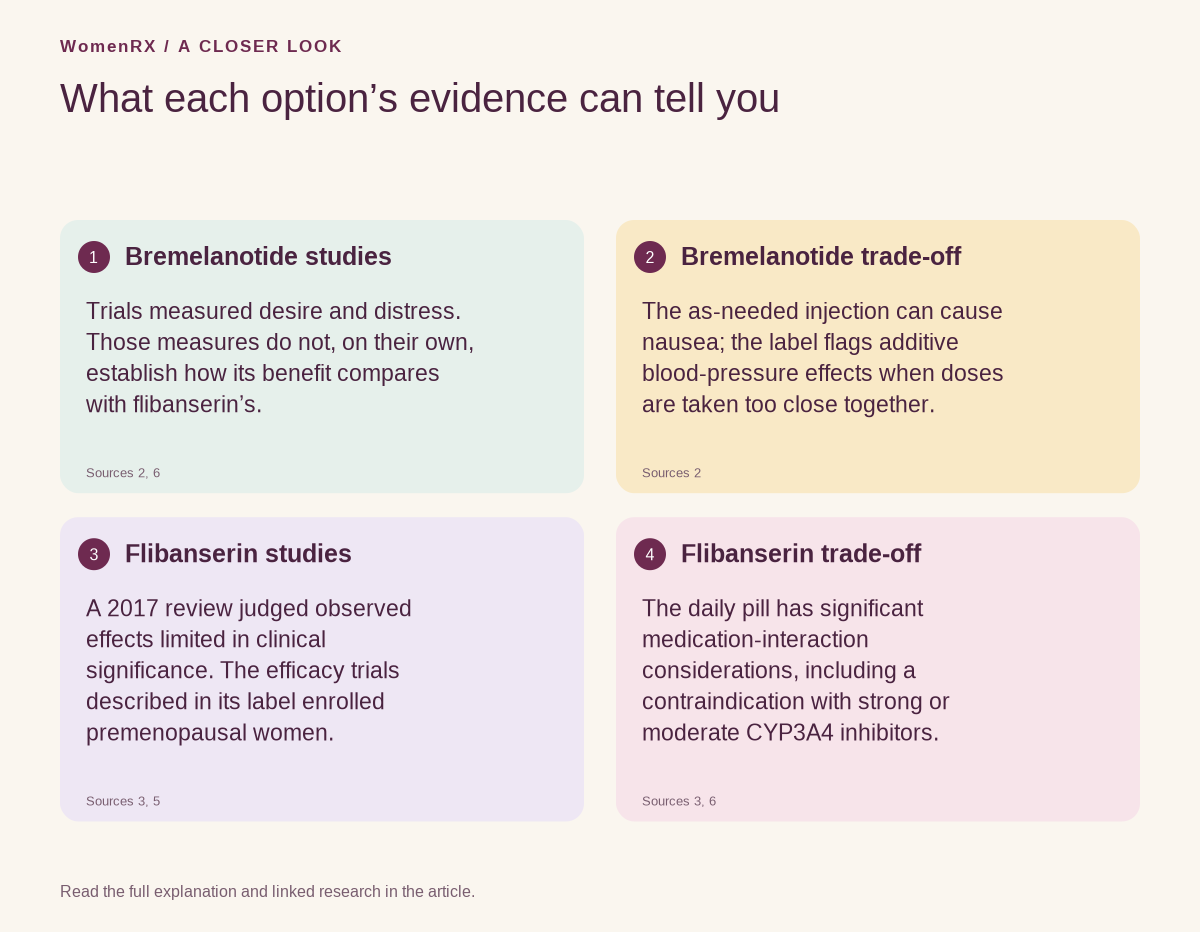
What each option’s evidence can tell you
Bremelanotide studies: Trials measured desire and distress. Those measures do not, on their own, establish how its benefit compares with flibanserin’s.26
Bremelanotide trade-off: The as-needed injection can cause nausea; the label flags additive blood-pressure effects when doses are taken too close together.2
Flibanserin studies: A 2017 review judged observed effects limited in clinical significance. The efficacy trials described in its label enrolled premenopausal women.35
Flibanserin trade-off: The daily pill has significant medication-interaction considerations, including a contraindication with strong or moderate CYP3A4 inhibitors.36
Read the figure as text
Use this alongside the eligibility and routine table: evidence for one option is not a head-to-head test against another.- Bremelanotide studies: Trials measured desire and distress. Those measures do not, on their own, establish how its benefit compares with flibanserin’s.26
- Bremelanotide trade-off: The as-needed injection can cause nausea; the label flags additive blood-pressure effects when doses are taken too close together.2
- Flibanserin studies: A 2017 review judged observed effects limited in clinical significance. The efficacy trials described in its label enrolled premenopausal women.35
- Flibanserin trade-off: The daily pill has significant medication-interaction considerations, including a contraindication with strong or moderate CYP3A4 inhibitors.36
More questions, answered
Does a difference in desire between partners mean I have HSDD?
No. A difference in desire by itself isn’t enough to diagnose a sexual interest or desire disorder; the woman’s own distress and the broader context matter. 5
Are bremelanotide and flibanserin approved for every woman with low desire?
No. Their US labels describe narrower groups based on age or menopausal status and a particular pattern of distressing low desire. Flibanserin’s label also excludes low desire due to certain other causes. The two labels don’t define identical populations. 2 3
Sources you can check
- Sexual Health | MedlinePlusAccessed 2026-09-25Return to first citation
- VYLEESI (BREMELANOTIDE) INJECTION [COSETTE PHARMACEUTICALS, INC.] | US prescribing information and patient instructionsAccessed 2026-09-25Return to first citation
- ADDYI (FLIBANSERIN) TABLET, FILM COATED [SPROUT PHARMACEUTICALS, INC.] | US prescribing information and patient instructionsAccessed 2026-09-25Return to first citation
- Other medicines for menopause symptoms - NHSAccessed 2026-09-25Return to first citation
- Recent Developments in Psychopharmaceutical Approaches to Treating Female Sexual Interest and Arousal Disorder.Both S. · Current sexual health reports · 2017Return to first citation
- Clinical trial evidence on emerging pharmacological therapies for hypoactive sexual desire disorder in women: a systematic review and analysis of completed studies registered on ClinicalTrials.gov.Ashour AM. · Frontiers in medicine · 2026Return to first citation
- Testosterone therapy for female sexual dysfunction: a systematic review of the literature demonstrating outcomes in premenopausal and postmenopausal women.Furlan VA, Hammad MAM, Quesada S, Nguyen S, Yih J. · The journal of sexual medicine · 2026Return to first citation