How Long Tirzepatide Stays in Your Body
Tirzepatide’s half-life is about five days, so its level declines gradually after your last dose rather than disappearing overnight.
Tirzepatide has a mean half-life of about 5.4 days. Using that estimate, five half-lives is roughly 27 days, a useful guide to substantial decline in drug levels, not a guaranteed point when the medicine or its effects are gone. That estimate does not set a safe interval for pregnancy, breastfeeding, restarting, or a procedure. 3
The short answer: think weeks, not days
Tirzepatide leaves the body gradually. Its mean half-life is about 5.4 days, meaning the amount in the body falls by roughly half over that interval during the elimination phase. Researchers found that this long half-life supports once-weekly dosing. 3
A rough calculation of five half-lives is about 27 days. In a simplified calculation, that would leave about 3% of the starting level. This is an estimate, not a measurement of when every person has cleared the medicine. It also isn't a guaranteed safe waiting period for any particular decision. 3
Half-life isn't the same as being fully clear
Half-life describes how quickly drug levels decline; it doesn't mean the drug is gone after one half-life. Nor does the estimate predict exactly when a change in appetite, blood sugar, or another effect will end. Those are separate questions from how long measurable drug exposure may persist.
The estimate comes from a population pharmacokinetic model drawing on 19 studies, including people with type 2 diabetes and other study populations. It describes an average, not an individual countdown. 3
A missed dose isn't the same as stopping
If you missed just one weekly dose, follow the instructions for the specific product you use. For both Zepbound and Mounjaro, US prescribing information says to take a missed dose within four days; after that, skip it and take the next dose on the regular day. It also says doses should be at least three days apart. These directions address a missed dose, not how to restart after a longer break. 1 2
If you've stopped for longer, don't use the half-life calculation to choose a restart dose or schedule. The information for a single missed dose doesn't answer how to restart after an extended interruption. Ask the prescriber who manages your treatment what plan fits your situation.
Before a procedure, pregnancy, or breastfeeding
If you're scheduled for surgery or another procedure involving anesthesia or deep sedation, tell the procedural team and the clinician who prescribes tirzepatide. The product information flags these procedures, but the half-life alone doesn't tell you whether or when to pause treatment. Don't make that decision based only on a calendar estimate. 1 2
If you're pregnant or planning a pregnancy, discuss tirzepatide with your prescriber before making a plan. Zepbound's patient information says the medicine may harm an unborn baby; Mounjaro's says it is not known whether it will harm an unborn baby. Neither statement supplies a universal pre-pregnancy washout interval. 1 2
For breastfeeding, ask your prescriber about your individual plan rather than treating five half-lives as a proven waiting period. Drug elimination estimates don't, by themselves, establish when breastfeeding is appropriate.
The useful question to ask
Tell the prescriber when your last dose was, which product you take, and whether you're asking about a missed dose, a longer interruption, a procedure, pregnancy, or breastfeeding. Those situations call for different decisions. The roughly four-week elimination estimate can help frame the conversation, but it cannot replace a plan tailored to the reason you're stopping.
How Tirzepatide Levels Decline
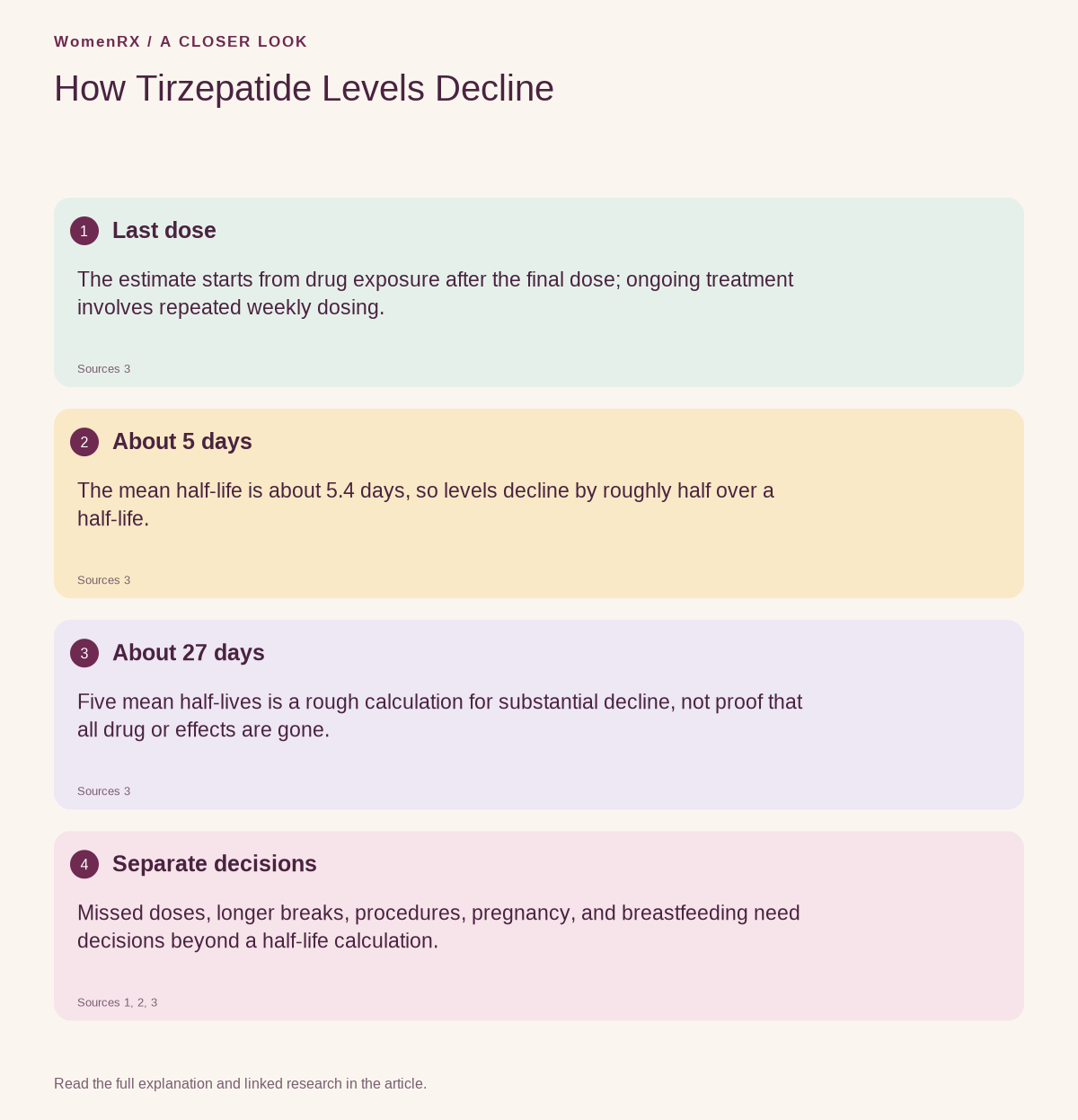
Last dose: The estimate starts from drug exposure after the final dose; ongoing treatment involves repeated weekly dosing.3
About 5 days: The mean half-life is about 5.4 days, so levels decline by roughly half over a half-life.3
About 27 days: Five mean half-lives is a rough calculation for substantial decline, not proof that all drug or effects are gone.3
Separate decisions: Missed doses, longer breaks, procedures, pregnancy, and breastfeeding need decisions beyond a half-life calculation.123
Read the figure as text
A half-life describes a gradual drop in drug level. It is not a switch-off date or a schedule for individual treatment decisions.- Last dose: The estimate starts from drug exposure after the final dose; ongoing treatment involves repeated weekly dosing.3
- About 5 days: The mean half-life is about 5.4 days, so levels decline by roughly half over a half-life.3
- About 27 days: Five mean half-lives is a rough calculation for substantial decline, not proof that all drug or effects are gone.3
- Separate decisions: Missed doses, longer breaks, procedures, pregnancy, and breastfeeding need decisions beyond a half-life calculation.123
More questions, answered
Does tirzepatide leave the body after one week?
No. With a mean half-life of about 5.4 days, drug levels decline over multiple half-lives. A week is not the same as complete elimination. 3
Can I use the half-life to decide when to restart?
No. Half-life describes declining drug exposure; it does not give a restart dose or schedule. The product instructions for one missed dose do not cover every longer interruption. 1 2 3
Sources you can check
- ZEPBOUND (TIRZEPATIDE) INJECTION, SOLUTION ZEPBOUND (TIRZEPATIDE) INJECTION, SOLUTION ZEPBOUND KWIKPEN (TIRZEPATIDE) INJECTION, SOLUTION [ELI LILLY AND COMPANY] | US prescribing information and patient instructionsAccessed 2026-09-25Return to first citation
- MOUNJARO (TIRZEPATIDE) INJECTION, SOLUTION MOUNJARO KWIKPEN (TIRZEPATIDE) INJECTION, SOLUTION [ELI LILLY AND COMPANY] | US prescribing information and patient instructionsAccessed 2026-09-25Return to first citation
- Population pharmacokinetics of the GIP/GLP receptor agonist tirzepatide.Schneck K, Urva S. · CPT: pharmacometrics & systems pharmacology · 2024Return to first citation