How Long Does Mounjaro Stay in Your Body?
Tirzepatide’s half-life is about five days, but that doesn’t tell you exactly when its effects or side effects will end.
Tirzepatide, the medicine in Mounjaro, has a half-life of about five days. That means the amount in your blood falls by roughly half over that time, rather than disappearing all at once. A simple estimate puts most of a dose’s drug concentration decline over several weeks, but this is not a personal washout date or a guide to when symptoms end. 3
Half-life is a measure of decline, not an on-off switch
Tirzepatide’s average half-life is about 5.4 days, based on a population analysis pooling data from 19 studies. In practical terms, a half-life is the time it takes for the amount of medicine in the body to fall by about half. It doesn’t mean the medicine is gone after five days. 3
If you use the five-day estimate as a simple illustration, the amount would fall to about half after five days, a quarter after ten, and a smaller amount with each additional half-life. That is a mathematical way to picture declining concentration, not a measurement of exactly how long tirzepatide remains in any one person. The drug’s half-life supports once-weekly dosing, and repeated doses build up exposure compared with a single dose. 3
Drug concentration and effects are different questions
A concentration curve describes how much medicine is in the blood over time. It doesn’t pinpoint when appetite changes, blood-sugar effects, or gastrointestinal symptoms will stop. A phase 1 study in Chinese patients with type 2 diabetes measured pharmacokinetics and treatment effects as separate outcomes; it does not establish a universal schedule for effects or side effects to resolve after a final dose. 2
So if you’re asking because you still feel an effect after a missed or final injection, the half-life can explain why some drug remains, but it can’t predict your individual experience. Likewise, a declining concentration is not by itself a reason to restart, stop, or change treatment.
What to do after a missed Mounjaro dose
The US Mounjaro instructions say to take a missed dose within four days (96 hours). If more than four days have passed, skip that dose and take the next one on the regular day. The instructions also say to leave at least 72 hours between doses. These are missed-dose directions, not a general restart plan after a longer break. 1
If you’ve been off treatment longer than that, or stopped because of side effects, ask the prescriber who manages your treatment what to do next. The half-life does not tell you whether to resume at your previous dose or how to restart safely.
Pregnancy planning and breastfeeding need individual guidance
If you’re planning a pregnancy, pregnant, or breastfeeding, bring the timing question to your prescriber rather than using a half-life calculation as a personal washout rule. The Mounjaro Medication Guide says it is not known whether the medicine will harm an unborn baby and advises telling your prescriber if you’re pregnant or plan to become pregnant. It also says Mounjaro may pass into breast milk and recommends discussing feeding plans. 1
The key distinction is that an estimated time for drug concentration to decline is not the same as a proven safe interval before pregnancy or breastfeeding. Your prescriber can consider your treatment reason and overall plan instead of relying on a one-size-fits-all number.
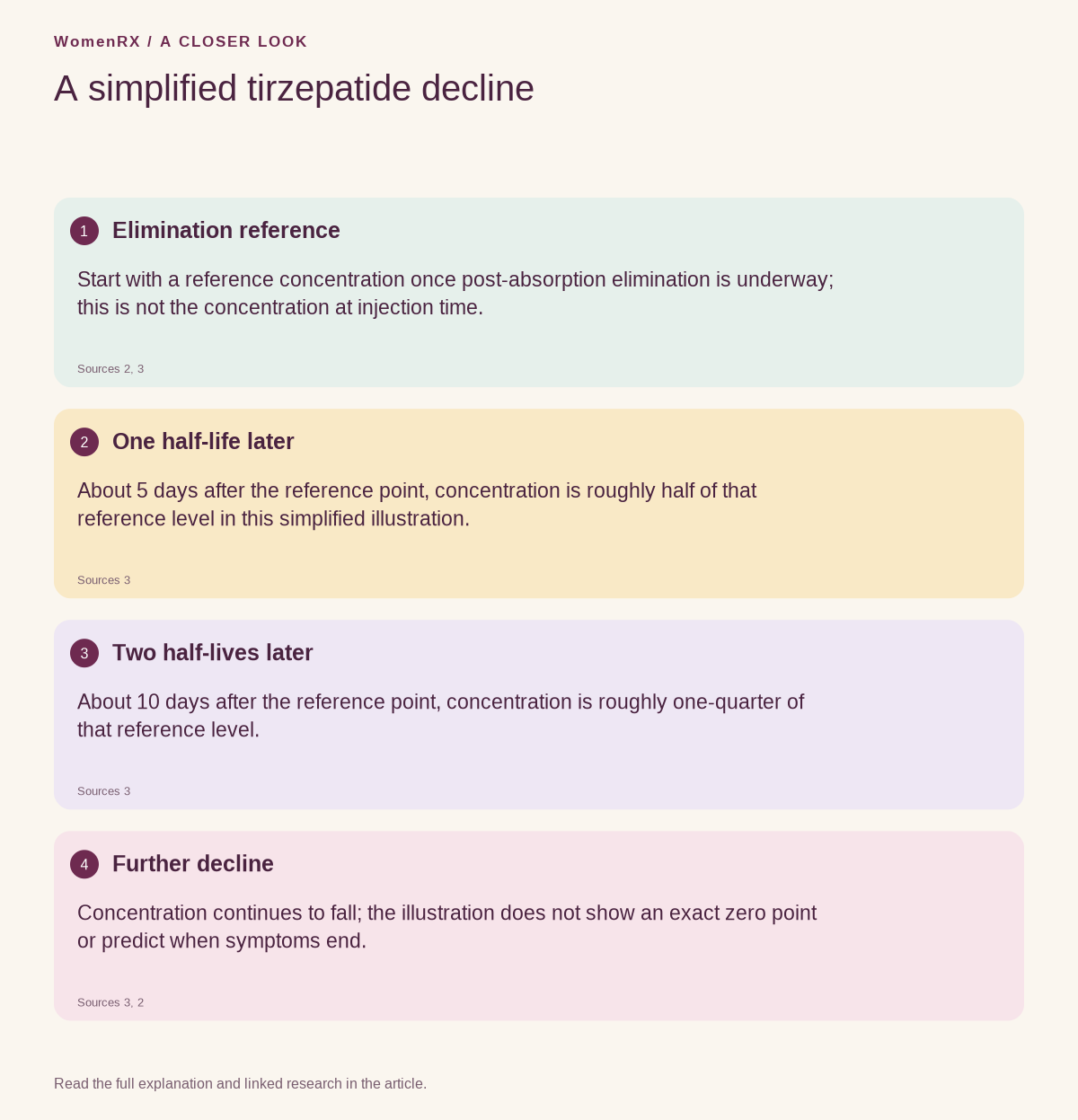
A simplified tirzepatide decline
Elimination reference: Start with a reference concentration once post-absorption elimination is underway; this is not the concentration at injection time.23
One half-life later: About 5 days after the reference point, concentration is roughly half of that reference level in this simplified illustration.3
Two half-lives later: About 10 days after the reference point, concentration is roughly one-quarter of that reference level.3
Further decline: Concentration continues to fall; the illustration does not show an exact zero point or predict when symptoms end.32
Read the figure as text
This illustration begins with a reference concentration during post-absorption elimination, not at the injection. The half-life intervals show a simplified decline, not an individual concentration curve or a schedule for effects to end.- Elimination reference: Start with a reference concentration once post-absorption elimination is underway; this is not the concentration at injection time.23
- One half-life later: About 5 days after the reference point, concentration is roughly half of that reference level in this simplified illustration.3
- Two half-lives later: About 10 days after the reference point, concentration is roughly one-quarter of that reference level.3
- Further decline: Concentration continues to fall; the illustration does not show an exact zero point or predict when symptoms end.32
More questions, answered
Does Mounjaro leave your body completely after five days?
No. Five days is about one half-life, meaning the amount in the blood falls by roughly half, not to zero. The decline continues over additional half-lives. 3
Does the half-life tell me when Mounjaro side effects will stop?
Not exactly. Half-life describes drug concentration, not the duration of a particular symptom. The available study findings do not establish a predictable symptom-ending timeline for each person. 2
Sources you can check
- MOUNJARO (TIRZEPATIDE) INJECTION, SOLUTION MOUNJARO KWIKPEN (TIRZEPATIDE) INJECTION, SOLUTION [ELI LILLY AND COMPANY] | US prescribing information and patient instructionsAccessed 2026-09-25Return to first citation
- A Phase 1 Multiple Dose Study of Tirzepatide in Chinese Patients with Type 2 Diabetes.Feng P, Sheng X, Ji Y, Urva S, Wang F, Miller S, Qian C, An Z, Cui Y. · Advances in therapy · 2023Return to first citation
- Population pharmacokinetics of the GIP/GLP receptor agonist tirzepatide.Schneck K, Urva S. · CPT: pharmacometrics & systems pharmacology · 2024Return to first citation