How Long Should You Stay on Semaglutide for Weight Management?
Whether to continue semaglutide depends on the benefits you’re getting, side effects, health changes, and your plans.
There isn’t one stop date that fits everyone. The useful question is whether treatment is still helping enough to justify its downsides, and what support you’d have if you changed or stopped it. Research suggests weight loss may be harder to maintain without active treatment, but it doesn’t show that everyone should take semaglutide indefinitely. 3
Think in decision points, not a countdown
Losing the amount of weight you hoped for doesn’t automatically mean it’s time to stop, and reaching a goal doesn’t automatically mean treatment has served its purpose. Instead, review the balance over time: what has improved, what side effects you’re managing, whether your health or priorities have changed, and what might happen if treatment changes.
Neither the maintenance trial nor the 24-month follow-up described here sets a treatment duration for women or men. The US real-world study followed adults taking semaglutide for weight management at maintenance doses for 24 months. Among the 175 people with weight data at that point, average weight had fallen 16.6% from baseline. But this was an observational study, and the people included had stayed on treatment; it doesn’t tell us how long any one person should continue or what would happen after stopping. 3 4
If you’re losing weight or maintaining a loss
A plateau is not, by itself, proof that treatment has stopped helping. The relevant comparison may be how your weight and health are doing with treatment versus what might happen without it. In a randomized trial, people who had reached a weight-loss plateau after 72 weeks of semaglutide were assigned to a different weight-management medicine, orforglipron, or placebo. At 52 weeks, the estimated share of their previous weight loss maintained was 79.3% with orforglipron and 37.6% with placebo. This study suggests that having an active maintenance approach can matter. It did not compare continuing semaglutide with stopping it, so it can’t answer which option is best for you. 3
A useful review can look beyond the scale, too. For example, you might consider whether changes in weight have come with improvements in health concerns that matter to you, whether side effects interfere with daily life, and whether the current plan still fits your priorities. Weight is only one part of health, and it doesn’t describe muscle, bone, or fluid on its own. 2
If progress feels limited
A smaller-than-hoped-for change is a reason to review the plan, not a reason to blame yourself or assume there’s one obvious fix. Discuss how long you’ve been on your current plan, what you’ve experienced, and whether the medicine remains tolerable and worthwhile. No single response threshold or time point for stopping or changing treatment emerges from these findings. 3 4 5
Be cautious about using small real-world studies to decide that a lower dose or a particular adjustment will work for you. One retrospective study of 40 people reported weight loss over three and six months, but its size, short follow-up, and treatment-selection limits make it unsuitable for setting a general duration or dose rule. 5
If side effects or health changes shift the balance
Treatment decisions can change when side effects become difficult to live with, another health issue arises, or your goals change. Bring the specific problem to the prescriber rather than increasing, reducing, or stopping treatment on your own. The choice may be to continue, reconsider the plan, or stop; what makes sense depends on your situation and the product being used.
If you stop or switch, ask what the next plan is for maintaining health and managing possible weight change. In the semaglutide cohort of the trial described above, participants assigned to placebo maintained a smaller estimated share of their previous weight loss than those assigned to orforglipron. That finding does not predict exactly what will happen to you, but it’s a reason to plan the transition rather than assume the medication’s effects will simply persist unchanged. 3
If pregnancy is part of your plans
Raise pregnancy plans before you try to conceive so there’s time to review the specific product and make a treatment plan. The prescribing information for oral semaglutide products says to discontinue them at least two months before a planned pregnancy; it also says available human pregnancy data are insufficient to assess medication-associated risks, while animal studies found potential fetal risks. That two-month instruction in the cited information is for oral products, so confirm timing using the prescribing information for your specific medication. 1
Does duration evidence differ for women?
There’s no established different treatment duration for women in these comparisons. In the 24-month real-world study, most patients were women, but the reported results don’t show a women-specific duration comparison. A separate, very small retrospective study reported a sex subgroup analysis, but it followed people for only three and six months and can’t determine how long women should stay on treatment. 4 5
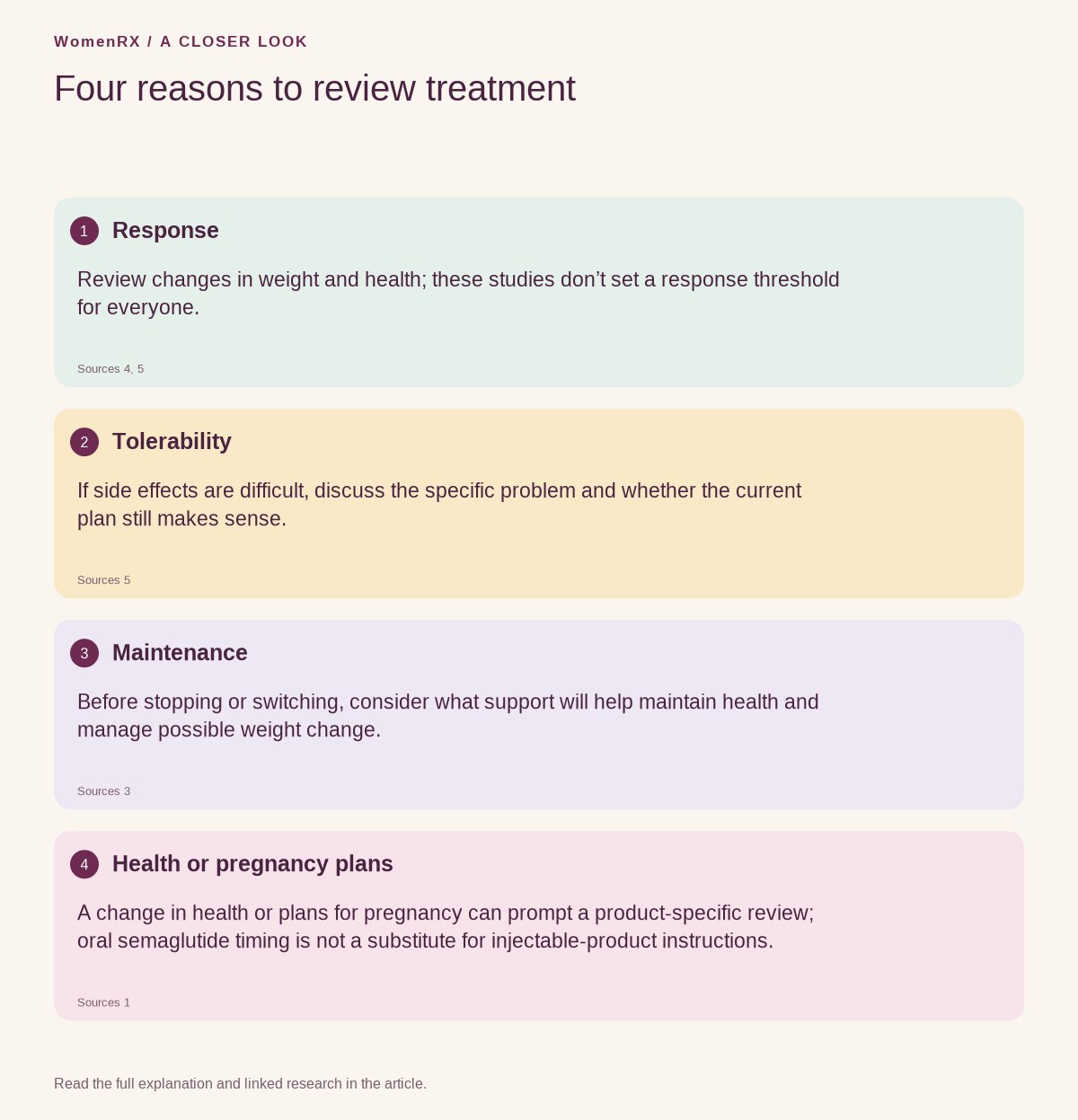
Four reasons to review treatment
Response: Review changes in weight and health; these studies don’t set a response threshold for everyone.45
Tolerability: If side effects are difficult, discuss the specific problem and whether the current plan still makes sense.5
Maintenance: Before stopping or switching, consider what support will help maintain health and manage possible weight change.3
Health or pregnancy plans: A change in health or plans for pregnancy can prompt a product-specific review; oral semaglutide timing is not a substitute for injectable-product instructions.1
Read the figure as text
Use these decision points to organize a treatment review. They are prompts for discussion, not a scoring tool or a rule that determines whether you should stop.- Response: Review changes in weight and health; these studies don’t set a response threshold for everyone.45
- Tolerability: If side effects are difficult, discuss the specific problem and whether the current plan still makes sense.5
- Maintenance: Before stopping or switching, consider what support will help maintain health and manage possible weight change.3
- Health or pregnancy plans: A change in health or plans for pregnancy can prompt a product-specific review; oral semaglutide timing is not a substitute for injectable-product instructions.1
More questions, answered
Does reaching a goal weight mean I should stop?
Not automatically. A goal weight is one consideration; the next decision also depends on how treatment is affecting your health and whether you have a plan for maintenance if it changes. A trial after semaglutide treatment found different maintenance outcomes with an active medicine versus placebo, but it did not compare either option with continued semaglutide. 3
Is there a proven treatment length specifically for women?
These studies don’t establish one. A longer real-world study included mostly women but didn’t report a sex-specific duration comparison. 4
Sources you can check
- OZEMPIC (ORAL SEMAGLUTIDE) TABLET RYBELSUS (ORAL SEMAGLUTIDE) TABLET [NOVO NORDISK PHARMACEUTICAL INDUSTRIES, LP] | US prescribing information and patient instructionsAccessed 2026-09-25Return to first citation
- Body Weight: MedlinePlusAccessed 2026-09-25Return to first citation
- Orforglipron for maintenance of body weight reduction: the double-blind, randomized phase 3b ATTAIN-MAINTAIN trial.Aronne LJ, Horn DB, le Roux CW, Chao AM, Ho W, Halpern B, Griffin R, Xie C, Valderas EG, Lee CJ, Ribeiro A, Hyman DM, Glass L, Xavier N. · Nature medicine · 2026Return to first citation
- Sustained weight reduction with once-weekly semaglutide: results from a real-world retrospective cohort study in the United States (SCOPE 24 months).Ruseva A, Michalak W, Fabricatore A, Hartaigh BÓ, Zhao Z, Wang J, Umashanker D. · Current medical research and opinion · 2025Return to first citation
- A Real-World Study of the Effectiveness and Safety of Semaglutide for Weight Loss.Tzoulis P, Batavanis M, Baldeweg S. · Cureus · 2024Return to first citation