How Long Ozempic Stays in Your System After a Dose
Ozempic’s half-life is about a week, and the prescribing information says semaglutide can remain in circulation for about five weeks after the last injection.
Ozempic (semaglutide) has an elimination half-life of about one week. That means the amount in your circulation falls gradually, not all at once; the prescribing information says semaglutide remains in circulation for about five weeks after the last injection. That estimate doesn’t identify the exact day effects stop or establish a safe date for pregnancy planning. 2
What a one-week half-life means
A half-life is the time it takes for the amount of a drug in the body to fall by about half. For Ozempic, that’s approximately one week. It doesn’t mean the medicine disappears after a week: semaglutide levels decline gradually, and the prescribing information says it can remain in circulation for about five weeks after the last injection. 2
Semaglutide’s long half-life helps make once-weekly dosing possible. It binds to albumin, a protein in the blood, which slows its clearance and helps protect it from breakdown. 2 A systematic review summarizes human pharmacokinetic data for both oral and injected semaglutide. 3
Drug in circulation isn’t the same as a precise “effects end” date
The five-week estimate describes how long semaglutide may be present in the circulation. It doesn’t tell you exactly when you’ll stop noticing an effect, when a side effect will resolve, or when blood sugar or appetite changes will shift. Those aren’t dates you can calculate from half-life alone.
So if you’re stopping after a final dose, don’t treat five weeks as a personal washout schedule or as proof the medicine is clinically inactive on a particular day. If you need to plan a change in diabetes treatment, discuss what to do next with your prescriber rather than using the half-life estimate as a substitute for a treatment plan.
Missed dose? Follow the injection instructions
For Ozempic injection, the prescribing information says to take a missed dose as soon as possible within five days. If more than five days have passed, skip it and take the next dose on your regularly scheduled day. 2
That instruction is specific to the injection. Oral semaglutide tablets have different missed-dose directions, so don’t transfer the injection schedule to a tablet product. 12 If you’re unsure which directions apply to your medication, check its instructions or ask your prescriber or pharmacist.
Pregnancy or breastfeeding planning needs its own guidance
The five-week circulation estimate is not a pregnancy-planning or breastfeeding safety date. If either is part of your decision, ask your prescriber for guidance specific to your treatment and circumstances. Half-life alone can’t establish when it’s appropriate to start trying to conceive or whether a medicine is suitable while breastfeeding.
The practical takeaway: use the half-life to understand why semaglutide leaves the body gradually. Use the product’s instructions for a missed dose, and get individualized guidance for stopping, changing treatment, or planning around pregnancy or breastfeeding.
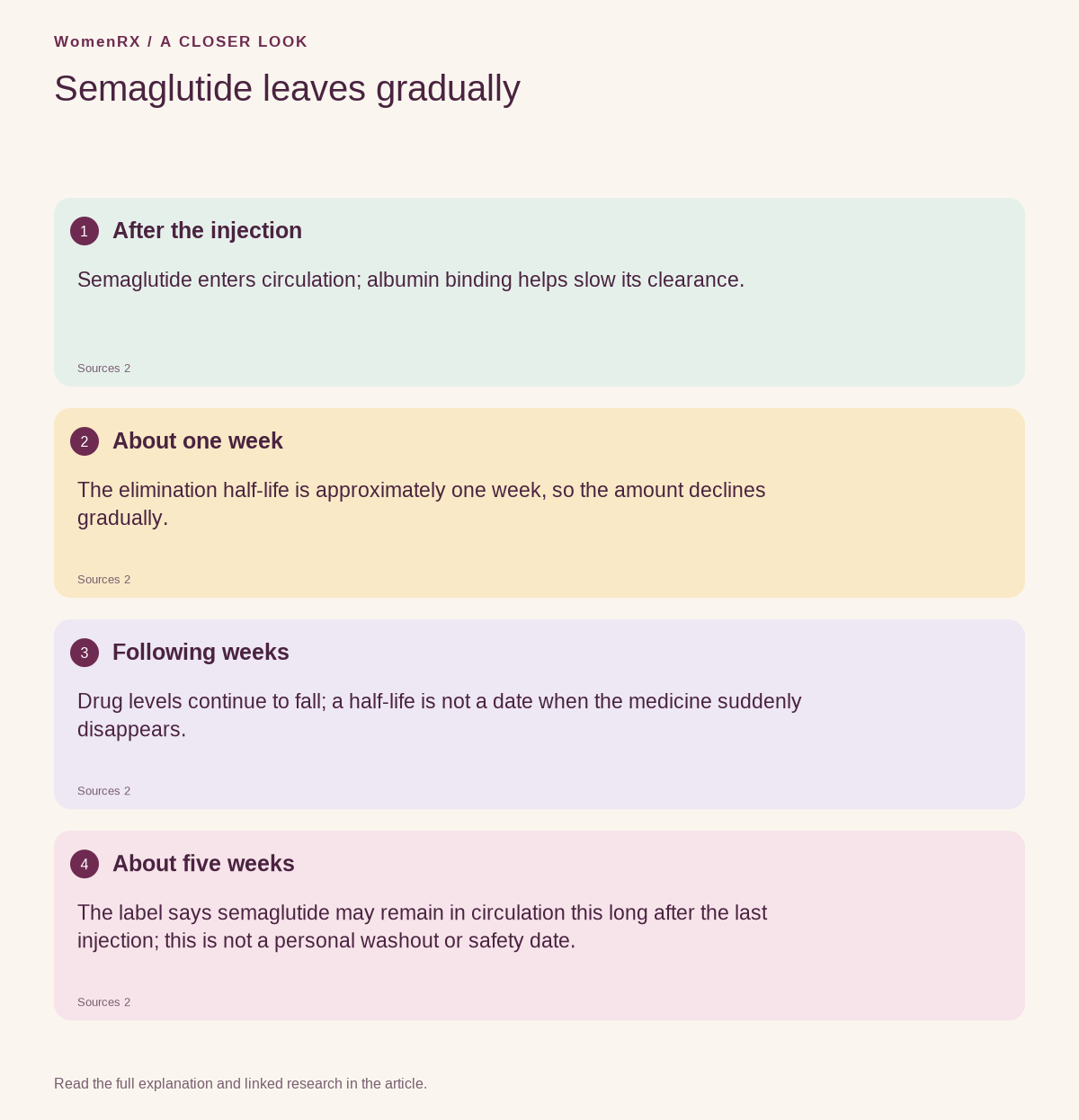
Semaglutide leaves gradually
After the injection: Semaglutide enters circulation; albumin binding helps slow its clearance.2
About one week: The elimination half-life is approximately one week, so the amount declines gradually.2
Following weeks: Drug levels continue to fall; a half-life is not a date when the medicine suddenly disappears.2
About five weeks: The label says semaglutide may remain in circulation this long after the last injection; this is not a personal washout or safety date.2
Read the figure as text
A simple timeline shows what the half-life and circulation estimate describe, and where they stop answering the question.- After the injection: Semaglutide enters circulation; albumin binding helps slow its clearance.2
- About one week: The elimination half-life is approximately one week, so the amount declines gradually.2
- Following weeks: Drug levels continue to fall; a half-life is not a date when the medicine suddenly disappears.2
- About five weeks: The label says semaglutide may remain in circulation this long after the last injection; this is not a personal washout or safety date.2
More questions, answered
Does “about five weeks” mean Ozempic is completely gone?
No. The prescribing information says semaglutide is present in the circulation for about five weeks after the last injection. That estimate isn’t a claim that every trace is gone on a specific day. 2
Sources you can check
- OZEMPIC (ORAL SEMAGLUTIDE) TABLET RYBELSUS (ORAL SEMAGLUTIDE) TABLET [NOVO NORDISK PHARMACEUTICAL INDUSTRIES, LP] | US prescribing information and patient instructionsAccessed 2026-09-25Return to first citation
- OZEMPIC (SEMAGLUTIDE) INJECTION, SOLUTION [A-S MEDICATION SOLUTIONS] | US prescribing information and patient instructionsAccessed 2026-09-25Return to first citation
- Clinical Pharmacokinetics of Semaglutide: A Systematic Review.Yang XD, Yang YY. · Drug design, development and therapy · 2024Return to first citation