How Long Semaglutide Stays in Your Body
Semaglutide fades gradually, and the exact clearance estimate and next-step instructions depend on the product and reason you take it.
Semaglutide has an elimination half-life of about one week, so its level falls gradually rather than disappearing after your last dose. Product labeling says it can remain in the circulation for about five weeks after some oral products and five to seven weeks after specified Wegovy doses. Pregnancy and breastfeeding guidance is product-specific; half-life alone isn’t a missed-dose or procedure schedule. 1 2
The short answer: it fades over weeks
Semaglutide doesn’t leave your body all at once when you stop taking it. Its elimination half-life is about one week: in simple terms, the amount in circulation falls by roughly half over that interval. Repeated halving means there can still be some drug present for several weeks, even as the amount declines. Semaglutide’s structure and strong binding to albumin help slow its clearance. 2 3
The half-life is a way to describe how drug levels change, not a promise about the exact day a particular person will have no semaglutide left or stop noticing an effect. The product information gives practical estimates of how long semaglutide remains in circulation, but those estimates don’t set a precise end date for appetite changes, blood-sugar effects, or side effects.
The estimate depends on the product
For Wegovy, US prescribing information says semaglutide can remain in circulation for about five to seven weeks after the last injectable dose of 2.4 mg or 7.2 mg, or after the 25 mg oral dose. The Rybelsus/Ozempic tablet information gives an estimate of about five weeks after the last tablet dose. These are product-label estimates, not a universal countdown for every semaglutide product or dose. 1 2
Check the name and form on your prescription. Wegovy and the oral semaglutide tablets have their own instructions, and a tablet estimate shouldn’t be used as a dosing rule for an injection. If you miss a dose or are switching products, use the instructions for that specific product rather than calculating from its half-life.
Pregnancy planning and breastfeeding need separate answers
For planned pregnancy, the cited US labels advise stopping Wegovy or Rybelsus/Ozempic tablets at least two months before trying to become pregnant. That is a product-specific instruction that accounts for semaglutide’s long persistence; it isn’t something to calculate from the date of your last dose yourself. 1 2
Breastfeeding guidance is also not interchangeable across products. The Rybelsus/Ozempic tablet information says semaglutide passes into breast milk, that its effect on the baby is not known, and advises against breastfeeding during treatment. That statement doesn’t establish when breastfeeding is appropriate after stopping, and it shouldn’t be applied automatically to a different formulation. 2
If you’re planning a pregnancy, breastfeeding, or making a change for reproductive care, check the instructions for your exact prescription and discuss the timing with the clinician managing it. A half-life estimate by itself can’t answer every one of those questions.
A half-life is not a missed-dose or procedure schedule
A gradual decline in drug levels explains why “I stopped” and “there’s no drug left” aren’t the same thing. But the clearance estimate alone doesn’t tell you what to do after a missed dose, when to restart, or when to stop before a procedure. Those decisions depend on the product instructions and the situation; don’t turn a five-week estimate into a personal stop-or-restart date.
Practical next step: identify whether your prescription is an injection or an oral tablet, then use that product’s instructions for the question you’re facing. For pregnancy planning, the cited labels specify the two-month interval; for a missed dose or procedure, follow the relevant product and care-team instructions rather than substituting a half-life calculation. 1 2
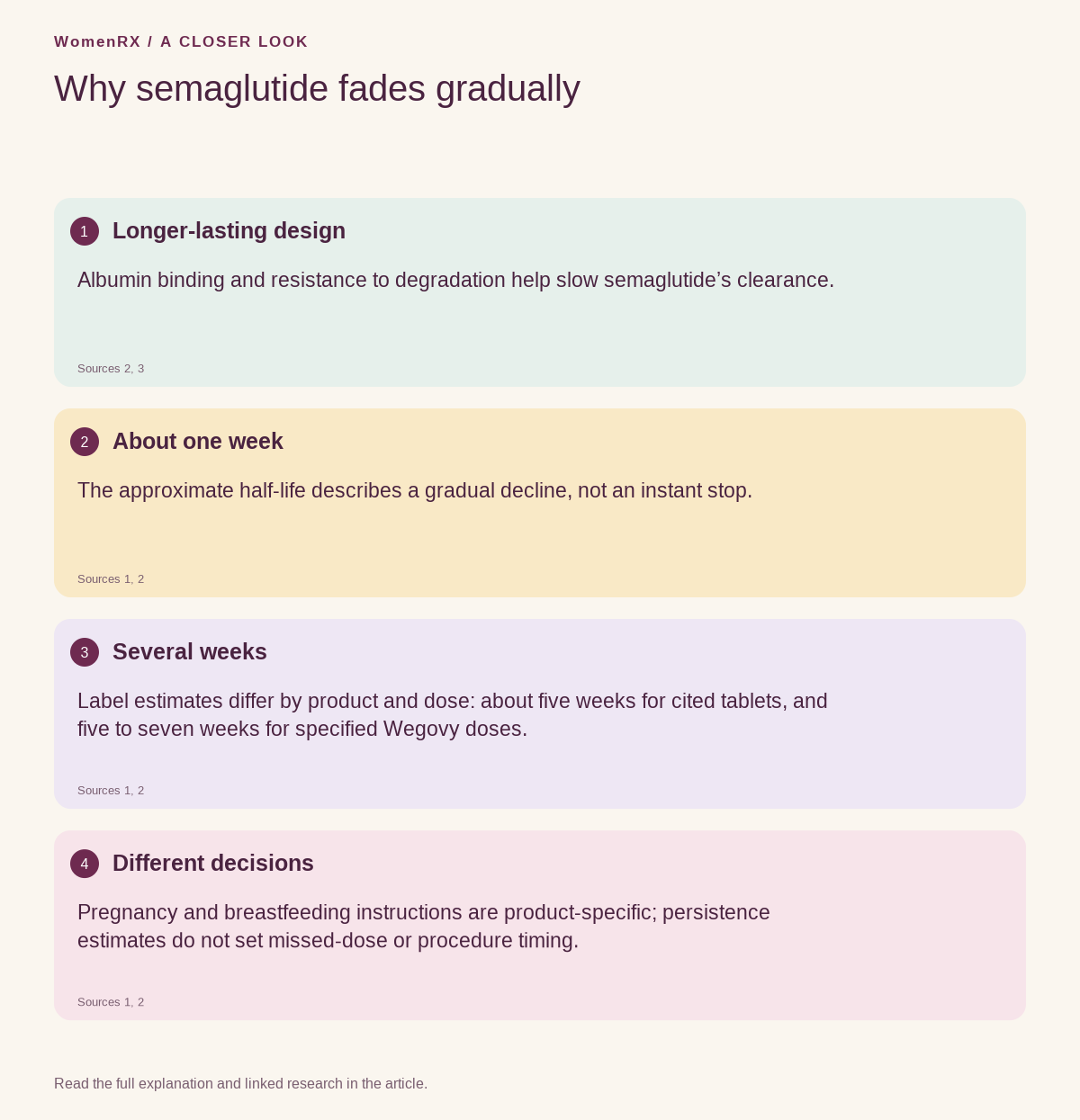
Why semaglutide fades gradually
Longer-lasting design: Albumin binding and resistance to degradation help slow semaglutide’s clearance.23
About one week: The approximate half-life describes a gradual decline, not an instant stop.12
Several weeks: Label estimates differ by product and dose: about five weeks for cited tablets, and five to seven weeks for specified Wegovy doses.12
Different decisions: Pregnancy and breastfeeding instructions are product-specific; persistence estimates do not set missed-dose or procedure timing.12
Read the figure as text
A conceptual view of falling drug levels and the difference between a half-life estimate and product-specific instructions.- Longer-lasting design: Albumin binding and resistance to degradation help slow semaglutide’s clearance.23
- About one week: The approximate half-life describes a gradual decline, not an instant stop.12
- Several weeks: Label estimates differ by product and dose: about five weeks for cited tablets, and five to seven weeks for specified Wegovy doses.12
- Different decisions: Pregnancy and breastfeeding instructions are product-specific; persistence estimates do not set missed-dose or procedure timing.12
More questions, answered
Does “five weeks in circulation” mean semaglutide is completely gone after five weeks?
No. It’s an approximate label estimate for how long semaglutide may remain in circulation, not a guarantee that every trace is gone on a particular day. The drug level declines over time; the estimate is not an exact individual cutoff. 1 2
Sources you can check
- WEGOVY (SEMAGLUTIDE) INJECTION, SOLUTION WEGOVY (SEMAGLUTIDE) TABLET [NOVO NORDISK PHARMACEUTICAL INDUSTRIES, LP] | US prescribing information and patient instructionsAccessed 2026-09-25Return to first citation
- OZEMPIC (ORAL SEMAGLUTIDE) TABLET RYBELSUS (ORAL SEMAGLUTIDE) TABLET [NOVO NORDISK PHARMACEUTICAL INDUSTRIES, LP] | US prescribing information and patient instructionsAccessed 2026-09-25Return to first citation
- Population Pharmacokinetics of Semaglutide for Type 2 Diabetes.Overgaard RV, Delff PH, Petri KCC, Anderson TW, Flint A, Ingwersen SH. · Diabetes therapy : research, treatment and education of diabetes and related disorders · 2019Return to first citation