How Long Does Zepbound Stay in Your System?
Tirzepatide has a roughly five-day half-life, so its level falls gradually rather than disappearing after a missed or final dose.
Zepbound’s active ingredient, tirzepatide, has a plasma half-life of about five days: concentration declines by roughly half per interval. In a simplified model, five half-lives (about 25 days) leave roughly 3% of a reference concentration. That is not a personal level, washout instruction, or date effects end. Missed doses, pregnancy planning, and procedures need separate guidance. 23
What a five-day half-life means
Zepbound is the brand name for tirzepatide. Its reported plasma half-life is about five days. Half-life describes how long it takes for the amount of drug in plasma to fall by roughly half during the relevant phase of decline. It does not mean the medicine is gone after five days. 123
Tirzepatide concentrations typically peak about one to two days after a dose. That peak is not necessarily the starting point for calculating a five-day halving of the concentration. Think of half-life as a way to understand gradual decline: during the phase the estimate describes, one half-life corresponds to roughly half the concentration, and another to roughly half of what remains. Those fractions explain the concept, not your level on a particular day or when the medicine or its effects end. 23
For a rough sense of scale, a simplified calculation that halves a reference concentration every five days leaves about 3% after five intervals, or roughly 25 days. This is an illustration of the arithmetic, not a personal prediction of your drug level, a washout instruction, or a date when effects end. Tirzepatide’s population pharmacokinetic model describes a two-compartment profile, so the simple calculation should not be treated as a precise forecast after a dose. 3
Tirzepatide is designed for once-weekly dosing, and its roughly five-day half-life helps explain why exposure continues between weekly injections. A population pharmacokinetic analysis pooled data from 19 studies and also estimated a half-life of about five days. 23
A missed dose is not a stopping plan
If you missed a Zepbound dose, the U.S. prescribing information gives specific instructions: take it as soon as possible within four days (96 hours) of the missed dose. If more than four days have passed, skip it and take the next dose on your regular day. Do not take two doses within 72 hours of each other. These product-specific directions are more useful than trying to work out a dose from the half-life. 1
Stopping is a different question. The half-life does not tell you whether to stop, how to manage a treatment change, or what to expect in your particular situation. If you’re considering stopping, ask the prescriber who manages your treatment what the next step should be. If you’re taking other medicines or have an upcoming procedure, share that you use tirzepatide and ask for instructions specific to your care. Don’t infer a medication hold or a procedure schedule from a half-life calculation alone.
Pregnancy planning and oral contraceptives are separate questions
If you’re planning a pregnancy, bring that up with your prescriber before changing treatment. A 2025 narrative review suggests stopping tirzepatide 25 to 35 days before conception, but it describes the underlying reproductive evidence as limited and largely observational. Treat that interval as a review’s suggested guidance, not as a universal rule derived from the five-day half-life. Your clinician can help weigh pregnancy timing and your reason for taking the medicine. 5
Oral contraceptives raise a different issue from how long tirzepatide remains in the body. A 2025 review reports changes in oral contraceptive exposure with tirzepatide, but the evidence summarized there does not establish what those changes mean for an individual’s contraceptive protection or provide a personal plan. Ask your prescriber or pharmacist about your specific contraceptive and what to do when starting or changing tirzepatide. Don’t use the half-life as a measure of contraceptive effectiveness. 4
The practical takeaway
The five-day figure is a useful way to understand gradual decline, not a countdown for missed doses, pregnancy planning, or procedures. Use the product’s directions for a missed Zepbound dose. For stopping, upcoming care, pregnancy planning, or questions about oral contraception, get guidance that fits that situation rather than relying on an estimated clearance date.
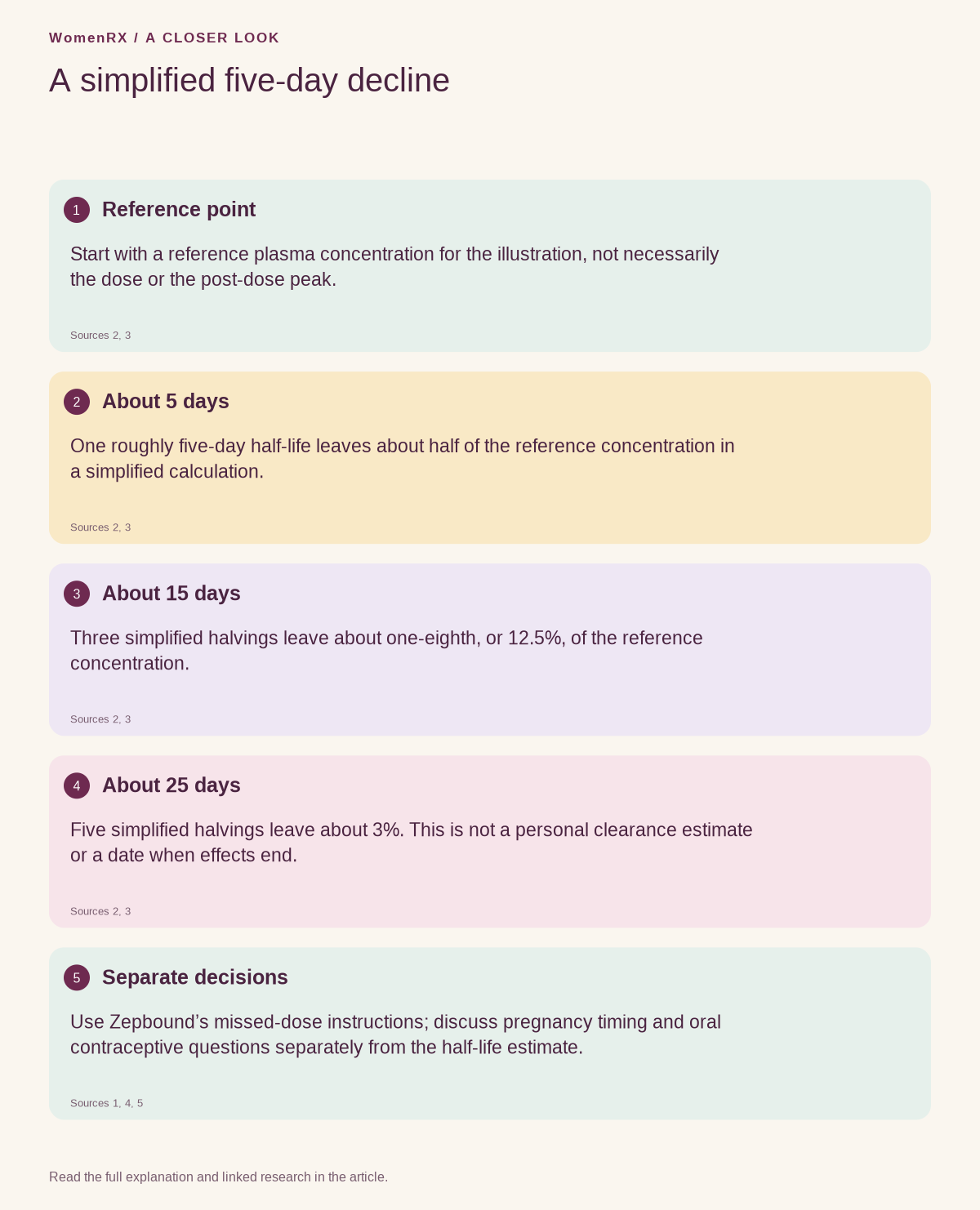
A simplified five-day decline
Reference point: Start with a reference plasma concentration for the illustration, not necessarily the dose or the post-dose peak.23
About 5 days: One roughly five-day half-life leaves about half of the reference concentration in a simplified calculation.23
About 15 days: Three simplified halvings leave about one-eighth, or 12.5%, of the reference concentration.23
About 25 days: Five simplified halvings leave about 3%. This is not a personal clearance estimate or a date when effects end.23
Separate decisions: Use Zepbound’s missed-dose instructions; discuss pregnancy timing and oral contraceptive questions separately from the half-life estimate.145
Read the figure as text
This illustration shows what repeated halvings mean mathematically. It is not a personal drug-level forecast or a schedule for treatment decisions.- Reference point: Start with a reference plasma concentration for the illustration, not necessarily the dose or the post-dose peak.23
- About 5 days: One roughly five-day half-life leaves about half of the reference concentration in a simplified calculation.23
- About 15 days: Three simplified halvings leave about one-eighth, or 12.5%, of the reference concentration.23
- About 25 days: Five simplified halvings leave about 3%. This is not a personal clearance estimate or a date when effects end.23
- Separate decisions: Use Zepbound’s missed-dose instructions; discuss pregnancy timing and oral contraceptive questions separately from the half-life estimate.145
More questions, answered
Does Zepbound leave your body after five days?
No. Five days is approximately one half-life, not a date when the drug is completely gone. During the phase of decline described by that estimate, plasma concentration falls by roughly half over one half-life. That doesn’t predict your concentration five days after an injection. 23
Can I use the half-life to decide when to take a missed dose?
Use the product’s missed-dose instructions instead. The label says to take a missed dose within four days, or skip it if more than four days have passed, and not to take two doses within 72 hours. 1
Sources you can check
- ZEPBOUND (TIRZEPATIDE) INJECTION, SOLUTION ZEPBOUND (TIRZEPATIDE) INJECTION, SOLUTION ZEPBOUND KWIKPEN (TIRZEPATIDE) INJECTION, SOLUTION [ELI LILLY AND COMPANY] | US prescribing information and patient instructionsAccessed 2026-09-25Return to first citation
- A Phase 1 Multiple Dose Study of Tirzepatide in Chinese Patients with Type 2 Diabetes.Feng P, Sheng X, Ji Y, Urva S, Wang F, Miller S, Qian C, An Z, Cui Y. · Advances in therapy · 2023Return to first citation
- Population pharmacokinetics of the GIP/GLP receptor agonist tirzepatide.Schneck K, Urva S. · CPT: pharmacometrics & systems pharmacology · 2024Return to first citation
- A Comprehensive Review on the Pharmacokinetics and Drug-Drug Interactions of Approved GLP-1 Receptor Agonists and a Dual GLP-1/GIP Receptor Agonist.Min JS, Jo SJ, Lee S, Kim DY, Kim DH, Lee CB, Bae SK. · Drug design, development and therapy · 2025Return to first citation
- GLP-1 receptor agonists and preconception planning: bridging the gap between obesity treatment and reproductive safety, a narrative review.Saad Alfaiz A. · Annals of medicine and surgery (2012) · 2025Return to first citation