When Might You Notice Mounjaro Working?
Appetite, glucose, and weight don’t follow one shared clock, and a slow first few weeks don’t prove tirzepatide has failed.
Appetite may change, but the reported trial data don’t establish when that happens or whether it comes before weight loss. 1 In a tirzepatide weight-management trial in adults without diabetes, dose increases continued for up to 20 weeks, depending on the assigned target dose. Some participants who had lost less than 5% by week 12 continued losing weight later. One early weigh-in isn’t a verdict on your response. 2
Different changes can show up at different times
“Mounjaro working” can mean several things: feeling less hungry, seeing different glucose readings, or losing weight. These aren’t interchangeable signs, and a change in one doesn’t tell you exactly when another will happen.
Decreased appetite was reported in adult trials of Mounjaro in people with type 2 diabetes. That makes appetite something you might notice, not a guaranteed effect or a reliable countdown to weight loss. The prescribing information reports whether it happened during trials, not when it began. 1
Glucose is another separate measure. An analysis that included adults with type 2 diabetes reported improvements in HbA1c through week 72, but it doesn’t provide a first-week glucose timetable for an individual. 3 Don’t use the scale as a stand-in for your diabetes readings. If you already check glucose as part of your care, keep following the plan you have for those readings.
Dose increases mean treatment is still building
In the SURMOUNT-1 weight-management trial, participants started at 2.5 mg once weekly and increased their dose in 2.5 mg steps every four weeks, reaching their assigned target dose by week 4, 12, or 20. That trial schedule helps explain why the first weeks aren’t the same as a full period at the target dose. It’s a study protocol, not an instruction to change your own dose. 2
Weight outcomes also continued to develop during and after dose escalation. In a post hoc analysis of trial participants without diabetes, “late responders” meant people who had lost less than 5% of their starting weight at week 12. Among the 278 late responders included in the analysis, 70% had reached at least 5% weight reduction by week 24, and 90% by week 72. For late responders who reached that threshold by week 72, the average time to reach it was about 25 weeks. 2
Those results don’t promise that everyone will lose a particular amount or follow the same pattern. The analysis included participants who took at least 75% of assigned doses and had weight measurements at specified visits. And its week-12 category was used to study response, not to create a stop-or-continue rule for an individual. 2
Make follow-up more useful than a single weigh-in
One scale reading can’t show whether your weight is trending over time. As a practical way to prepare for follow-up, you could note your weight under similar conditions each week, alongside dose changes, appetite, side effects, and glucose readings if you monitor them. Look at the pattern with your prescriber rather than treating one number as a pass or fail.
For women, the available findings don’t establish a different early timetable. A retrospective study of people who stayed on tirzepatide continuously for at least 12 months found greater average weight loss among women than men at 15 months, but it did not establish that women start losing sooner. That longer-term group comparison can’t predict an individual woman’s first few weeks. 4
Pregnancy or breastfeeding raises a different question: whether tirzepatide is appropriate at all. The response-timing findings cited here do not answer it.
If you’re concerned about what you’re experiencing, bring the pattern and any side effects to your follow-up. A lack of dramatic early weight change, by itself, isn’t proof the medication isn’t working.
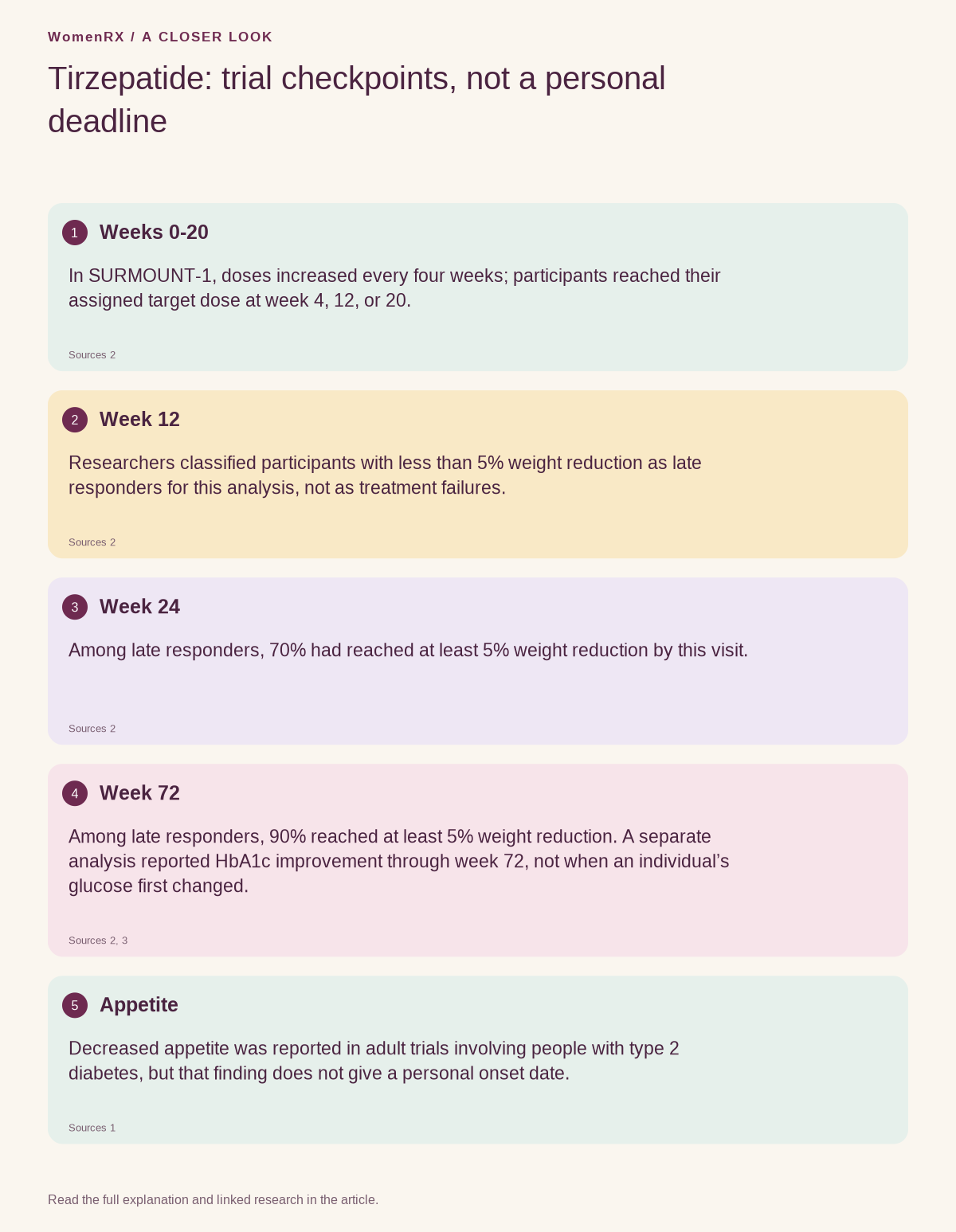
Tirzepatide: trial checkpoints, not a personal deadline
Weeks 0-20: In SURMOUNT-1, doses increased every four weeks; participants reached their assigned target dose at week 4, 12, or 20.2
Week 12: Researchers classified participants with less than 5% weight reduction as late responders for this analysis, not as treatment failures.2
Week 24: Among late responders, 70% had reached at least 5% weight reduction by this visit.2
Week 72: Among late responders, 90% reached at least 5% weight reduction. A separate analysis reported HbA1c improvement through week 72, not when an individual’s glucose first changed.23
Appetite: Decreased appetite was reported in adult trials involving people with type 2 diabetes, but that finding does not give a personal onset date.1
Read the figure as text
These study milestones show dose escalation and later weight-response checkpoints. The week-24 and week-72 percentages describe a selected group who took at least 75% of assigned doses and had the required weight measurements, not everyone who started tirzepatide. Appetite and glucose are separate signals, and the milestones don’t predict an individual’s exact timeline.- Weeks 0-20: In SURMOUNT-1, doses increased every four weeks; participants reached their assigned target dose at week 4, 12, or 20.2
- Week 12: Researchers classified participants with less than 5% weight reduction as late responders for this analysis, not as treatment failures.2
- Week 24: Among late responders, 70% had reached at least 5% weight reduction by this visit.2
- Week 72: Among late responders, 90% reached at least 5% weight reduction. A separate analysis reported HbA1c improvement through week 72, not when an individual’s glucose first changed.23
- Appetite: Decreased appetite was reported in adult trials involving people with type 2 diabetes, but that finding does not give a personal onset date.1
More questions, answered
Does little weight loss by week 12 mean Mounjaro isn’t working?
Not necessarily. In a post hoc analysis of SURMOUNT-1 participants without diabetes, many people who had lost less than 5% by week 12 reached that threshold later. The analysis doesn’t make week 12 a personal pass-or-fail point. 2
Do women lose weight sooner on tirzepatide?
The available findings don’t establish a different early timeline for women. A retrospective study found greater average weight loss for women than men at 15 months among people who stayed on treatment, but the reported 15-month comparison does not establish whether women began losing weight sooner. 4
Sources you can check
- MOUNJARO (TIRZEPATIDE) INJECTION, SOLUTION MOUNJARO KWIKPEN (TIRZEPATIDE) INJECTION, SOLUTION [ELI LILLY AND COMPANY] | US prescribing information and patient instructionsAccessed 2026-09-25Return to first citation
- Weight reduction over time in tirzepatide-treated participants by early weight loss response: Post hoc analysis in SURMOUNT-1.Ard J, Lee CJ, Gudzune K, Addison B, Lingvay I, Cao D, Mast CJ, Stefanski A, Falcon B, Mojdami D. · Diabetes, obesity & metabolism · 2025Return to first citation
- Tirzepatide Efficacy and Tolerability According to Early Weight Response: A Post Hoc Analysis of the SURMOUNT-1 and SURMOUNT-2 Trials.Kokkinos A, Thethi T, Lee CJ, Neff LM, Stefanski A, Cao D, Rodriguez A, Bartee A. · Diabetes, obesity & metabolism · 2026Return to first citation
- Sex, Not Age, Predicts Weight Loss Outcomes With Tirzepatide: A Retrospective Analysis.Castaneda R, Bechenati D, Rivera Gutierrez RJ, Espinosa MA, Villamarin J, Tama E, Safwan N, Fansa S, Verastegui A, McNally AW, Meek JL, Cole KC, Winham SJ, Rajjo TI, Acosta A, Faub... · Obesity (Silver Spring, Md.) · 2026Return to first citation