How to Tell Whether Ozempic Is Meeting Your Goal
If you take Ozempic for type 2 diabetes, glucose measures tell you something the scale cannot.
If Ozempic is being used to manage type 2 diabetes, A1C and any glucose checks in your care plan are more relevant than weight alone. A1C reflects average blood glucose over about three months; people with diabetes usually have it checked at least twice a year, and more often when goals aren’t being met. Weight can be tracked separately, but another semaglutide product’s weight-loss results aren’t an Ozempic benchmark. 13
Start with the reason it was prescribed
“Is it working?” needs a goal attached to it. Ozempic is a specific semaglutide product, and semaglutide brands have different indications and formulations. A measure that makes sense for one use may not answer whether another treatment goal is being met. 3
For type 2 diabetes management, the central question is whether glucose is moving toward the target set for you. Weight change may be something you track too, but Wegovy is a separate semaglutide product identified for weight loss. If the prescription is intended to reduce cardiovascular risk, neither a scale reading nor one glucose result tells you whether a cardiovascular event has been prevented. Those goals shouldn’t be treated as interchangeable. 32
For glucose goals, look beyond one reading
A home blood glucose reading is a snapshot. It can help show glucose at the time you check, while an A1C test estimates average blood glucose over roughly the previous three months. People with diabetes usually have an A1C test at least twice a year; testing may be more frequent when treatment goals aren’t being met. This is general diabetes-monitoring guidance, not an Ozempic-specific check-in schedule. 1
Your glucose target isn’t necessarily the same as someone else’s. MedlinePlus notes that targets can differ with factors such as age and other health problems, so compare results with the target set for you, not a number borrowed from another person or a general online chart. 1
Treat weight as its own outcome
If you and your clinician are tracking weight change, review it alongside glucose results, not in place of them. A person taking Ozempic for diabetes could have a change in glucose measures that matters even if the scale is changing slowly; conversely, weight change by itself doesn’t show that blood glucose is at an individual target. This distinction follows from the fact that blood glucose tests measure glucose, while weight is a different outcome. 1
Don’t use weight-loss results reported for another semaglutide product as an Ozempic benchmark. Wegovy is identified for weight loss; the brands have different indications and formulations, and the trial results in a product’s prescribing information belong to the product and study population described there. 23
Cardiovascular benefit isn’t a quick personal reading
Ozempic’s product information describes a cardiovascular outcomes trial in adults with type 2 diabetes and cardiovascular disease or specified risk factors. The trial compared major cardiovascular events over a minimum observation period of two years. That is a research outcome across groups, not a short-term reading you can use on your own to confirm an individual benefit. The trial description reports that 61% of participants were men but does not give outcomes separately for women and men, so it cannot establish a different effect by sex. 2
Bring your situation into the review
A useful question is: “Which measure are we using for my treatment goal, and when will we review it?” If you’re planning a pregnancy or breastfeeding, bring that up during the medication review too, so the discussion accounts for your circumstances.
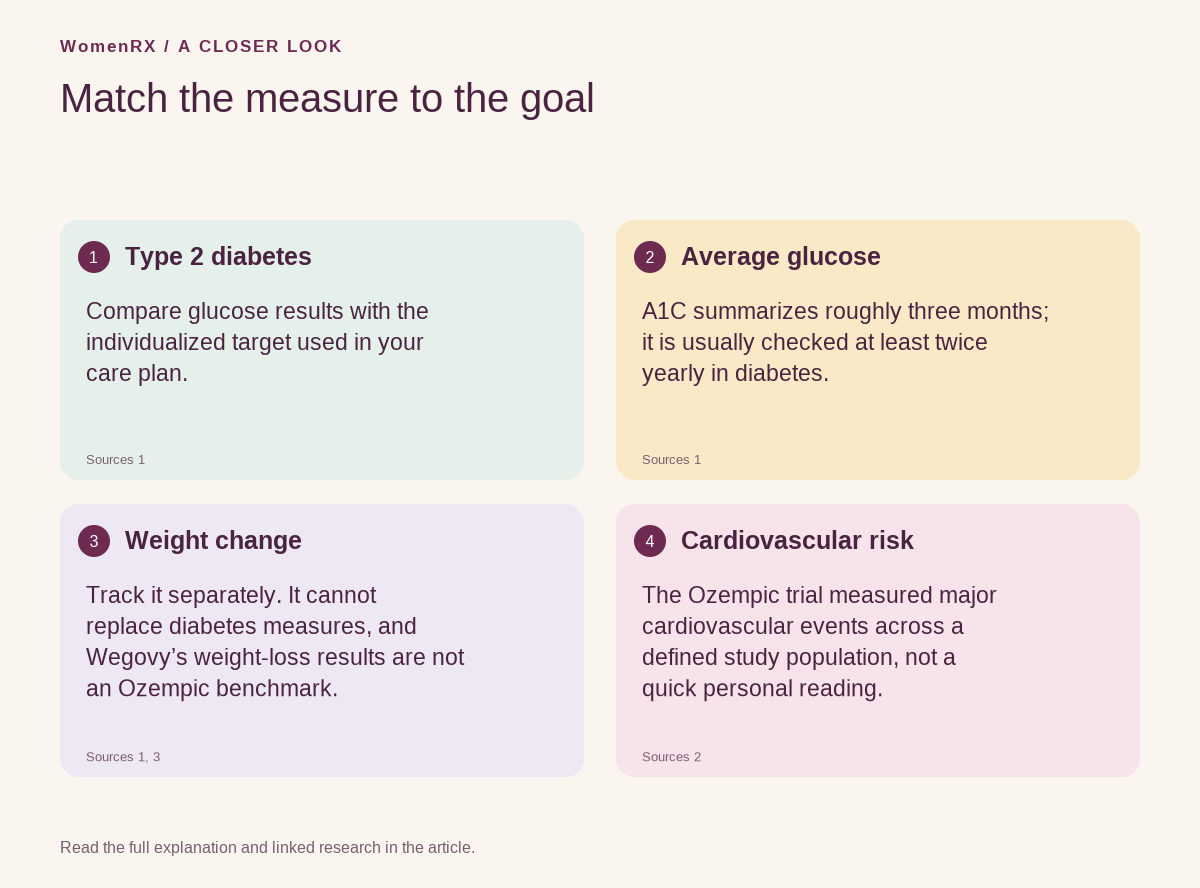
Match the measure to the goal
Type 2 diabetes: Compare glucose results with the individualized target used in your care plan.1
Average glucose: A1C summarizes roughly three months; it is usually checked at least twice yearly in diabetes.1
Weight change: Track it separately. It cannot replace diabetes measures, and Wegovy’s weight-loss results are not an Ozempic benchmark.13
Cardiovascular risk: The Ozempic trial measured major cardiovascular events across a defined study population, not a quick personal reading.2
Read the figure as text
These measures answer different questions. Use the one that matches the reason for treatment rather than treating every result as a score for Ozempic.- Type 2 diabetes: Compare glucose results with the individualized target used in your care plan.1
- Average glucose: A1C summarizes roughly three months; it is usually checked at least twice yearly in diabetes.1
- Weight change: Track it separately. It cannot replace diabetes measures, and Wegovy’s weight-loss results are not an Ozempic benchmark.13
- Cardiovascular risk: The Ozempic trial measured major cardiovascular events across a defined study population, not a quick personal reading.2
Sources you can check
- Blood Glucose | Blood Sugar | Diabetes | MedlinePlusAccessed 2026-09-25Return to first citation
- OZEMPIC (SEMAGLUTIDE) INJECTION, SOLUTION [A-S MEDICATION SOLUTIONS] | US prescribing information and patient instructionsAccessed 2026-09-25Return to first citation
- SemaglutideKommu S, Whitfield P. · 2024Return to first citation