When Ozempic Starts Affecting Blood Sugar and Weight
Blood sugar readings, A1C, and weight each tell a different part of the story, and they don’t change on one guaranteed schedule.
Ozempic can affect blood sugar and body weight, but there isn’t a reliable calendar date when you should expect to notice either change. Your glucose readings can show day-to-day patterns, while A1C reflects an average over about three months. Dose increases, if prescribed, happen over time, and weight change is not a substitute for checking diabetes control. 1 2
Look for different signals, not one start date
Ozempic (semaglutide) is used to improve blood sugar in people with type 2 diabetes. It can lower fasting and after-meal glucose, and it can reduce body weight, but these are separate outcomes. A change on the scale can’t tell you whether your blood sugar is in your target range. 2
There isn’t one dependable day when everyone starts responding. The product information describes glucose effects measured after 12 weeks of treatment, including dose escalation, at a particular steady-state dose. That is not a promise that you’ll feel a change by 12 weeks, or a rule for when to change treatment. 2
What to watch while your dose is being adjusted
If your care team has asked you to check glucose at home, those readings can show patterns between appointments. Use the target range and checking schedule your team gave you; targets and monitoring needs can differ. If readings are often above your personal range, or you have symptoms of high blood sugar, contact your diabetes care team rather than changing medicines on your own. 1
A1C answers a different question. It estimates average blood glucose over roughly the previous three months, so it won’t reflect just a few recent readings. Your care team can use it alongside home readings to assess progress and decide whether your treatment plan needs attention. 1
Ozempic dosing may be increased if additional glucose control is needed after a period on the current dose. The prescribing information describes waiting at least four weeks on the 0.5 mg dose before increasing it to 1 mg, if needed. Follow your own prescription and care plan; don’t increase or otherwise change your dose based on weight or a single glucose result. 2
Weight can change on its own timetable
Weight loss may take time to become noticeable, and it is not the only measure of whether diabetes treatment is helping. In one small study of 34 Japanese people with obesity and type 2 diabetes, researchers reported improvements in both weight and A1C at three and six months. That study offers an example, not a timetable or expected result for every person. 3
It can be useful to consider weight alongside glucose readings and A1C, not instead of them. If your weight hasn’t changed but glucose is improving, or the reverse, that difference is worth discussing in the context of your treatment goals. It does not, by itself, show that the medicine has failed or that the dose should change.
When side effects or pregnancy change the conversation
Nausea, vomiting, or diarrhea can make it harder to keep up with fluids. The prescribing information describes kidney injury reports associated with volume depletion, often in people experiencing gastrointestinal symptoms. Tell your care team if these symptoms are significant or ongoing, especially during treatment initiation or dose increases. Persistent or severe abdominal pain, sometimes spreading to the back and with or without nausea or vomiting, needs prompt medical attention. 2
If you’re planning a pregnancy, arrange a diabetes-care review in advance. The Ozempic prescribing information says to stop it at least two months before a planned pregnancy and to discuss how to manage blood sugar. If you become pregnant while taking it, contact your care team promptly to review treatment and glucose control. Weight change should not be the focus of that conversation. 2
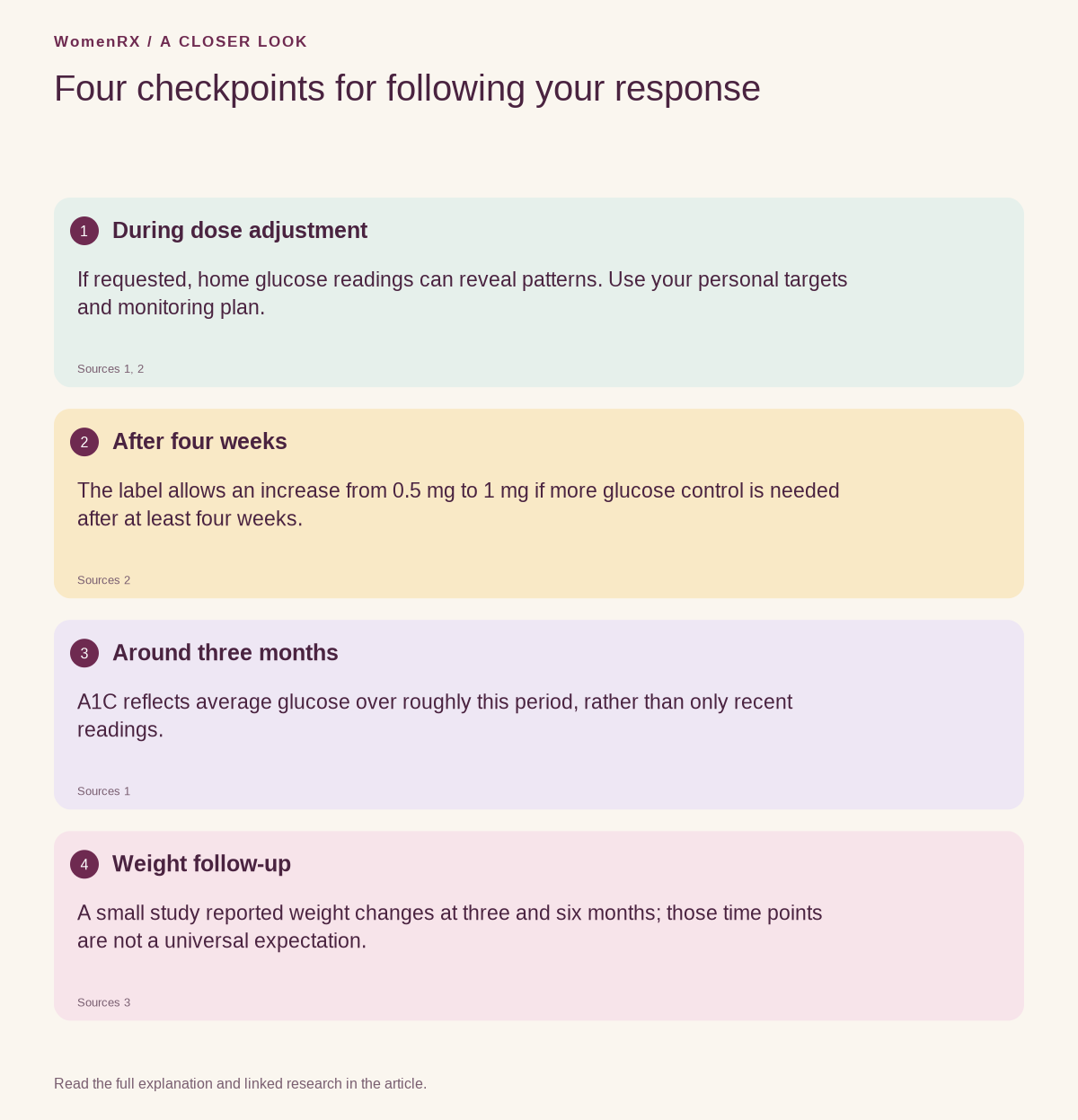
Four checkpoints for following your response
During dose adjustment: If requested, home glucose readings can reveal patterns. Use your personal targets and monitoring plan.12
After four weeks: The label allows an increase from 0.5 mg to 1 mg if more glucose control is needed after at least four weeks.2
Around three months: A1C reflects average glucose over roughly this period, rather than only recent readings.1
Weight follow-up: A small study reported weight changes at three and six months; those time points are not a universal expectation.3
Read the figure as text
These checkpoints describe different kinds of information, not a promised schedule for when Ozempic will work.- During dose adjustment: If requested, home glucose readings can reveal patterns. Use your personal targets and monitoring plan.12
- After four weeks: The label allows an increase from 0.5 mg to 1 mg if more glucose control is needed after at least four weeks.2
- Around three months: A1C reflects average glucose over roughly this period, rather than only recent readings.1
- Weight follow-up: A small study reported weight changes at three and six months; those time points are not a universal expectation.3
More questions, answered
Should I wait for weight loss before deciding if Ozempic is helping?
No. Weight is only one outcome. Home glucose readings and A1C provide information about blood sugar, and your care team can interpret them against your individual targets. Don’t change treatment based on the scale alone. 1 2
Why might my A1C not match this week’s glucose readings?
A1C estimates average blood glucose over about three months, while home readings show glucose at particular times or patterns during the day. They describe different windows, so your care team may consider both. 1
Sources you can check
- Blood Glucose | Blood Sugar | Diabetes | MedlinePlusAccessed 2026-09-25Return to first citation
- OZEMPIC (SEMAGLUTIDE) INJECTION, SOLUTION [A-S MEDICATION SOLUTIONS] | US prescribing information and patient instructionsAccessed 2026-09-25Return to first citation
- Glucagon-Like Peptide-1 Receptor Agonist Semaglutide Improves Eating Behavior and Glycemic Control in Japanese Obese Type 2 Diabetic Patients.Masaki T, Ozeki Y, Yoshida Y, Okamoto M, Miyamoto S, Gotoh K, Shibata H. · Metabolites · 2022Return to first citation