Persistent Vulvar Pain: Finding a Path to Care
Vulvodynia is considered when vulvar pain lasts at least three months and no other clear cause explains it, so evaluation starts by mapping the pain and checking for treatable alternatives.
Vulvodynia describes vulvar pain lasting at least three months without another clearly identifiable cause. Evaluation usually begins with a detailed, sensitive history and an examination suited to your symptoms; tests may be useful when infection or another pelvic condition is suspected, but they aren’t routine for everyone. Care is individualized and may include pelvic floor physical therapy or psychosocial support. 4
Start with the shape of the pain
Persistent vulvar pain doesn’t point to one cause by itself. To make the pattern easier to explain, note where it hurts and what brings it on. For example, is the pain at the vulva, or does it feel deeper during penetration? Does it happen with light touch, sexual contact, clothing pressure, or sitting? Does it come and go, or occur without an obvious trigger? Describe the sensation in your own words, such as burning, stinging, or aching. These details help guide the evaluation; they don’t diagnose vulvodynia on their own. 4
In a small treatment trial, researchers recorded responses to a cotton-swab test and measured sexual-pain intensity. That describes the study’s assessments, not a test that every evaluation must include. 1
Evaluation looks for an explanation first
Vulvodynia is a diagnosis of exclusion: the term applies to vulvar pain lasting at least three months when there isn’t another clearly identifiable cause. A detailed history and a sensitive, patient-centered examination can help identify possible causes and guide treatment. 4
That distinction matters because vulvodynia itself isn’t an infection, but an infection or another condition may need to be considered. Laboratory tests can help rule out infection when appropriate. Imaging isn’t routinely needed for every person with vulvar pain, though it may be considered when pain is deep or there’s concern about pelvic-organ causes. 4
A useful evaluation is tailored to your symptoms rather than automatically sending you through every test. You can describe when the pain began, where it is, what seems to trigger it, and how it affects activities such as sex, getting dressed, or sitting. If an examination or test is suggested, ask what possibility it is meant to check.
Treatment is matched to the findings
Pelvic floor physical therapy may be considered, especially when evaluation points to pelvic floor muscle problems. It can involve retraining muscle function, including relaxation, rather than simply strengthening. A systematic review found possible benefit from physical therapy for pelvic floor hypertonicity, but the included studies were generally small or at risk of bias, and their treatments were not standardized. 23
There is also vulvodynia-specific research, though some studies are small. In a randomized pilot study of 57 women, a physical therapy program added to amitriptyline was compared with amitriptyline alone over eight weeks; several pain and examination measures improved more in the physical therapy group. This result supports considering physical therapy, not assuming it will work the same way for everyone. 1
Psychosocial interventions may also be considered. A review reports that pelvic floor physical therapy and psychosocial interventions have the most consistent evidence of benefit for vulvodynia, while also noting that high-quality treatment studies are limited. 4
The next step is a shared decision based on what the evaluation finds, what feels manageable, and what matters in your daily life. You might ask which possible causes have been considered, what a proposed treatment is intended to address, and how you’ll decide whether it’s helping.
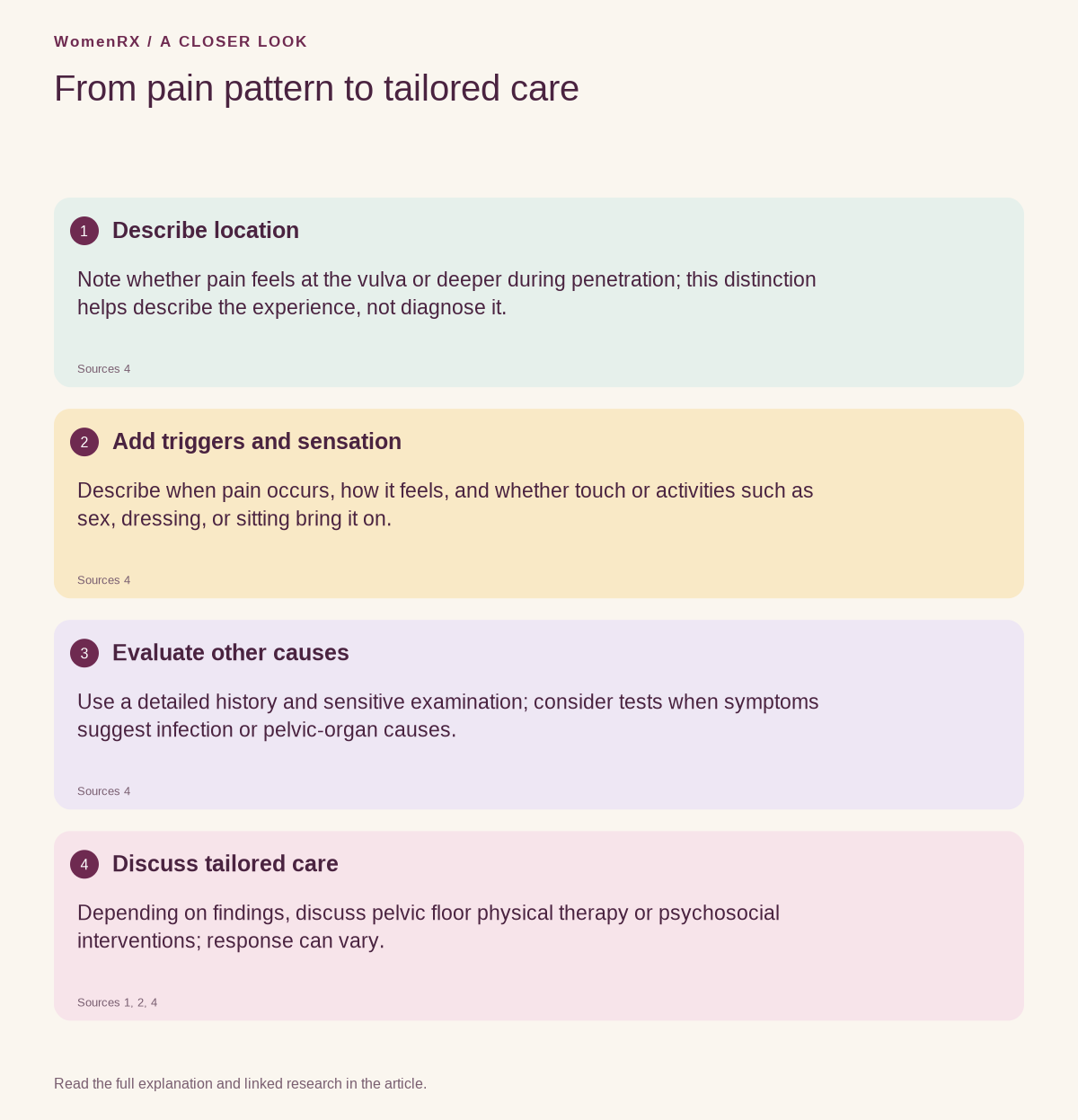
From pain pattern to tailored care
Describe location: Note whether pain feels at the vulva or deeper during penetration; this distinction helps describe the experience, not diagnose it.4
Add triggers and sensation: Describe when pain occurs, how it feels, and whether touch or activities such as sex, dressing, or sitting bring it on.4
Evaluate other causes: Use a detailed history and sensitive examination; consider tests when symptoms suggest infection or pelvic-organ causes.4
Discuss tailored care: Depending on findings, discuss pelvic floor physical therapy or psychosocial interventions; response can vary.124
Read the figure as text
This flow separates describing the pain, checking for other explanations, and choosing care based on findings.- Describe location: Note whether pain feels at the vulva or deeper during penetration; this distinction helps describe the experience, not diagnose it.4
- Add triggers and sensation: Describe when pain occurs, how it feels, and whether touch or activities such as sex, dressing, or sitting bring it on.4
- Evaluate other causes: Use a detailed history and sensitive examination; consider tests when symptoms suggest infection or pelvic-organ causes.4
- Discuss tailored care: Depending on findings, discuss pelvic floor physical therapy or psychosocial interventions; response can vary.124
Sources you can check
- Pelvic Floor Biometric Changes Assessed by 4D Translabial Ultrassound in Women With Vulvodynia Submitted to Physical Therapy: A Pilot Study of a Randomized Controlled Trial.Bardin MG, Giraldo PC, Martinho N. · The journal of sexual medicine · 2020Return to first citation
- Pelvic Floor Physical Therapy for Pelvic Floor Hypertonicity: A Systematic Review of Treatment Efficacy.van Reijn-Baggen DA, Han-Geurts IJM, Voorham-van der Zalm PJ, Pelger RCM, Hagenaars-van Miert CHAC, Laan ETM. · Sexual medicine reviews · 2022Return to first citation
- Pelvic floor physical therapy in the treatment of pelvic floor dysfunction in women.Wallace SL, Miller LD, Mishra K. · Current opinion in obstetrics & gynecology · 2019Return to first citation
- Female Pelvic Conditions: Dyspareunia and Vulvodynia.Brown B. · FP essentials · 2024Return to first citation