Bladder Changes Around Menopause: What to Check
Urgency, leakage, and discomfort can overlap with menopause-related tissue changes, but the symptom pattern and a basic evaluation help identify what treatment may fit.
Menopause-related tissue changes can contribute to urinary symptoms, especially when vaginal dryness or irritation is present. But urgency, leakage, or burning may have another cause. A history, examination, and urine test can help sort out whether to discuss treatment for infection, overactive bladder, or genitourinary syndrome of menopause. Medication may be an option for overactive bladder after other causes are excluded; vaginal estrogen isn’t a treatment for every bladder condition. 1 4 5
Start with the pattern, not the menopause label
A new bladder symptom around perimenopause or after menopause can feel as if it must have one cause. It may not. Menopause-related genitourinary syndrome can involve vaginal or vulvar dryness, itching, discomfort with sex, and urinary symptoms such as urgency. These symptoms can overlap, but the overlap does not prove that every urinary change comes from menopause. 4
The details of leakage can point toward different bladder-control patterns. Leaking with a cough, laugh, or sneeze is called stress incontinence. A sudden, hard-to-delay urge followed by leakage fits urge incontinence. Frequent leaking alongside difficulty emptying may suggest overflow incontinence. Some people have more than one pattern. 2 3
Other contributors matter too. A urinary tract infection can cause painful or burning urination. Constipation, caffeine, very concentrated urine when fluid intake is low, and conditions affecting the bladder or nerves can also contribute to urgency or frequency. These possibilities are reasons to assess the symptom rather than assume its cause. 1 2
What an evaluation can clarify
A useful first conversation covers when symptoms began, what triggers them, whether leakage accompanies urgency or exertion, how emptying feels, and whether vaginal dryness or irritation is also present. A clinician may ask about medicines and other health conditions as part of understanding the pattern.
For urgency and other symptoms suggestive of overactive bladder, a clinical guideline describes an initial assessment that includes medical history, physical examination, and urinalysis. A bladder diary or an ultrasound measurement of urine left after urinating may add useful information in some cases. 5
Some features call for a closer look rather than simply treating symptoms as overactive bladder. The guideline identifies blood in the urine, pelvic pain or a pelvic mass, difficulty urinating, and neurologic conditions as reasons further investigation may be needed. 5
If burning is prominent, mention it specifically: painful urination can occur with a urinary tract infection, and a urine test may help clarify whether infection is part of the picture. 1 If dryness or irritation is also present, describe where you feel it so both the urinary and vaginal symptoms can be considered. 4
Treatment depends on what the assessment finds
If the pattern points toward menopause-related vaginal or vulvar tissue symptoms, nonhormonal vaginal moisturizers or lubricants are options, particularly for milder symptoms. Lubricants are used to reduce friction during sexual activity; moisturizers are used regularly for ongoing dryness. 4
For more bothersome genitourinary symptoms, vaginal estrogen may be a treatment to discuss. Vaginal DHEA and ospemifene are other options described in a clinical review. These treatments address genitourinary syndrome of menopause; they should not be treated as interchangeable remedies for infection, incomplete bladder emptying, or every type of leakage. Urinary improvement is possible for some people when urinary symptoms occur alongside menopause-related tissue changes, but it is not guaranteed. 4
If you have had breast cancer, or take an aromatase inhibitor, the choice of treatment for menopause-related tissue symptoms needs an individualized discussion; the review advises involving the oncology team in these decisions. 4
Other findings lead to different treatment conversations. A suspected UTI may be treated with antibiotics, although they aren’t always needed. 1 If sudden urgency is the main problem, whether or not you leak, reviewing caffeine, alcohol, constipation, and fluid intake may reveal contributors. When an evaluation supports overactive bladder and excludes other causes, medication is another treatment category to discuss. The diagnostic guideline supports that option but does not establish which medication would fit an individual. 2 3 5
Leakage with coughing or laughing calls for a different conversation: a sling procedure is one surgical option for stress incontinence. Nerve stimulation is among the procedures described for urge incontinence. Neither is a default next step for everyone with bladder symptoms. 3
If you often feel unable to empty your bladder, that needs its own assessment: frequent leakage can occur when urine is left behind, sometimes because of an obstruction or a bladder muscle that does not contract fully. A measurement of urine remaining after you urinate may help clarify the problem before treatment is chosen. Constipation, caffeine, and low fluid intake may also be worth reviewing because they can contribute to bladder irritation or urgency. 2 5 The assessment matters because a treatment aimed at vaginal dryness may not address the actual cause of leakage or discomfort.
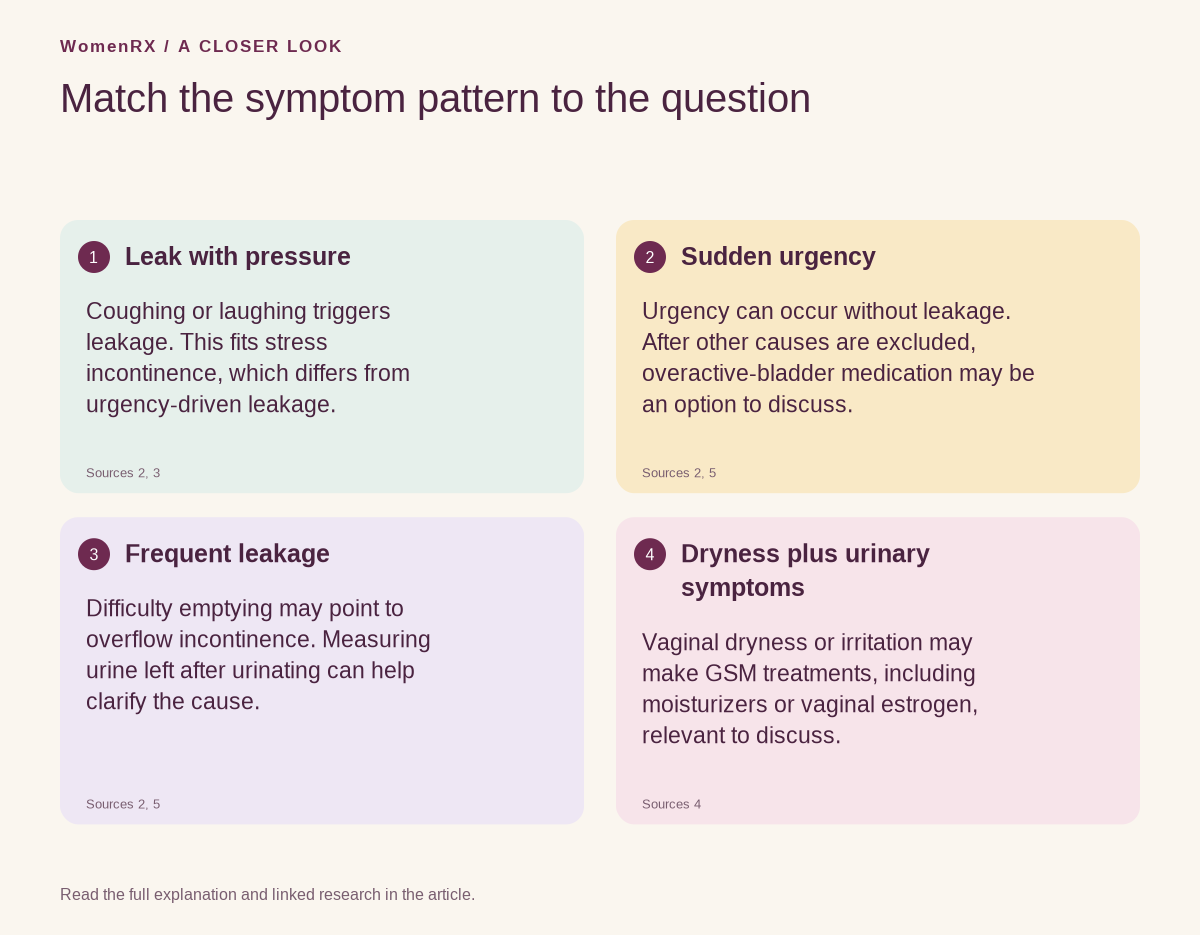
Match the symptom pattern to the question
Leak with pressure: Coughing or laughing triggers leakage. This fits stress incontinence, which differs from urgency-driven leakage.23
Sudden urgency: Urgency can occur without leakage. After other causes are excluded, overactive-bladder medication may be an option to discuss.25
Frequent leakage: Difficulty emptying may point to overflow incontinence. Measuring urine left after urinating can help clarify the cause.25
Dryness plus urinary symptoms: Vaginal dryness or irritation may make GSM treatments, including moisturizers or vaginal estrogen, relevant to discuss.4
Read the figure as text
Urinary symptoms can point toward different issues. The pattern helps shape what to assess and which treatment category may be relevant.- Leak with pressure: Coughing or laughing triggers leakage. This fits stress incontinence, which differs from urgency-driven leakage.23
- Sudden urgency: Urgency can occur without leakage. After other causes are excluded, overactive-bladder medication may be an option to discuss.25
- Frequent leakage: Difficulty emptying may point to overflow incontinence. Measuring urine left after urinating can help clarify the cause.25
- Dryness plus urinary symptoms: Vaginal dryness or irritation may make GSM treatments, including moisturizers or vaginal estrogen, relevant to discuss.4
More questions, answered
Does vaginal estrogen treat every kind of bladder leakage?
No. It may be discussed when urinary symptoms occur with menopause-related vaginal or vulvar tissue changes, but leakage with coughing or sneezing, infection, and difficulty emptying can involve different problems. Assessment helps match treatment to the pattern. 2 4
What symptoms should I mention together?
Describe urinary urgency, frequency, burning, leakage triggers, and any difficulty emptying. Also mention vaginal dryness, itching, or discomfort with sex, since those symptoms can help identify whether menopause-related tissue changes may be part of the picture. 4 5
Sources you can check
- Urinary tract infections (UTIs) - NHSAccessed 2026-09-25Return to first citation
- Urinary incontinence - Causes - NHSAccessed 2026-09-25Return to first citation
- Urinary incontinence - NHSAccessed 2026-09-25Return to first citation
- Case-Based Perspectives on the Management of Genitourinary Syndrome of Menopause.Cyriac J, Sood R. · Clinics and practice · 2026Return to first citation
- The Urogynecology Section of the Polish Society of Gynecologists and Obstetricians Guideline on the diagnostic management of non-neurogenic overactive bladder syndrome in women.Dybowski B, Narojczyk-Swiesciak E, Baranowski W, Rechberger T, Miotla P, Futyma K, Wrobel A, Grzybowska ME, Stangel-Wojcikiewicz K, Kluz T, Rogowski A, Wlazlak E, Surkont G. · Ginekologia polska · 2025Return to first citation