How Overactive Bladder Is Evaluated and Treated
Urgency can point to overactive bladder, but a few basic checks help distinguish the symptom pattern from other causes and guide what to try next.
Overactive bladder is a symptom syndrome, not a conclusion drawn from urgency alone. Evaluation usually starts with your health history, a focused examination, and a urine test; a bladder diary or an ultrasound measurement of urine left after you go may add useful information. If other causes are ruled out, you and your clinician can weigh behavioral approaches, medication, or specialist treatments according to your symptoms and preferences. 1 3
Urgency is a clue, not the whole diagnosis
Overactive bladder (OAB) describes urinary urgency, often with frequent urination or waking at night to urinate, with or without leakage on the way to the bathroom. The pattern is considered OAB when a urinary infection or another identifiable cause does not better explain the symptoms. So urgency alone doesn’t settle the question. 2
That distinction matters because several conditions can produce urinary symptoms, and the next step depends on the pattern. For example, urgency alongside pelvic pain, blood in the urine, difficulty emptying, or a neurological condition may call for a more specialized evaluation rather than assuming uncomplicated OAB. 1
What a first assessment may include
A clinician will usually ask about your urinary symptoms and general health, then do a focused physical examination and urinalysis. The urine test helps look for infection or other findings that could change the explanation. A diary recording bathroom trips and symptoms can help make the pattern clearer. An ultrasound measurement of post-void residual, or urine left in the bladder after urinating, may also be useful in some cases. 1
Not everyone needs every test. The guideline on women’s evaluation describes the diary and bladder ultrasound with residual measurement as supplementary tools, while recommending additional investigation when symptoms or health factors suggest another problem. 1
Bring up relevant context, such as prior pregnancies or pelvic conditions, menopausal status, other health conditions, and medicines you take. These details help the clinician understand your overall health and decide what deserves attention; they don’t, by themselves, establish that OAB is the cause.
Choosing a first approach
Once OAB is the working diagnosis, treatment is a shared decision. The AUA/SUFU guideline describes noninvasive approaches, medication, and minimally invasive or invasive options, with the choice tailored to symptom control, treatment burden, possible adverse effects, and your preferences. The goal isn’t to move through a mandatory ladder or assume everyone needs medication. 3
Behavioral approaches are one place to discuss starting. The options described in a review of the 2024 guideline include changes to fluid habits or diet and weight loss where relevant. What is useful will depend on your symptoms and circumstances; a broad instruction to restrict fluids, for example, is not a personalized plan. 2
Medication is another option if symptoms remain disruptive or you prefer to discuss it. Two classes named in the review are antimuscarinics and beta-3 adrenergic agonists. Neither class is automatically the better fit; the choice depends on the specific medicine and your health. Ask what effects and health considerations matter for the specific medicine being offered, and how you’ll decide whether it’s helping. 2 3
Specialist treatments can be discussed when symptoms need more help. The treatment options described in the review include bladder injections with onabotulinumtoxinA and neuromodulation. These are options to weigh with a specialist, not steps every woman must reach. 2
Questions that make the choice more useful
Rather than asking only, “What’s the strongest treatment?”, try questions that connect the plan to your daily life:
- What findings make OAB more likely in my case, and what else are we checking for?
- Would a diary or a measurement of urine left after urinating help clarify the picture?
- What’s a reasonable first option for my most disruptive symptom?
- If we discuss medicine, what benefits and possible adverse effects should I weigh for that particular choice?
- When should we review the plan, and what other options could we consider if it isn’t helping?
The useful outcome of an assessment is not just a label. It’s a clearer explanation of the symptoms and a plan you understand well enough to decide whether it fits.
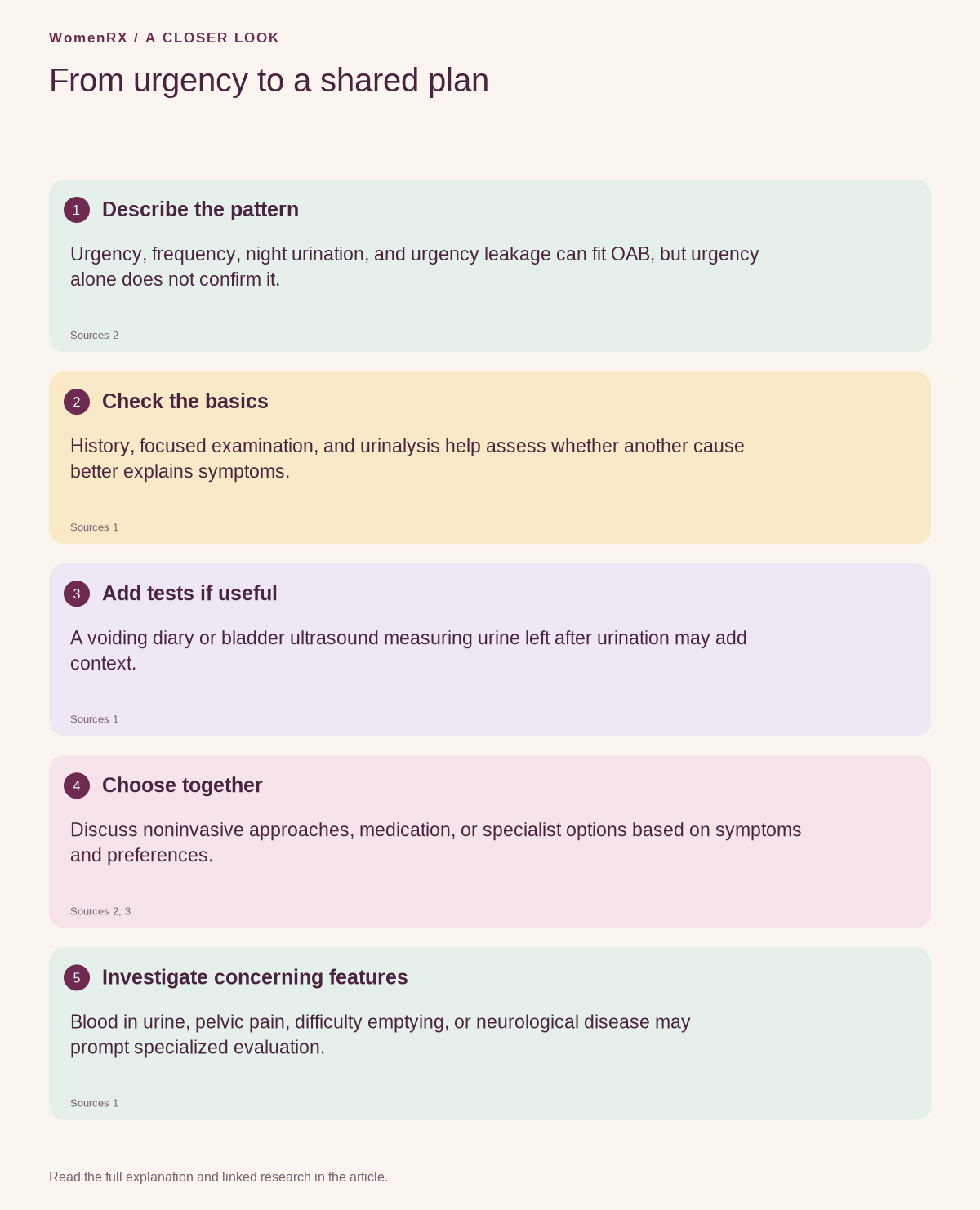
From urgency to a shared plan
Describe the pattern: Urgency, frequency, night urination, and urgency leakage can fit OAB, but urgency alone does not confirm it.2
Check the basics: History, focused examination, and urinalysis help assess whether another cause better explains symptoms.1
Add tests if useful: A voiding diary or bladder ultrasound measuring urine left after urination may add context.1
Choose together: Discuss noninvasive approaches, medication, or specialist options based on symptoms and preferences.23
Investigate concerning features: Blood in urine, pelvic pain, difficulty emptying, or neurological disease may prompt specialized evaluation.1
Read the figure as text
A simple path from symptom pattern through basic evaluation to treatment choices, with a branch for symptoms that may need further investigation.- Describe the pattern: Urgency, frequency, night urination, and urgency leakage can fit OAB, but urgency alone does not confirm it.2
- Check the basics: History, focused examination, and urinalysis help assess whether another cause better explains symptoms.1
- Add tests if useful: A voiding diary or bladder ultrasound measuring urine left after urination may add context.1
- Choose together: Discuss noninvasive approaches, medication, or specialist options based on symptoms and preferences.23
- Investigate concerning features: Blood in urine, pelvic pain, difficulty emptying, or neurological disease may prompt specialized evaluation.1
More questions, answered
When might urgency need more than a basic OAB assessment?
Blood in the urine, pelvic pain, difficulty urinating, a pelvic mass, neurological disease, or another condition that may affect urinary function can prompt more specialized evaluation. These findings do not establish a particular diagnosis, but they are reasons not to assume urgency is uncomplicated OAB. 1
Sources you can check
- The Urogynecology Section of the Polish Society of Gynecologists and Obstetricians Guideline on the diagnostic management of non-neurogenic overactive bladder syndrome in women.Dybowski B, Narojczyk-Swiesciak E, Baranowski W, Rechberger T, Miotla P, Futyma K, Wrobel A, Grzybowska ME, Stangel-Wojcikiewicz K, Kluz T, Rogowski A, Wlazlak E, Surkont G. · Ginekologia polska · 2025Return to first citation
- Health Disparities and Overactive Bladder: Bridging the Gap.Gunamany S, Hartt A, Kopkin R, Omole I, Enemchukwu EA. · Current bladder dysfunction reports · 2026Return to first citation
- The AUA/SUFU guideline on the diagnosis and treatment of idiopathic overactive bladder.Cameron AP, Chung DE, Dielubanza EJ, Enemchukwu E, Ginsberg DA, Helfand BT, Linder BJ, Reynolds WS, Rovner ES, Souter L, Suskind AM, Takacs E, Welk B, Smith AL. · Neurourology and urodynamics · 2024Return to first citation