Pelvic Leakage, Pressure, or Pain: What Gets Checked
Where leakage happens, what triggers it, and whether you also feel pressure or pain can point toward different assessments.
Describe what happens rather than calling every symptom “pelvic floor weakness.” Urine leakage with a cough or exercise is assessed differently from leakage after a sudden urge; a bladder diary may help clarify the pattern. Stool or gas leakage, vaginal pressure or a bulge, and pelvic pain each deserve to be named separately. An examination or further tests depend on the symptoms that come with them. 6971
Pelvic symptoms don’t always arrive one at a time. You might notice a bulge and urine leakage, or pain and a frequent need to pee. Describe each symptom rather than assuming one condition explains them all. Pelvic pain, for instance, can come from the bladder, bowel, an infection, or a reproductive-organ condition. 178
Start with what happens, not a diagnosis
For urine leakage, the trigger is a useful distinction. Does urine escape when you cough, laugh, or exercise? Does it happen after a sudden need to pee, before you reach the bathroom? Or do both happen? Clinical guidance separates stress, urgency, and mixed urinary incontinence at the initial assessment because the pattern helps guide what happens next. A bladder diary can show how symptoms fit into ordinary days, including work and leisure. 96
For stool or gas leakage, say which you’re having, whether you also struggle to pass stool, and how it affects your day. Bowel-control problems are among the symptoms reported with pelvic floor disorders, but leakage alone doesn’t identify its cause. An initial assessment may involve a history and physical examination, with any further tests chosen for the problem found. 9
For a vaginal bulge with urine leakage, describe where you feel the bulge, when urine escapes, and whether you also have trouble peeing. If prolapse is suspected, a clinician can ask about your symptoms and examine you; bladder problems alongside it may lead to further tests. Don’t let the bulge take the place of describing the leakage pattern. 76
For bowel changes with a bulge, say whether you struggle to pass stool or also have stool leakage. Constipation can occur with prolapse, but it can also contribute to pelvic pain for other reasons. Naming each concern keeps it from being folded into a general description of “pelvic weakness.” 71
For pressure or a bulge, describe where you feel it and whether it affects daily life. Pelvic organ prolapse means that the uterus, bladder, or bowel bulges into the vagina. Pressure alone isn’t enough to tell whether that’s happening. Treatment decisions take account of how much the symptoms bother you, not just what an examination finds. 7
For pain, say where it is, what it feels like, when it began, and whether it happens with peeing, sex, exercise, or your period. A clinician may need to consider bowel or bladder conditions, infection, and reproductive-organ causes rather than assuming the pelvic floor muscles are the source. Pain with a frequent urge to pee, even when your bladder feels empty, is one pattern that may lead to a bladder-focused assessment. 182
What an assessment might involve
For urine leakage, the first distinction is usually whether the pattern is stress, urgency, or mixed incontinence. A clinician may ask you to keep a bladder diary covering different parts of your usual routine. This is more useful than assuming all leakage needs the same test: NICE guidance does not recommend routine imaging or cystoscopy for an initial assessment of urinary incontinence alone. It recommends supervised pelvic floor muscle training as a first-line treatment for stress or mixed incontinence, after assessment of the muscle contraction. 6
Stool or gas leakage deserves its own description even if you have no vaginal bulge. A clinician can begin with your symptoms and an examination; the pelvic floor reference describes special tests as possible, but it doesn’t give a single test pathway for every kind of bowel leakage. If you have trouble passing stool along with a vaginal bulge, mention both when discussing a possible prolapse examination. A prolapse examination does not, by itself, explain why stool escapes or why it’s hard to pass. Persistent bowel changes warrant attention even without a bulge. 971
A vaginal bulge or suspected prolapse may be assessed through a conversation and physical examination. The history includes bladder and bowel function as well as the bulge itself. If you also have bladder problems, further testing may be considered. 67
When bladder or lower-abdominal pain comes with a frequent urge to pee, an assessment may include a urine test to check for another cause, such as a urinary tract infection, and a pelvic examination. Bladder pain syndrome has no single diagnostic test; additional tests may be considered depending on what needs to be ruled out. That’s a different question from assessing urine leakage without pain. 86
Pelvic pain may call for a broader examination or tests guided by its possible cause. Timing can help: pain around a period raises different questions from pain that starts suddenly or occurs when peeing. If pain during your period is getting worse, disrupting usual activities, or accompanied by pain during sex, peeing, or bowel movements, it’s worth having assessed. 12
Life stage adds context, not a diagnosis
Pregnancy, childbirth, and later life can all be relevant to the conversation. A hospital-based study of pregnant women recorded urinary, prolapse, and colorectal symptoms; a long-term childbirth cohort found differences in pelvic floor symptom scores across delivery groups decades later. Neither finding can tell you the cause of your own symptom. Prolapse is also common after age 50, but pelvic concerns can arise outside pregnancy, postpartum recovery, or menopause. 437
Mention a recent birth or pregnancy if it’s relevant. Otherwise, don’t feel you need a life-stage explanation before bringing up leakage, a bulge, bladder changes, or pain. What the symptom does to your day matters too: for example, whether you avoid exercise, interrupt work to find a bathroom, or find sex painful. 4951
When pain changes the urgency
Get prompt medical help for pelvic pain with difficulty peeing or passing stool, blood in urine or stool, unusual vaginal bleeding, fever or chills, or a possible pregnancy. Severe or worsening pain, fainting, shoulder-tip pain, difficulty breathing, or heavy vaginal bleeding calls for emergency care. These signs need assessment for causes beyond a pelvic floor disorder. 1
You don’t have to work out whether your pelvic floor is “weak” before seeking help. A clear description of each symptom, especially when it happens and what else comes with it, gives the person assessing you a better place to start. 169
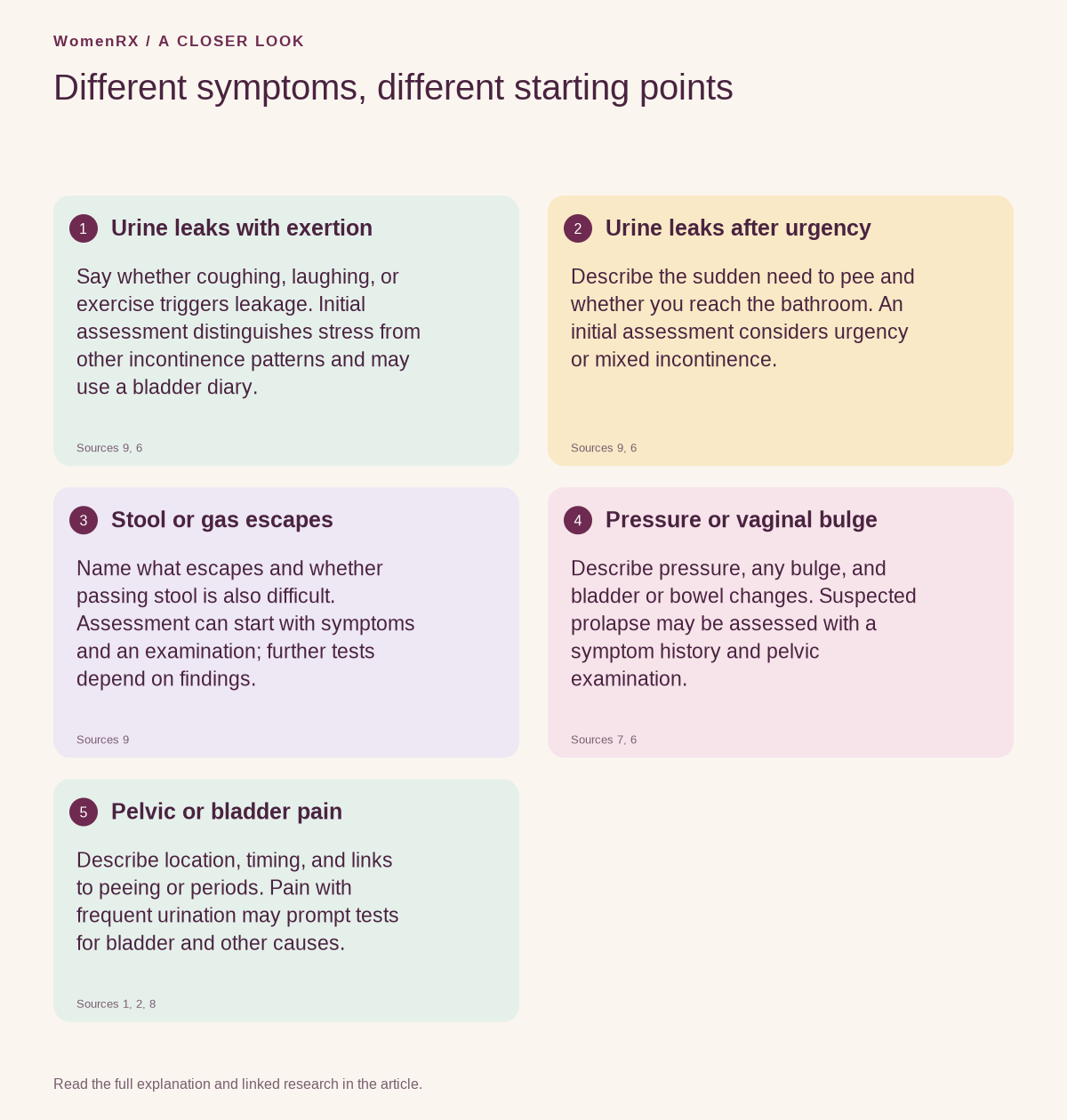
Different symptoms, different starting points
Urine leaks with exertion: Say whether coughing, laughing, or exercise triggers leakage. Initial assessment distinguishes stress from other incontinence patterns and may use a bladder diary.96
Urine leaks after urgency: Describe the sudden need to pee and whether you reach the bathroom. An initial assessment considers urgency or mixed incontinence.96
Stool or gas escapes: Name what escapes and whether passing stool is also difficult. Assessment can start with symptoms and an examination; further tests depend on findings.9
Pressure or vaginal bulge: Describe pressure, any bulge, and bladder or bowel changes. Suspected prolapse may be assessed with a symptom history and pelvic examination.76
Pelvic or bladder pain: Describe location, timing, and links to peeing or periods. Pain with frequent urination may prompt tests for bladder and other causes.128
Read the figure as text
Symptoms can overlap. These starting points show why describing each one separately helps shape an assessment; they are not a way to diagnose yourself.- Urine leaks with exertion: Say whether coughing, laughing, or exercise triggers leakage. Initial assessment distinguishes stress from other incontinence patterns and may use a bladder diary.96
- Urine leaks after urgency: Describe the sudden need to pee and whether you reach the bathroom. An initial assessment considers urgency or mixed incontinence.96
- Stool or gas escapes: Name what escapes and whether passing stool is also difficult. Assessment can start with symptoms and an examination; further tests depend on findings.9
- Pressure or vaginal bulge: Describe pressure, any bulge, and bladder or bowel changes. Suspected prolapse may be assessed with a symptom history and pelvic examination.76
- Pelvic or bladder pain: Describe location, timing, and links to peeing or periods. Pain with frequent urination may prompt tests for bladder and other causes.128
Sources you can check
- Pelvic pain - NHSAccessed 2026-09-25Return to first citation
- Period pain - NHSAccessed 2026-09-25Return to first citation
- Obstetric Factors Associated with Pelvic Floor Disorders and Surgery 30 Years After Childbirth: A Prospective Cohort Study.Volløyhaug I, Belluardo M, Svenningsen R, Salvesen KÅ, Belaska E, Nyhus MØ. · International urogynecology journal · 2026Return to first citation
- Burden and Awareness of Pelvic Floor Disorders Among Pregnant Women in Addis Ababa, Ethiopia: A Hospital-Based Study.Ayenachew F, Mikael G, Serawit A. · International urogynecology journal · 2026Return to first citation
- Pelvic Floor Disorders in Women with Breast Cancer and Gynaecological Cancer: Real-World Data from a Prospective Multicentre Cross-Sectional Survey.Schröder C, Bonilla Moran S, Kirn V, Faridi A, Meyer-Wilmes P, Najjari L, Thangarajah F, Hentsch S, Kurbacher C, Tascón Padrón L, Otten LA, Egger EK, Mustea A, Koensgen D. · Journal of clinical medicine · 2026Return to first citation
- Recommendations | Urinary incontinence and pelvic organ prolapse in women: management | Guidance | NICEAccessed 2026-09-25Return to first citation
- Pelvic organ prolapse - NHSAccessed 2026-09-25Return to first citation
- Bladder pain syndrome (BPS) - NHSAccessed 2026-09-25Return to first citation
- Pelvic Support Problems | Pelvic Floor | MedlinePlusAccessed 2026-09-25Return to first citation