When a Nap Helps and When It Gets in the Way
A nap can ease daytime sleepiness, but what happens at bedtime matters as much as how you feel when you wake.
A daytime nap can improve alertness, and studies in older adults have found little evidence that naps generally worsen nighttime sleep. But if you’re already struggling to fall or stay asleep, a nap may work against your goal of sleeping at night. Judge it by both outcomes: how you function afterward and whether your next main sleep period becomes harder. One review found an inconclusive signal of better daytime performance with earlier-afternoon naps; it does not tell us which nap time or length protects nighttime sleep. If a later or longer nap seems to make bedtime harder, compare that with days you do not nap. Persistent sleepiness deserves a closer look. 6531
A nap can help your afternoon without fixing your night
If you’re fighting to stay focused in the afternoon, a nap may offer a real, if temporary, lift. A 2021 review of 11 studies involving 381 working-aged adults found better cognitive performance after a nap than under no-nap conditions, particularly for alertness. Almost all the studies took place in laboratories, so the results don’t tell us exactly how much a nap will help during an ordinary workday. They also don’t establish its effect specifically after an unusually short night. 6
For example, if caregiving kept you awake last night, you might hope a nap makes the afternoon more manageable. The review did not establish benefits after caregiving-related sleep loss or whether a nap makes up for sleep missed during the night. The question for tonight is separate: does napping leave you able to sleep when you have the chance?
When bedtime is already difficult, make night sleep the priority
If you regularly lie awake at bedtime or wake repeatedly during the night, pay attention to what happens on days you nap. Insomnia can mean trouble falling asleep, staying asleep, or both, and it can cause daytime sleepiness. Guidance for people trying to improve insomnia advises against daytime naps. That advice is about protecting night sleep, not a claim that every nap harms every sleeper. 23
Try comparing like with like: after a day you nap, is it noticeably harder to fall asleep at your usual bedtime than after a day you don’t? Notice when you napped and for how long, especially if some naps seem to leave bedtime harder than others. If a later or longer nap seems to interfere, compare it with days you skip the nap. If a nap helps and your night remains steady, there’s less reason to treat it as a problem.
The evidence does not set a bedtime-safe cutoff for nap timing or duration. A review of working-aged adults found an inconclusive signal of better daytime cognitive performance with earlier-afternoon naps, while nap duration did not change performance in its analysis; it did not assess the following night’s sleep. Studies in older adults found little evidence that naps generally worsened nighttime sleep, but they do not establish one best time or length for every sleeper. Judge timing and duration against your next main sleep period, which may not begin at night if you work shifts. 6512
There’s another tradeoff just after waking. The working-age review found conflicting results during the period of grogginess immediately after a nap, even though performance improved afterward. If you need to be sharp the moment you get up, factor in how you feel on waking, not only how you feel later. 6
Older adults don’t need a blanket no-nap rule
Night sleep can become more interrupted with age. In a systematic review of 15 studies with 326 older adults, napping generally improved reported sleepiness and fatigue and some measures of performance. The studies found little evidence of worse nighttime sleep compared with no-nap conditions, though they did not settle what happens with repeated naps over the long term. These findings don’t mean a nap will help every older person, but they do challenge the idea that an afternoon nap automatically steals sleep from the night. 5
Nor does simply giving up a habitual nap guarantee more night sleep. In a secondary analysis of a study of community-living older adults, participants who stopped napping had different total-sleep outcomes depending on whether they were in an occupation-based intervention group. That finding can’t tell an individual what will happen if she stops napping, but it’s a useful reminder to look at sleep across the whole day. 4
Look beyond the nap when sleepiness keeps returning
A missed night, an irregular work schedule, and poor-quality sleep can all affect how sleepy you feel. Some people who are tired during the day aren’t getting enough sleep; others have a sleep disorder. Loud snoring with gasping or pauses in breathing is one clue that nighttime sleep needs attention. If you’re repeatedly struggling to stay awake despite allowing enough time for sleep, or you’re sleepy while driving, a nap shouldn’t be your only response. Don’t drive when you feel sleepy, and arrange an assessment of the ongoing sleepiness. 123
Shift work changes the practical question. A fixed clock-time rule for an afternoon nap may not fit someone whose main sleep period begins in the morning. Irregular schedules can contribute to sleep problems, so judge a nap against your intended main sleep period and whether you’re alert enough for the tasks ahead. 12
MedlinePlus identifies women as being at higher risk of insomnia, but that doesn’t establish a separate nap rule for women. The working-age nap review found no difference in the performance benefit by sex; it did not provide a nap plan for pregnancy, postpartum recovery, or caregiving-related sleep loss. The older-adult findings answer a different question about aging, not those life circumstances. Use your actual pattern of daytime function and nighttime sleep to make the call. 265
What the Nap Is Solving
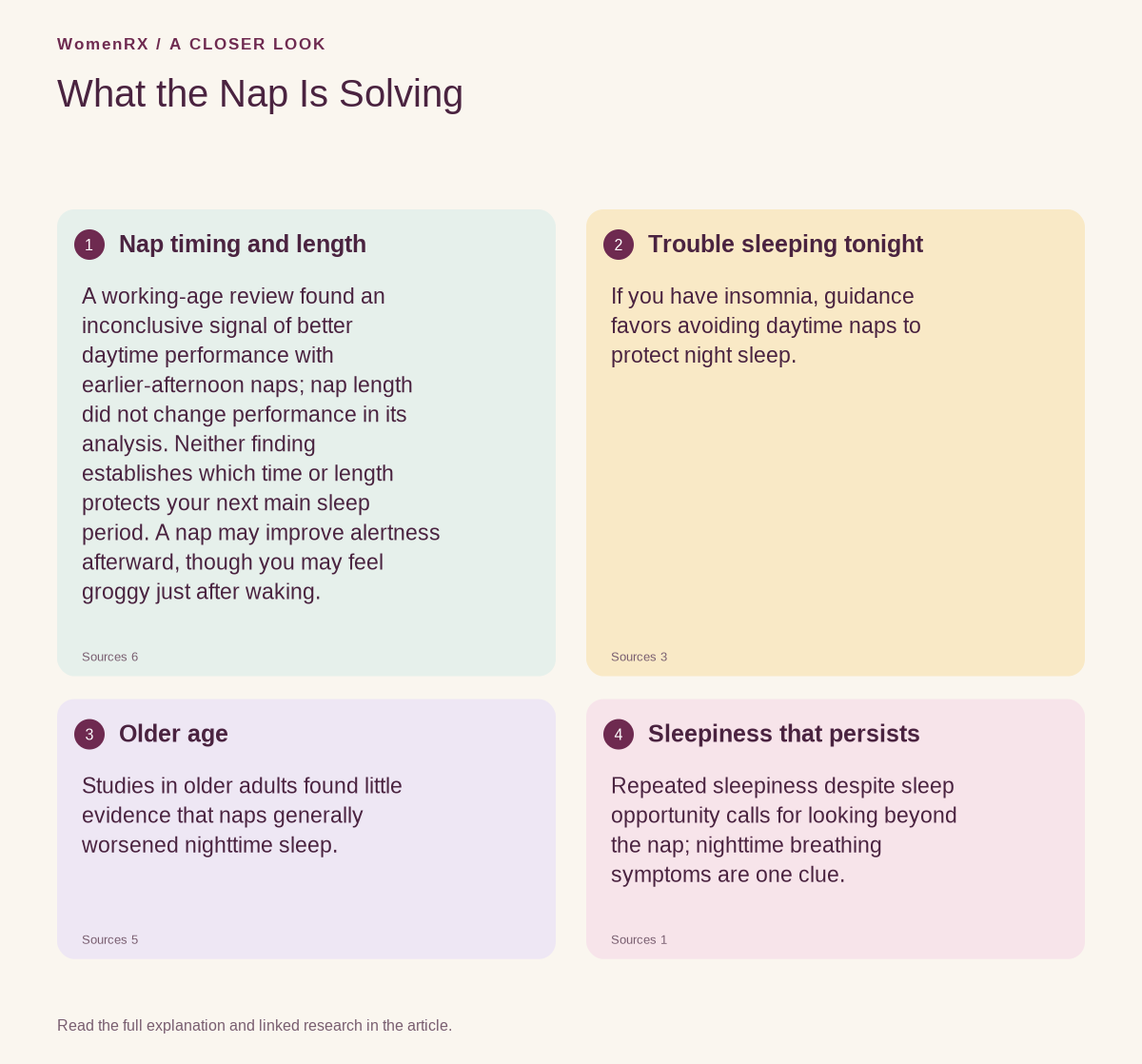
Nap timing and length: A working-age review found an inconclusive signal of better daytime performance with earlier-afternoon naps; nap length did not change performance in its analysis. Neither finding establishes which time or length protects your next main sleep period. A nap may improve alertness afterward, though you may feel groggy just after waking.6
Trouble sleeping tonight: If you have insomnia, guidance favors avoiding daytime naps to protect night sleep.3
Older age: Studies in older adults found little evidence that naps generally worsened nighttime sleep.5
Sleepiness that persists: Repeated sleepiness despite sleep opportunity calls for looking beyond the nap; nighttime breathing symptoms are one clue.1
Read the figure as text
Compare the possible daytime benefit with what happens during the next main sleep period.- Nap timing and length: A working-age review found an inconclusive signal of better daytime performance with earlier-afternoon naps; nap length did not change performance in its analysis. Neither finding establishes which time or length protects your next main sleep period. A nap may improve alertness afterward, though you may feel groggy just after waking.6
- Trouble sleeping tonight: If you have insomnia, guidance favors avoiding daytime naps to protect night sleep.3
- Older age: Studies in older adults found little evidence that naps generally worsened nighttime sleep.5
- Sleepiness that persists: Repeated sleepiness despite sleep opportunity calls for looking beyond the nap; nighttime breathing symptoms are one clue.1
Sources you can check
- Sleep Disorders | MedlinePlusAccessed 2026-09-25Return to first citation
- Insomnia | MedlinePlusAccessed 2026-09-25Return to first citation
- Insomnia - NHSAccessed 2026-09-25Return to first citation
- Napping and Nighttime Sleep: Findings From an Occupation-Based Intervention.Leland NE, Fogelberg D, Sleight A, Mallinson T, Vigen C, Blanchard J, Carlson M, Clark F. · The American journal of occupational therapy : official publication of the American Occupational Therapy Association · 2016Return to first citation
- Benefits and risks of napping in older adults: A systematic review.Souabni M, Souabni MJ, Hammouda O, Romdhani M, Trabelsi K, Ammar A, Driss T. · Frontiers in aging neuroscience · 2022Return to first citation
- Effects of a Short Daytime Nap on the Cognitive Performance: A Systematic Review and Meta-Analysis.Dutheil F, Danini B, Bagheri R, Fantini ML, Pereira B, Moustafa F, Trousselard M, Navel V. · International journal of environmental research and public health · 2021Return to first citation