Breathing Exercises for Anxiety: A Gentle Way to Start
You can try a slow, comfortable breathing rhythm without forcing deep breaths, holding your breath, or buying a device.
For everyday anxiety, you can try a gentle, paced breath for a few minutes. If keeping a rhythm feels like too much, let your breathing follow its natural pace instead. Slow breathing has shown promise in adult studies, but it isn’t a treatment you need to push through. Stop if either approach makes you uncomfortable, especially during panic symptoms. 2 4
Try a slow rhythm without forcing it
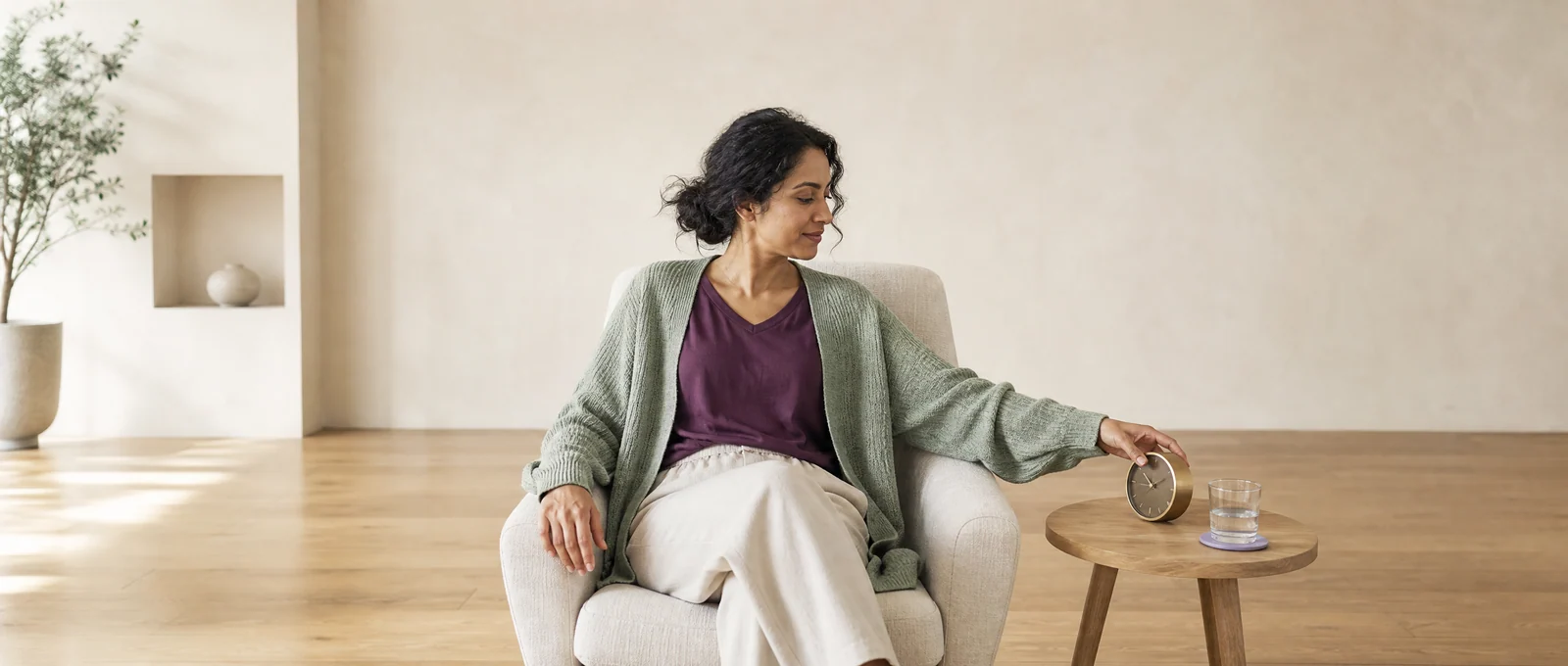
Find a comfortable position and let your breathing stay gentle. If it feels okay, watch the seconds on a clock or timer and let one full in-and-out breath take roughly ten seconds. You don’t need to divide that time evenly between breathing in and out. Try it for up to five minutes, stopping sooner if you want to. There’s no need to force a bigger breath or hold your breath between breaths.
This is a way to try the slow-breathing pace described in research: approximately six breaths a minute for 5-15 minutes. It isn’t a target you have to meet. If following the clock makes you strain, stop following it and let your breathing return to its usual pattern. 4
Or leave the pace alone
If counting seconds draws too much attention to your breathing, skip the clock. Sit comfortably and notice a few ordinary breaths without trying to make them slower or deeper. Then carry on with what you were doing, or stop noticing your breath if that feels better. This is an unpaced alternative for a moment when a set rhythm doesn’t suit you, not a technique proven to work as well as paced breathing for anxiety. Natural breathing has been used as a comparison condition in breathing research. 3
Choose based on what feels manageable, rather than on a promise that one method will work best. In a systematic review of 19 adult studies using varied breathing exercises, 12 reported significant improvements in anxiety. Evidence from large randomized trials remains limited, so that result doesn’t tell us which exercise is best for you. 2
If focusing on your breath feels worse, stop
Anxiety can come with a pounding or rapid heartbeat, dizziness, or shortness of breath. 1 If focusing on your breath feels unsettling, stop and breathe normally. You don’t have to push through discomfort to make an exercise work. If you feel lightheaded, more tense, or distressed while practicing, leave the exercise there. That includes a moment of panic: if attention to your breathing intensifies the distress, you don’t need to keep doing it.
If you’re pregnant or have a respiratory or cardiac condition, don’t assume a generic breathing pace is right for you. This research doesn’t establish a suitable pace for those circumstances. Ask your care team for guidance if you’re unsure what feels appropriate, particularly if breathing symptoms are already part of your day.
Know what this tool can and can’t do
A breathing exercise may offer a way to settle during an anxious moment. It isn’t a test of whether you can control anxiety, and it shouldn’t delay care when anxiety is taking over daily life. Anxiety disorders can persist, worsen, and interfere with work, relationships, or other activities. Psychotherapy, medication, or both are established treatment options. 1
A useful question after trying a practice is simply: Did that feel comfortable, and did it help me in this moment? If not, you’re free to choose another way to respond to anxiety.
Choose a comfortable breathing try
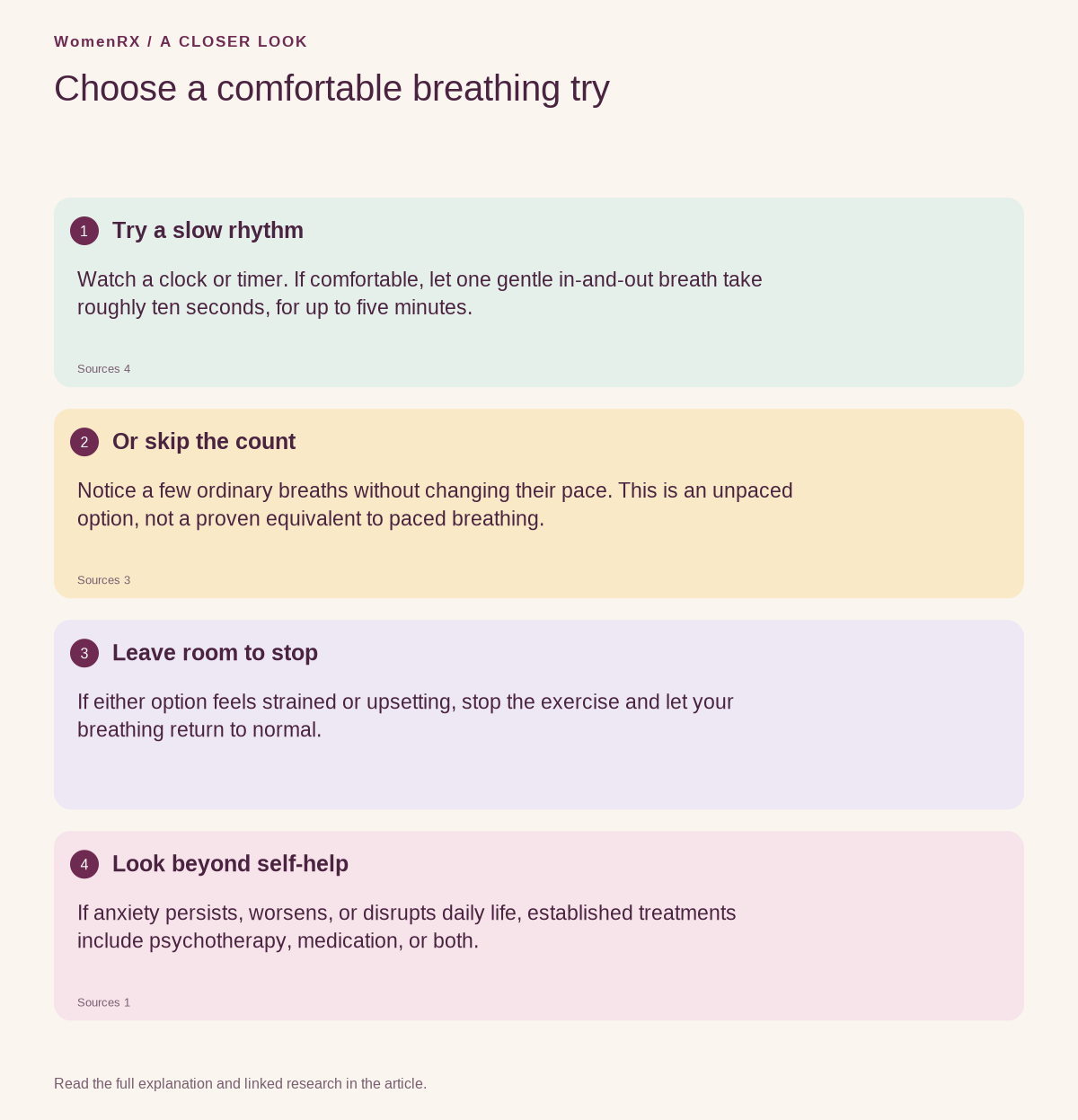
Try a slow rhythm: Watch a clock or timer. If comfortable, let one gentle in-and-out breath take roughly ten seconds, for up to five minutes.4
Or skip the count: Notice a few ordinary breaths without changing their pace. This is an unpaced option, not a proven equivalent to paced breathing.3
Leave room to stop: If either option feels strained or upsetting, stop the exercise and let your breathing return to normal.
Look beyond self-help: If anxiety persists, worsens, or disrupts daily life, established treatments include psychotherapy, medication, or both.1
Read the figure as text
Start with the option that asks less of you. Neither requires a device or breath-holding.- Try a slow rhythm: Watch a clock or timer. If comfortable, let one gentle in-and-out breath take roughly ten seconds, for up to five minutes.4
- Or skip the count: Notice a few ordinary breaths without changing their pace. This is an unpaced option, not a proven equivalent to paced breathing.3
- Leave room to stop: If either option feels strained or upsetting, stop the exercise and let your breathing return to normal.
- Look beyond self-help: If anxiety persists, worsens, or disrupts daily life, established treatments include psychotherapy, medication, or both.1
Sources you can check
- Anxiety: MedlinePlusAccessed 2026-09-25Return to first citation
- A Systematic Review of Breathing Exercise Interventions: An Integrative Complementary Approach for Anxiety and Stress in Adult Populations.Morgan SP, Lengacher CA, Seo Y. · Journal of holistic nursing : official journal of the American Holistic Nurses' Association · 2025Return to first citation
- Virtual Reality Breathing Interventions for Mental Health: A Systematic Review and Meta-Analysis of Randomized Controlled Trials.Cortez-Vázquez G, Adriaanse M, Burchell GL, Ostelo R, Panayiotou G, Vlemincx E. · Applied psychophysiology and biofeedback · 2024Return to first citation
- Resonant breathing in hospitalised psychiatric patients with persistent somatic symptoms: a randomised controlled trial.Canazei M, Hüfner K, Sperner-Unterweger B, Lampe A, Weninger J, Staggl S, Dresen V, Weiss E. · General psychiatry · 2025Return to first citation