Anxiety Coping Skills: Match the Tool to the Moment
A useful coping skill depends on whether you need to settle, make a decision, or get support for anxiety that keeps interfering with life.
If anxiety feels physical, try comfortable, unforced breathing. If your thoughts are racing, bring your attention to what’s around you. If one solvable issue is driving the worry, choose a small next step. None of these has to make anxiety disappear to be useful. When anxiety persists, feels overwhelming, or disrupts daily life, consider treatment such as cognitive behavioral therapy (CBT). 12
Start with what you need right now
Anxiety isn’t always a sign that something is wrong. It can show up before a difficult conversation or decision. But anxiety that doesn’t go away, grows more overwhelming, or interferes with work and relationships deserves a different response than a passing stressful moment. 1
Ask yourself: Do I need to settle my body, return my attention to the present, or deal with a specific problem? That question won’t diagnose anything. It simply helps you pick a tool that fits the moment instead of trying every technique at once.
If your body feels keyed up, try a gentle pause
Anxiety can come with tension, sweating, restlessness, or a rapid heartbeat. 1 If slowing your breathing feels comfortable, you might let your breaths become a little easier and less hurried. There’s no need to force a deep breath or aim for a particular count. If focusing on your breath feels unpleasant, choose another way to pause.
Breathing is a coping option, not a reliably instant fix. In one randomized trial, 53 Latino adults with both asthma and panic disorder received either a program combining CBT, asthma education, and biofeedback or a music-and-relaxation program that included paced breathing. Both groups improved on several measures from before treatment to after treatment and a three-month follow-up. Because paced breathing was only one part of a program, the study doesn’t tell us what it would do on its own for everyday anxiety. 2
There’s another reason not to treat every physical sensation as anxiety: panic and asthma symptoms can be confused. If you have a condition that can cause similar sensations and you’re unsure what’s happening, don’t use a calming exercise to decide that the symptoms are harmless. 2
If your thoughts are racing, give your attention somewhere to land
Try noticing a few ordinary details around you: the feel of your feet on the floor, sounds in the room, or objects you can see. This is a grounding exercise. Its immediate purpose is modest: to give your attention something concrete to return to, not to prove that a worry is unfounded or make a feeling vanish.
Mindfulness is used within some structured therapies for anxiety disorders, including acceptance and commitment therapy. That doesn’t establish that a brief grounding exercise, by itself, treats an anxiety disorder. 1 If paying attention to your surroundings helps you continue with what matters next, that can be enough for this moment.
If there’s a solvable problem, choose one next step
Sometimes worry keeps replaying a real task. Rather than asking yourself to stop worrying, separate what you can act on from what you can’t settle right now. For example, if a conversation is coming up, you could write down the one point you want to make. If the issue is an appointment you need to arrange, the next step might simply be finding the contact information.
That’s a practical way to use problem-solving, not a claim that a short exercise treats generalized anxiety disorder. A small pilot studied a six-session problem-solving therapy in 16 adults aged 58 to 83 with generalized anxiety disorder. Twelve of the 14 people who completed treatment had a clinically significant reduction in anxiety or worry, but the study had no comparison group and tested a structured therapy, not a single do-it-yourself step. 3
If the problem isn’t yours to solve alone, your next step might instead be asking for help. A caregiving responsibility, for example, may leave little quiet time for a lengthy exercise. Pick a step that fits the time and support you actually have.
If anxiety keeps taking up space, add support
A coping skill can help with a moment without addressing a recurring pattern. If fear or worry persists, feels overwhelming, or starts limiting your work, relationships, or daily activities, consider talking with a mental health care provider about treatment. Psychotherapy, medication, or both are main treatments for anxiety disorders. CBT can address patterns of thinking and behavior and may include exposure therapy for things you’ve begun avoiding. 1
Structured support can also be adapted to a demanding life. In a randomized study of 120 caregivers of people with primary malignant brain tumors, a six-session telehealth CBT-based program improved anxiety symptoms compared with usual care at 11 weeks. That result applies to a specific caregiver group and a multi-session program, not to any one coping tip. 4
If you’re pregnant, postpartum, or noticing that anxiety seems to vary across your menstrual cycle, you can bring that context into a conversation about support. Those circumstances don’t automatically explain your anxiety, and you don’t have to work out the cause before asking for help. The useful question is whether your current tools and available support are enough for the life you’re living.
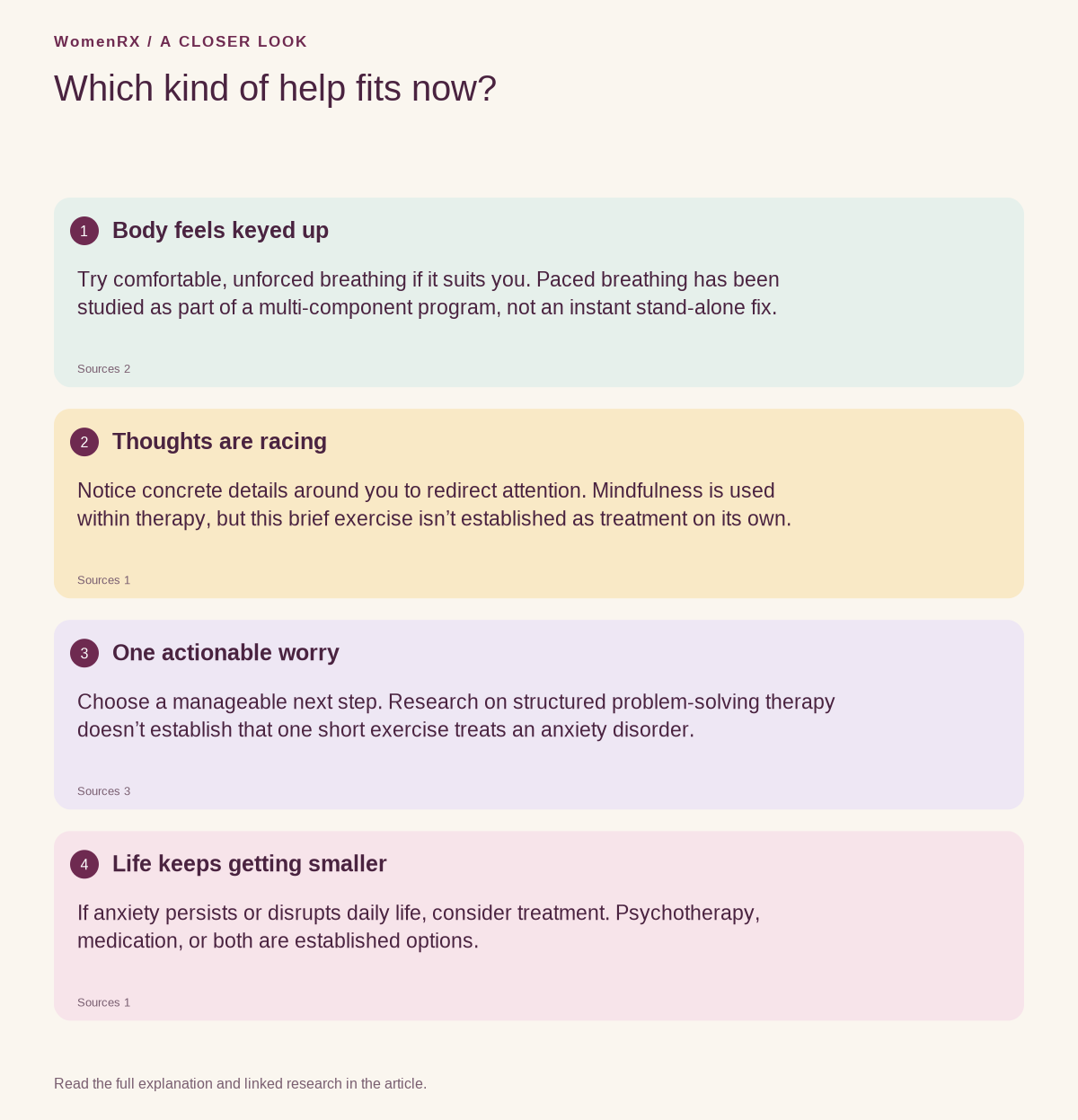
Which kind of help fits now?
Body feels keyed up: Try comfortable, unforced breathing if it suits you. Paced breathing has been studied as part of a multi-component program, not an instant stand-alone fix.2
Thoughts are racing: Notice concrete details around you to redirect attention. Mindfulness is used within therapy, but this brief exercise isn’t established as treatment on its own.1
One actionable worry: Choose a manageable next step. Research on structured problem-solving therapy doesn’t establish that one short exercise treats an anxiety disorder.3
Life keeps getting smaller: If anxiety persists or disrupts daily life, consider treatment. Psychotherapy, medication, or both are established options.1
Read the figure as text
Use the nature of the anxious moment to choose a starting point, then notice when a momentary skill isn’t enough.- Body feels keyed up: Try comfortable, unforced breathing if it suits you. Paced breathing has been studied as part of a multi-component program, not an instant stand-alone fix.2
- Thoughts are racing: Notice concrete details around you to redirect attention. Mindfulness is used within therapy, but this brief exercise isn’t established as treatment on its own.1
- One actionable worry: Choose a manageable next step. Research on structured problem-solving therapy doesn’t establish that one short exercise treats an anxiety disorder.3
- Life keeps getting smaller: If anxiety persists or disrupts daily life, consider treatment. Psychotherapy, medication, or both are established options.1
More questions, answered
What if a breathing exercise makes me feel worse?
You can stop and try a different way to pause, such as noticing what’s around you. Breathing isn’t a required skill, and the cited trial studied paced breathing within a larger program for adults with both asthma and panic disorder, not as a stand-alone solution for everyone. 2
Sources you can check
- Anxiety: MedlinePlusAccessed 2026-09-25Return to first citation
- Psychological treatment of comorbid asthma and panic disorder in Latino adults: Results from a randomized controlled trial.Feldman JM, Matte L, Interian A, Lehrer PM, Lu SE, Scheckner B, Steinberg DM, Oken T, Kotay A, Sinha S, Shim C. · Behaviour research and therapy · 2016Return to first citation
- Emotion-centered problem solving therapy for generalized anxiety disorder: a single-arm pilot study with middle-aged and older adults.Beaudreau SA, Otero MC, Lutz JA, Gould CE, Cassidy Eagle E, Suresh M, Kramer A, Wetherell JL, Warren SL, Mashal NM. · Aging & mental health · 2026Return to first citation
- Improved coping and self-efficacy drive improvements in mood among caregivers of patients with primary malignant brain tumors: Results from a randomized controlled trial.Willis KD, Forst DA, Horick N, Strander SM, Whitman J, Corveleyn A, Sannes T, Temel JS, Greer JA, El-Jawahri A, Jacobs JM. · Neuro-oncology · 2026Return to first citation