What to Expect From DBT: Skills, Structure, and Fit
DBT can mean a structured treatment program or skills training on its own, so ask what the specific offering includes before deciding whether it fits.
A comprehensive DBT program can include individual therapy, group skills training, between-session phone coaching, and a therapist consultation team. Skills-only programs focus on teaching DBT skills without necessarily providing those other components. Skills-only training has shown benefit in some specific settings, but that does not establish it as equivalent to a full DBT program. Ask which components are offered and what support is available between sessions. 1

First, find out what “DBT” means here
Dialectical behavior therapy (DBT) is a structured approach that helps people build skills for handling intense emotions and difficult situations. But a program described as “DBT” may not include every part of comprehensive DBT. Standard DBT can include individual therapy, group skills training, between-session phone coaching, and a therapist consultation team. Some services instead offer skills training on its own. 1
That difference matters when you’re weighing a referral. A skills group may teach useful strategies, but it doesn’t automatically provide individual therapy, coaching, or the coordination of a treatment team. Ask the provider to describe the actual program, rather than relying on the label.
What skills training may focus on
DBT skills training can address areas such as mindfulness, emotion regulation, and managing distress. In a randomized trial in China, 196 people with mental disorders and nonsuicidal self-injury were assigned to 13 weeks of DBT skills training or a social-support group. The skills-training group had a greater reduction in nonsuicidal self-injury behaviors. Both groups improved in self-injury thoughts, suicidal ideation and attempts, and depression, with no significant between-group differences on those outcomes. 1
That study supports skills training for a particular group and setting; it doesn’t show that every skills-only course works the same way or that it can replace a comprehensive program. A separate, nonrandomized study of 123 university students found preliminary improvements after online or in-person skills training. The researchers said further controlled studies are needed to establish effectiveness and clarify the role of delivery format. 3
What taking part may involve
If you’re considering comprehensive DBT, ask whether the offering includes individual sessions, a skills group, between-session coaching, and a therapist consultation team. If it’s skills-only, ask what happens when a situation comes up that you can’t manage with skills practice alone, and whether the group is connected to any individual care. These questions make clear what support you can expect without assuming every program uses the same schedule or structure.
It’s also reasonable to ask about time commitments and practical fit: how often sessions meet, how long the program runs, what attendance involves, and whether practice between sessions is expected. If work, caregiving, privacy, transportation, or scheduling could get in the way, bring that up while you compare options. These are practical questions about access and fit, not evidence that DBT works differently for women.
What outcome studies can tell you
DBT has been studied for specific concerns, including borderline personality disorder and self-harm. In a randomized trial of 204 Dutch outpatients with borderline personality disorder, DBT and schema therapy both showed substantial improvement, with no significant difference between treatments in the primary outcome. The trial included mostly women, but it did not establish whether outcomes differ by sex. This finding supports comparing treatment options rather than assuming DBT is the only fit. 2
A meta-analysis of 83 studies examined DBT outcomes in usual-care settings. In controlled studies, DBT had a significant effect on self-directed violence, but not on crisis-service use or suicidal ideation. The researchers found no difference in outcomes between usual-care and non-usual-care settings, while results varied substantially across studies. In uncontrolled studies, some delivery characteristics were associated with particular outcomes, but those associations don’t show that the characteristics caused the changes. 4
Questions that make a comparison clearer
- Is this comprehensive DBT or skills training only?
- Which treatment components are included, and who provides them?
- Is there support between sessions? If so, what does it cover?
- What is the expected schedule, duration, and attendance commitment?
- What concerns and goals is this program designed to address?
- If this format isn’t a fit, what other evidence-based options are available?
A useful next step is to get a clear description of the specific program and compare it with what you need help with. The name “DBT” alone doesn’t tell you how much support, or what kind, you’ll receive.
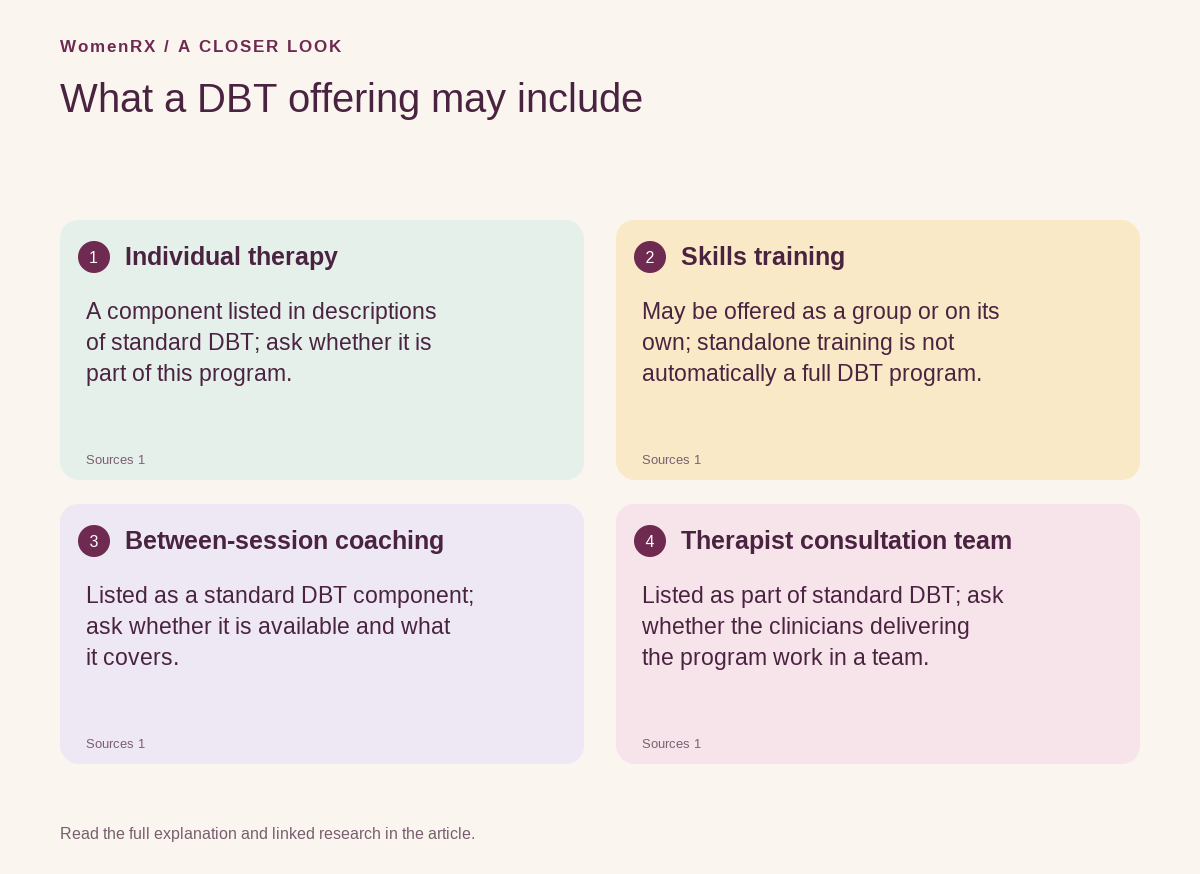
What a DBT offering may include
Individual therapy: A component listed in descriptions of standard DBT; ask whether it is part of this program.1
Skills training: May be offered as a group or on its own; standalone training is not automatically a full DBT program.1
Between-session coaching: Listed as a standard DBT component; ask whether it is available and what it covers.1
Therapist consultation team: Listed as part of standard DBT; ask whether the clinicians delivering the program work in a team.1
Read the figure as text
The DBT label alone doesn’t tell you which treatment components are part of a program. Use this comparison to ask what the specific offering provides.- Individual therapy: A component listed in descriptions of standard DBT; ask whether it is part of this program.1
- Skills training: May be offered as a group or on its own; standalone training is not automatically a full DBT program.1
- Between-session coaching: Listed as a standard DBT component; ask whether it is available and what it covers.1
- Therapist consultation team: Listed as part of standard DBT; ask whether the clinicians delivering the program work in a team.1
More questions, answered
Is DBT skills training the same as comprehensive DBT?
Not necessarily. Standard DBT can include individual therapy, group skills training, between-session phone coaching, and a therapist consultation team; skills training alone may not include those other components. Ask the provider to spell out what the program offers. 1
Does research show DBT works differently for women?
A randomized trial comparing DBT with schema therapy included mostly women, but it did not establish whether outcomes differ by sex. Its findings don’t tell us whether the treatments work differently for women than for men. 2
Sources you can check
- Effectiveness of 13-week dialectical behavior therapy skills training for non-suicidal self-injury: a multi-center randomized clinical trial in China.Ni F, Wu S, Liang M, Liu C, Zhang P, Zhang D, Rodriguez M, Glasenapp J, Yin C, Long J, Liu Y, Sun Y, Wu X, Liu G, Jiang X, Wang X, Lv H, Zhang Z, Wang S, Rosenthal Z, Wang C. · Psychological medicine · 2026Return to first citation
- Dialectical Behavior Therapy vs Schema Therapy for Patients With Borderline Personality Disorder: The BOOTS Multicenter Randomized Clinical Trial.Wibbelink CJM, Kamphuis JH, Sinnaeve R, Grasman RPPP, Alberts J, Alkema M, Dek ECP, Hupkes M, James C, Koppeschaar AM, Ploegmakers M, Schuur RJ, van Vliet M, Arntz A. · JAMA psychiatry · 2026Return to first citation
- Online and in-person Dialectical Behavior Therapy skills training for university students: a non-randomized comparative trial of feasibility and outcomes.Bani M, Zorzi F, Cavicchioli M, Russo S, Ardenghi S, Strepparava MG. · Journal of mental health (Abingdon, England) · 2026Return to first citation
- The Effectiveness of Dialectical Behavior Therapy in Reducing Self-Directed Violence and Suicidality in Usual Care Settings: A Meta-Analysis.Maxwell CA, Holland KE, Young L, Chen EY, Olino T, Kendall PC. · Journal of clinical psychology · 2026Return to first citation