When Anxiety Disrupts Life, What Are Your Options?
Anxiety treatment starts with understanding the pattern of your symptoms and checking whether something else may be contributing.
If worry, fear, or physical symptoms are interfering with daily life, an assessment can help clarify what’s happening before you choose a treatment. A clinician may ask about your symptoms and health history and consider an exam or tests for other health causes. Focused psychotherapy, medication, or both are main options; support groups and stress-management techniques may help too. 1
The pattern matters more than the label you give it
Anxiety before a difficult conversation or a big decision is a normal response to stress. Anxiety that doesn’t let up, feels overwhelming, or interferes with work, relationships, or daily activities deserves a closer look. It can feel physical as well as emotional: restlessness, tension, sweating, and a rapid heartbeat can all be part of it. 1
There’s no single known cause of anxiety disorders. Genetics, brain biology, stress, and environment may all play a role. And the same word, anxiety, can describe different patterns. Generalized anxiety disorder involves excessive worry about everyday matters on most days for at least six months. Panic disorder involves repeated, sudden episodes of intense fear. A phobia centers on a particular object or situation. Those distinctions matter because treatment can be focused on the fear or worry you’re actually experiencing. 1
Generalized anxiety disorder and phobias are more common in women, according to MedlinePlus, while social anxiety affects men and women equally. A population pattern doesn’t tell you what caused your symptoms or which treatment will work best for you. 1
What an assessment can sort out
Expect questions about your symptoms and medical history. A clinician may also consider a physical exam or lab tests to check for another health problem. Thyroid problems and heart rhythm problems are among the conditions that can be relevant when someone has anxiety symptoms. A racing heart shouldn’t automatically be written off as anxiety, even if you also feel afraid. 1
It helps to describe the effect, not just the feeling. For example, is worry taking up much of your day, are sudden episodes interrupting what you’re doing, or have you started avoiding a place or activity? Those examples point toward different patterns and give you and a clinician something concrete to work on. 1
If you’re pregnant or recently gave birth, say so when discussing symptoms and treatment. Research on a digital mindfulness program in pregnant women with diagnosed affective or stress-related disorders found improvement in some anxiety measures compared with usual care, but it was a secondary analysis whose primary outcome was depressive symptoms. It supports considering that kind of program as a possible addition to care, not assuming an app will treat every perinatal anxiety disorder. 3
Compare treatments by what they ask of you
Focused psychotherapy works on the thoughts, feelings, and behaviors connected to your particular anxiety. Cognitive behavioral therapy (CBT) teaches different ways to respond to situations that bring up fear or worry. It may include exposure therapy, which involves working toward facing things you’ve been avoiding. Acceptance and commitment therapy may help with some anxiety disorders as well. If avoidance is shrinking your life, ask what the proposed therapy would help you approach again. 1
Medication is another main option. Treatments include anti-anxiety medicines and certain antidepressants; different medicines may suit different anxiety disorders. Finding one that fits may involve trying more than one. Medication is a treatment discussion to have after looking at the symptom pattern and possible health contributors, not a substitute for that assessment. 1
Both together may be appropriate. Psychotherapy and medication aren’t competing explanations for whether your anxiety is “real.” They’re different ways of addressing it, and they can be used together. Support groups and stress-management techniques may also be helpful alongside a treatment plan. 1
A useful next question is: “What change would tell us this approach is helping?” Your answer might be less time spent worrying, fewer interruptions from sudden fear, or being able to do something you’ve avoided. That gives a follow-up conversation more substance than simply saying you feel better or worse. 1
If anxiety shows up around menopause
If you’re dealing with hot flashes around menopause, describe them separately from persistent worry or panic. The Menopause Society’s guidance identifies CBT among options for treating vasomotor symptoms such as hot flashes. That recommendation addresses vasomotor symptoms; it does not establish CBT as a treatment for an anxiety disorder in this context. 2
You don’t need to figure out which symptom came first before asking for help. Naming what’s happening, what it’s stopping you from doing, and any physical or reproductive-stage changes gives you a better starting point for choosing and reassessing care. 12
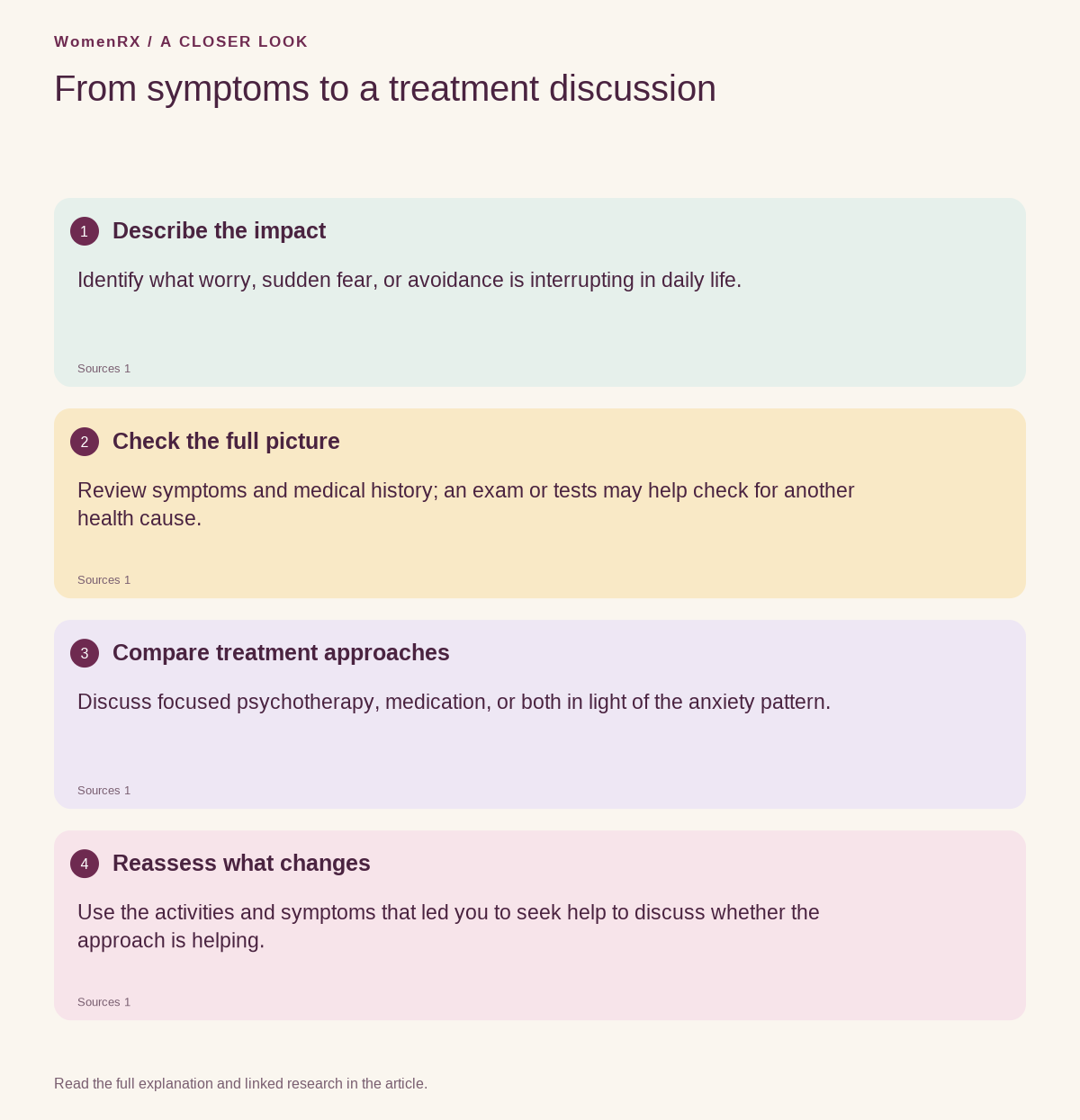
From symptoms to a treatment discussion
Describe the impact: Identify what worry, sudden fear, or avoidance is interrupting in daily life.1
Check the full picture: Review symptoms and medical history; an exam or tests may help check for another health cause.1
Compare treatment approaches: Discuss focused psychotherapy, medication, or both in light of the anxiety pattern.1
Reassess what changes: Use the activities and symptoms that led you to seek help to discuss whether the approach is helping.1
Read the figure as text
The useful next step is to connect anxiety’s effect on your life with an assessment and a treatment you can reassess.- Describe the impact: Identify what worry, sudden fear, or avoidance is interrupting in daily life.1
- Check the full picture: Review symptoms and medical history; an exam or tests may help check for another health cause.1
- Compare treatment approaches: Discuss focused psychotherapy, medication, or both in light of the anxiety pattern.1
- Reassess what changes: Use the activities and symptoms that led you to seek help to discuss whether the approach is helping.1
More questions, answered
Do physical symptoms mean it’s definitely anxiety?
No. Anxiety can cause symptoms such as sweating, tension, and a rapid heartbeat, but an assessment may include an exam or tests to check for another health cause. 1
Does choosing therapy mean ruling out medication?
No. Psychotherapy, medication, and a combination are all main treatment approaches for anxiety disorders. The discussion can be shaped by your symptom pattern and how you respond to an initial approach. 1
Sources you can check
- Anxiety: MedlinePlusAccessed 2026-09-25Return to first citation
- The 2023 nonhormone therapy position statement of The North American Menopause Society.Menopause (New York, N.Y.) · 2023Return to first citation
- Digital Mindfulness Intervention for Pregnant Women With Affective Disorders and Acute Stress Reactions: Prespecified Secondary Analysis of a Randomized Controlled Trial.Haßdenteufel K, Müller M, Multmeier J, Abele H, Brucker SY, Zipfel S, Graf J, Bauer A, Jakubowski P, Pauluschke-Fröhlich J, Wallwiener M, Wallwiener S. · Journal of medical Internet research · 2026Return to first citation