When Worry Starts Taking Over Your Day
Worry that spreads across everyday concerns, keeps returning, and disrupts your life deserves more than a reminder to relax.
Generalized anxiety disorder (GAD) involves excessive worry about several ordinary parts of life, such as health, money, work, or family, on most days for at least six months. The worry can interfere with daily life, but a symptom list can’t tell you whether GAD is the cause. An assessment looks at the pattern, its impact, and other possible explanations before you choose support. 3

The difference is the pattern, not the subject
It makes sense to worry about an overdue bill or a family member’s health. Anxiety can be a normal response to a stressful situation. With GAD, the concerns may be just as ordinary, but the worry is excessive, ranges across areas of life, and occurs almost every day for at least six months. Anxiety disorders can also interfere with work, school, relationships, and other daily activities. 3
A useful question isn’t simply, “Do I worry?” It’s, “What happens after I’ve dealt with one concern?” For example, you might resolve a work problem but find your attention pulled immediately toward money, then health, then family. That example isn’t a diagnosis. It illustrates why the spread and persistence of worry matter more than whether any one concern is reasonable. 3
Stress can last a long time, too, especially when demands involving work, family, or money don’t let up. Trouble sleeping, headaches, stomach problems, and feeling easily upset can accompany prolonged stress. Those experiences alone don’t settle whether you have GAD. The distinction calls for a closer look at what you’re worrying about, how often it happens, and how it affects your life. 53
What else might you notice?
Anxiety isn’t only a thought. It can come with restlessness or tension, a rapid or pounding heartbeat, dizziness, unexplained aches, or shortness of breath. Some people begin avoiding activities they used to do. These are symptoms seen across anxiety disorders, not signs that identify GAD on their own. Caffeine, other substances, and certain medicines can make anxiety symptoms worse. 3
The shape of the fear can help clarify what’s going on. Panic disorder involves sudden, repeated episodes of intense fear. A phobia centers on a particular object or situation. GAD is characterized instead by excessive worry across ordinary concerns. These conditions aren’t interchangeable, even though their physical symptoms can overlap. 3
What an assessment actually looks at
You can start with a primary care clinician. Expect questions about your symptoms and medical history, including how worry affects your day. A physical exam or lab tests may help check whether another health condition is contributing; thyroid problems and heart rhythm problems are among the physical conditions associated with anxiety symptoms. A psychological evaluation may follow, either with that clinician or a mental health professional. 3
You may also be asked to complete the GAD-7, a short questionnaire about anxiety symptoms. It’s a screening measure, not a stand-alone diagnosis. That’s why a conversation about the pattern of worry, its effect on daily life, and possible other causes still matters, whatever the score. 43
Support can be matched to what’s happening
The main treatments for anxiety disorders are talk therapy, medication, or both. Cognitive behavioral therapy (CBT) teaches ways to change how you respond to anxious thoughts and situations. Medication options include certain antidepressants and anti-anxiety medicines; finding a good fit can take discussion and sometimes more than one try. Support groups and stress-management techniques may also help alongside treatment. 3
The practical choice isn’t between “handling it yourself” and taking medication. You can discuss what you most want to change, such as being able to concentrate at work or participate in plans you’ve begun avoiding, and which approach fits your symptoms and circumstances. If you’re using caffeine, substances, medicines, or supplements, bring those into the conversation because they may affect symptoms or treatment choices. 32
If you’re pregnant or postpartum
Pregnancy and the months after birth can make the line between understandable concern and excessive worry harder to judge. A clinical review of perinatal GAD identifies this distinction as a particular challenge and describes treatment choices as depending on symptom severity. It discusses CBT, relaxation, and mindfulness approaches for milder symptoms, and medication and CBT, separately or together, for more severe symptoms. That review was published in 2015, so it shouldn’t be used as a personal medication plan. 6
Tell the person assessing you if you’re pregnant, recently gave birth, or breastfeeding, so those circumstances can be part of the treatment discussion. If you’re postpartum and feel extremely sad or unable to care for yourself or your baby, say so promptly: postpartum depression also needs attention and shouldn’t be assumed to be GAD. 61
You don’t have to decide whether your worry meets a diagnostic label before seeking help. If it keeps returning across parts of your life or is getting in the way of what you need to do, that’s enough reason to ask for an assessment. 3
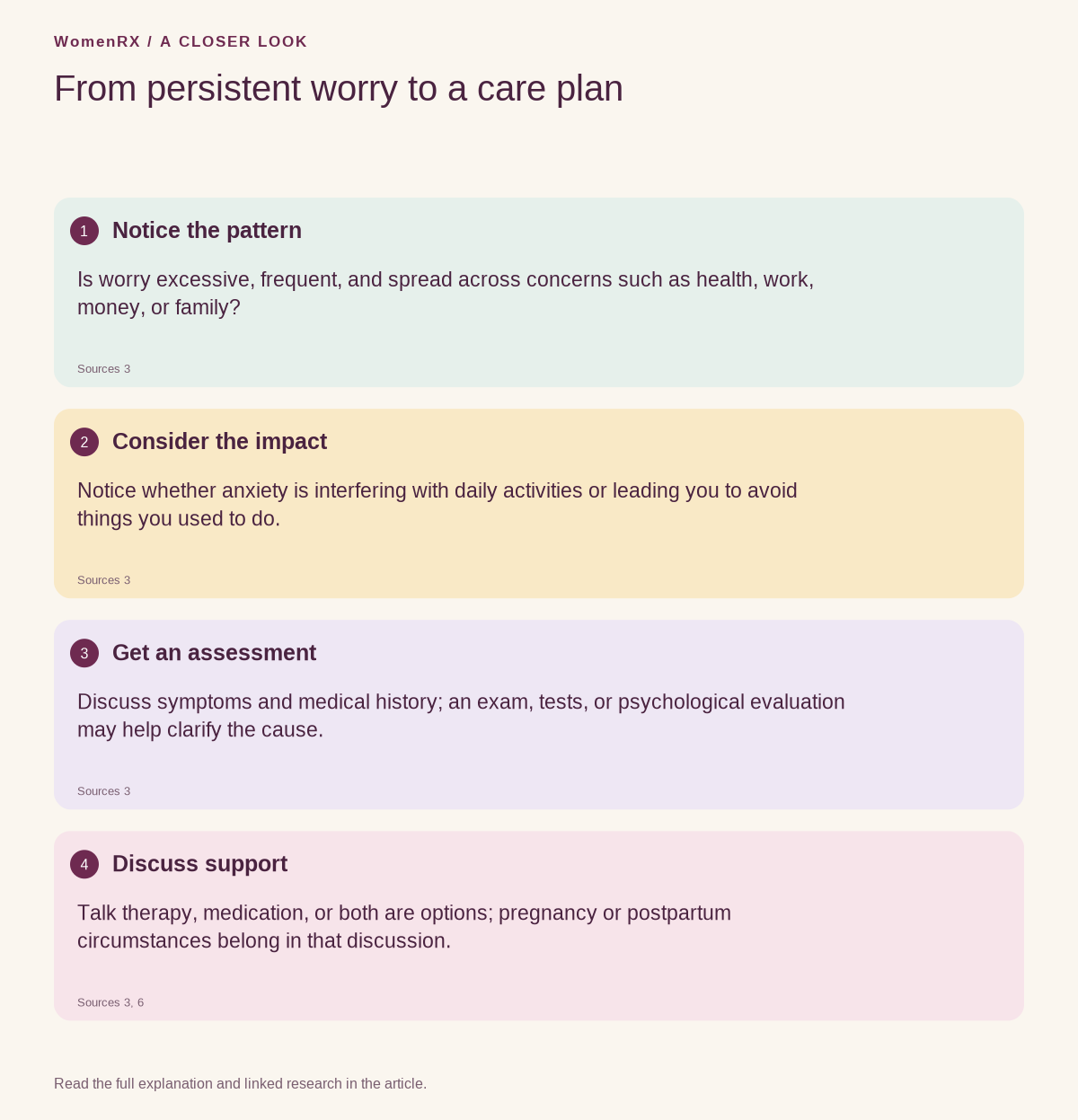
From persistent worry to a care plan
Notice the pattern: Is worry excessive, frequent, and spread across concerns such as health, work, money, or family?3
Consider the impact: Notice whether anxiety is interfering with daily activities or leading you to avoid things you used to do.3
Get an assessment: Discuss symptoms and medical history; an exam, tests, or psychological evaluation may help clarify the cause.3
Discuss support: Talk therapy, medication, or both are options; pregnancy or postpartum circumstances belong in that discussion.36
Read the figure as text
This flow shows what to consider when worry is starting to affect everyday life. It is not a diagnostic test.- Notice the pattern: Is worry excessive, frequent, and spread across concerns such as health, work, money, or family?3
- Consider the impact: Notice whether anxiety is interfering with daily activities or leading you to avoid things you used to do.3
- Get an assessment: Discuss symptoms and medical history; an exam, tests, or psychological evaluation may help clarify the cause.3
- Discuss support: Talk therapy, medication, or both are options; pregnancy or postpartum circumstances belong in that discussion.36
More questions, answered
Can a GAD-7 score tell me if I have generalized anxiety disorder?
No. The GAD-7 screens for anxiety symptoms. A diagnosis also calls for an assessment of your symptoms and history, their effect on daily life, and whether another health problem may be contributing. 43
Sources you can check
- Postpartum Care: MedlinePlusAccessed 2026-09-25Return to first citation
- Ashwagandha: Is it helpful for stress, anxiety, or sleep? - Health Professional Fact SheetAccessed 2026-09-25Return to first citation
- Anxiety: MedlinePlusAccessed 2026-09-25Return to first citation
- Cross-cultural validity of the generalized anxiety disorder 7-item scale (GAD-7): a systematic review and standardized assessment.Mantzari A, Botella-Juan L, Yadav P, Lavelle G, Henriques A, Munblit D, Ronaldson A, Dregan A, Bakolis I, Pinto da Costa M, Viana MC, Marcos-Delgado A, Molina AJ, Martín V, Valdera... · Epidemiology and psychiatric sciences · 2026Return to first citation
- Stress: MedlinePlusAccessed 2026-09-25Return to first citation
- Perinatal Generalized Anxiety Disorder: Assessment and Treatment.Misri S, Abizadeh J, Sanders S, Swift E. · Journal of women's health (2002) · 2015Return to first citation