When Health Worry Starts Taking Over Your Day
The clearest sign isn’t how often you check a symptom, but whether fear and reassurance-seeking are disrupting your life.
Health worry may be becoming a problem when fear of serious illness keeps returning, checking or reassurance brings only brief relief, and the cycle takes time away from work, relationships, or ordinary activities. That pattern doesn’t prove a diagnosis, and it doesn’t mean a physical symptom should be dismissed. Medical assessment and mental health support can address different parts of the problem. 1 2

The cycle that can keep worry going
A sensation catches your attention. You interpret it as a sign of serious illness, check your body or search online, and ask someone to reassure you. You may feel calmer for a while, but the relief fades. The doubt returns, so you check again. Health-anxiety research describes checking and reassurance-seeking as behaviors that can reinforce the worry cycle over time. 2 4
Online searching can become part of that loop when it’s compulsive, meant to settle fear, and instead leaves you more distressed. A systematic review found an association between excessive health-related searches and health anxiety, but also found that much of the research was descriptive and cross-sectional. Searching symptoms, by itself, doesn’t establish that you have health anxiety. 3
Look at the effect, not a single behavior
Checking your body, asking questions, or looking up a symptom can be reasonable at times. The more useful question is what the behavior is doing in your life. Does it repeatedly take up time? Does reassurance last only briefly? Are you avoiding activities or care because of fear, or making repeated requests for reassurance without feeling settled? These patterns matter more when they cause distress or interfere with daily activities. 1 2
Health anxiety can involve seeking care, avoiding it, or switching between the two. In qualitative interviews with 37 people who met criteria for illness anxiety disorder, 76% were women. Participants described physical symptoms, fear of missing an illness, reassurance-seeking, and past experiences with health professionals as influences on how they sought or avoided care. This small interview study helps illustrate varied experiences; it doesn’t show that women have a distinct pattern or establish how common the disorder is. 2
That distinction matters if you’re dealing with menstrual, pregnancy-related, postpartum, or menopause-related symptoms. The presence of health anxiety doesn’t show that a symptom is “just anxiety,” and symptom checking doesn’t tell you what caused it. Describe the physical change and the worry separately when seeking care, so neither gets lost. A clinician can assess the symptom, while mental health support can help with a persistent fear-and-checking cycle.
Support can address both the symptom and the fear
A good first step is an assessment that takes both your physical concerns and the anxiety seriously. You can explain what you’ve noticed, what you fear it means, what checking or reassurance you’ve tried, and how the pattern affects your day. That conversation isn’t a commitment to a particular diagnosis. Health anxiety can be difficult to distinguish from other concerns without an individual assessment.
If the pattern is affecting daily life, ask about therapy for anxiety, including cognitive behavioral therapy (CBT). CBT helps people notice and change troubling thoughts and behaviors; it may include practicing ways to face fears rather than avoiding them. Anxiety treatment can also include medication or a combination of medication and psychotherapy, depending on the person and the type of anxiety. 1
A practical arrangement can help keep physical care and anxiety support in view at the same time. For example, after discussing a symptom with a clinician, you might agree on what changes should prompt follow-up, rather than repeatedly seeking the same reassurance or deciding to avoid care altogether. The point isn’t to ignore new or changing symptoms; it’s to have a clearer plan and get support for the worry that keeps returning. Repeated care-seeking and care avoidance can both have costs, which is one reason an individualized plan matters. 2
You don’t need to be certain that your worry is “bad enough” before raising it. If fear is taking over time, relationships, work, or decisions about seeking care, that impact is worth discussing. The goal is not to prove that every sensation is harmless. It’s to respond to physical concerns thoughtfully while reducing the cycle that keeps fear in charge.
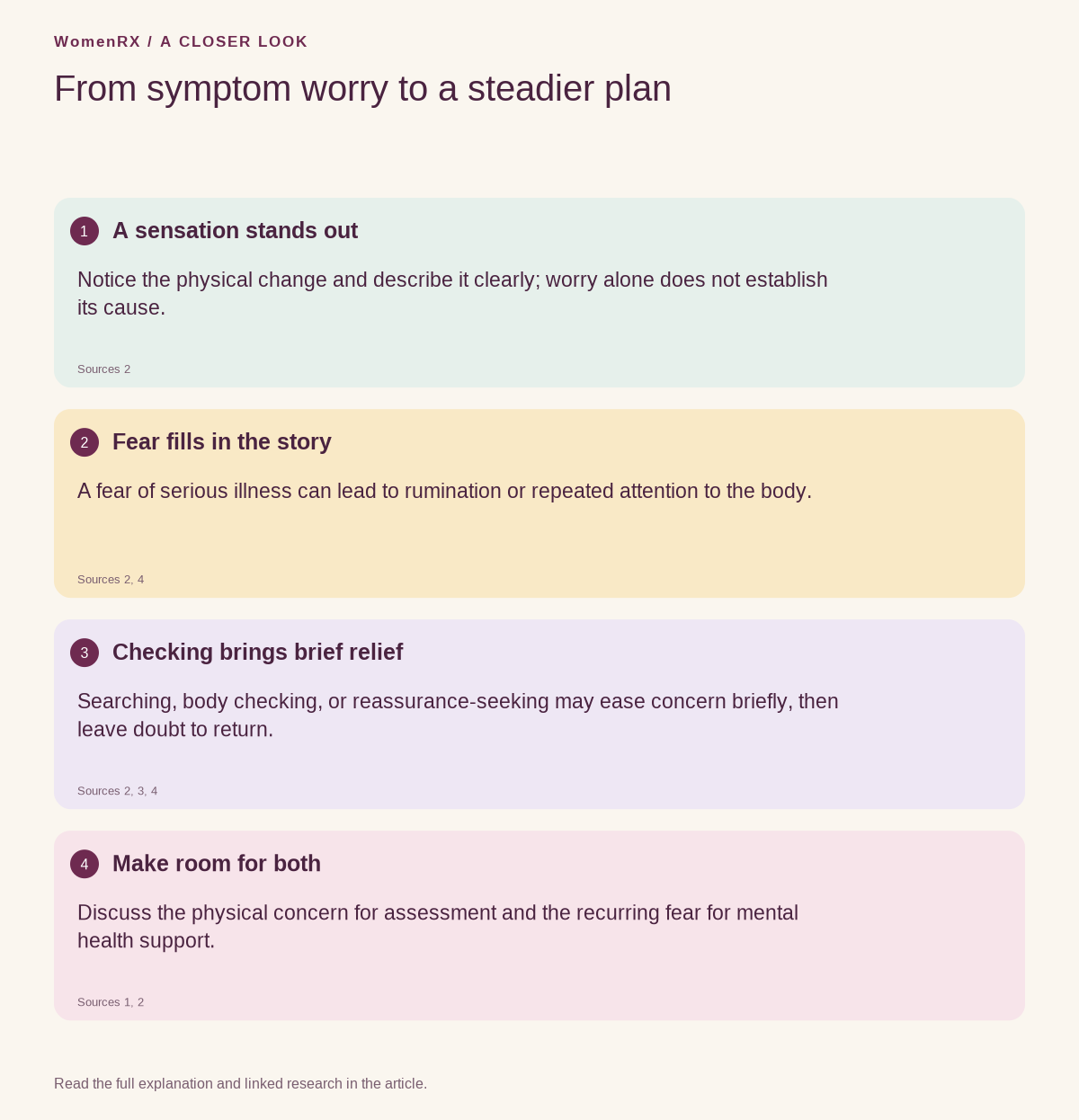
From symptom worry to a steadier plan
A sensation stands out: Notice the physical change and describe it clearly; worry alone does not establish its cause.2
Fear fills in the story: A fear of serious illness can lead to rumination or repeated attention to the body.24
Checking brings brief relief: Searching, body checking, or reassurance-seeking may ease concern briefly, then leave doubt to return.234
Make room for both: Discuss the physical concern for assessment and the recurring fear for mental health support.12
Read the figure as text
This flow shows how checking can briefly ease fear, why the worry may return, and where physical assessment and anxiety support can each help.- A sensation stands out: Notice the physical change and describe it clearly; worry alone does not establish its cause.2
- Fear fills in the story: A fear of serious illness can lead to rumination or repeated attention to the body.24
- Checking brings brief relief: Searching, body checking, or reassurance-seeking may ease concern briefly, then leave doubt to return.234
- Make room for both: Discuss the physical concern for assessment and the recurring fear for mental health support.12
More questions, answered
Does searching symptoms online mean I have health anxiety?
No. Searching alone doesn’t establish a diagnosis. It may be worth noticing if searching feels compulsive, is mainly an attempt to get reassurance, and leaves you more worried rather than settled. Research on this behavior is still limited. 3
Can someone with health anxiety also have a real physical problem?
Yes. Health worry doesn’t determine the cause of a symptom. Physical symptoms and past healthcare experiences can affect whether people seek or avoid care, so physical concerns and anxiety deserve to be considered separately. 2
Sources you can check
- Anxiety: MedlinePlusAccessed 2026-09-25Return to first citation
- Illness anxiety disorder: A qualitative study of people with health anxiety and their experiences seeking and avoiding medical care.Kikas K, Werner-Seidler A, Corkish B, Upton E, Holden M, Newby JM. · The British journal of clinical psychology · 2026Return to first citation
- Is cyberchondria a new transdiagnostic digital compulsive syndrome? A systematic review of the evidence.Vismara M, Caricasole V, Starcevic V, Cinosi E, Dell'Osso B, Martinotti G, Fineberg NA. · Comprehensive psychiatry · 2020Return to first citation
- Development and psychometric properties of the Health Anxiety Behavior Inventory (HABI).Hedman-Lagerlöf E, Björkander D, Andersson E, Axelsson E. · Behavioural and cognitive psychotherapy · 2024Return to first citation