What “High-Functioning Anxiety” Can Hide
You can keep meeting responsibilities and still feel persistently worried, tense, or worn down.
“High-functioning anxiety” can describe a contrast: you appear productive while feeling worried or tense. It isn’t a diagnosis you can determine from how much you accomplish. A more useful question is whether anxiety persists, feels overwhelming, or interferes with daily activities and relationships. 1
Looking capable doesn’t tell the whole story
You may finish the work, remember the appointments, and be the person others rely on, while spending much of your day bracing for something to go wrong. Here, “high-functioning anxiety” describes that contrast, not a clinical diagnosis. Being dependable doesn’t prove that your anxiety is harmless, just as feeling anxious doesn’t by itself mean you have a disorder.
Stress tends to pass; anxiety can stick around
Anxiety is a normal response to stress. Feeling tense before a difficult work conversation or an important decision can be uncomfortable and still temporary. It may even help you focus. Anxiety is more concerning when fear or worry doesn’t ease, feels overwhelming, or begins to interfere with daily life. 1
Notice the pattern rather than judging yourself for having a feeling. Is the worry tied to a particular pressure and easing as the situation changes? Or are you worrying excessively about ordinary concerns such as work, family, health, or money on most days? With generalized anxiety disorder, worry about ordinary issues is excessive and occurs almost every day for at least six months. That description is useful context, not a self-diagnosis test. 1
Check the cost, not just the output
A full calendar can hide strain. Notice whether you feel tense or restless, or whether fear or worry leads you to avoid situations or activities. Anxiety disorders can interfere with job performance, schoolwork, and relationships, even when you’re still completing many responsibilities. 1
A cross-sectional study of adults with post-COVID symptoms in Qatar also found greater functional impairment among participants with anxiety symptoms. That finding comes from a specific group and can’t show whether anxiety caused the impairment or establish the same pattern for everyone. 2
Caregiving demands or pressure to appear capable may be part of your circumstances. If so, ask yourself whether those expectations make it harder to notice your own distress or tell someone about it. That’s a question about your experience, not an established rule about women. Count the effect on your own day; meeting responsibilities isn’t the only measure of how you’re doing.
Getting support doesn’t require falling apart
If worry is persistent, hard to manage, or interfering with parts of life that matter to you, you can raise it with a mental health professional or another care provider. You don’t need to wait until you can’t function. It may help to describe what the worry is about, how often it shows up, what you avoid, and what it’s affecting. The goal is to explain the pattern, not to prove that you’re struggling enough.
Psychotherapy is one main treatment for anxiety disorders. Cognitive behavioral therapy, for example, works on how you respond to thoughts and situations that trigger fear; it may include gradually facing things you’ve been avoiding. Medication is another treatment option, and some people use therapy and medication together. The right approach depends on the person and the type of anxiety, so a discussion can start with what you’re experiencing and what you want help with. 1
You can be productive and still deserve support. The question isn’t whether you’re managing to keep up; it’s what keeping up is costing you.
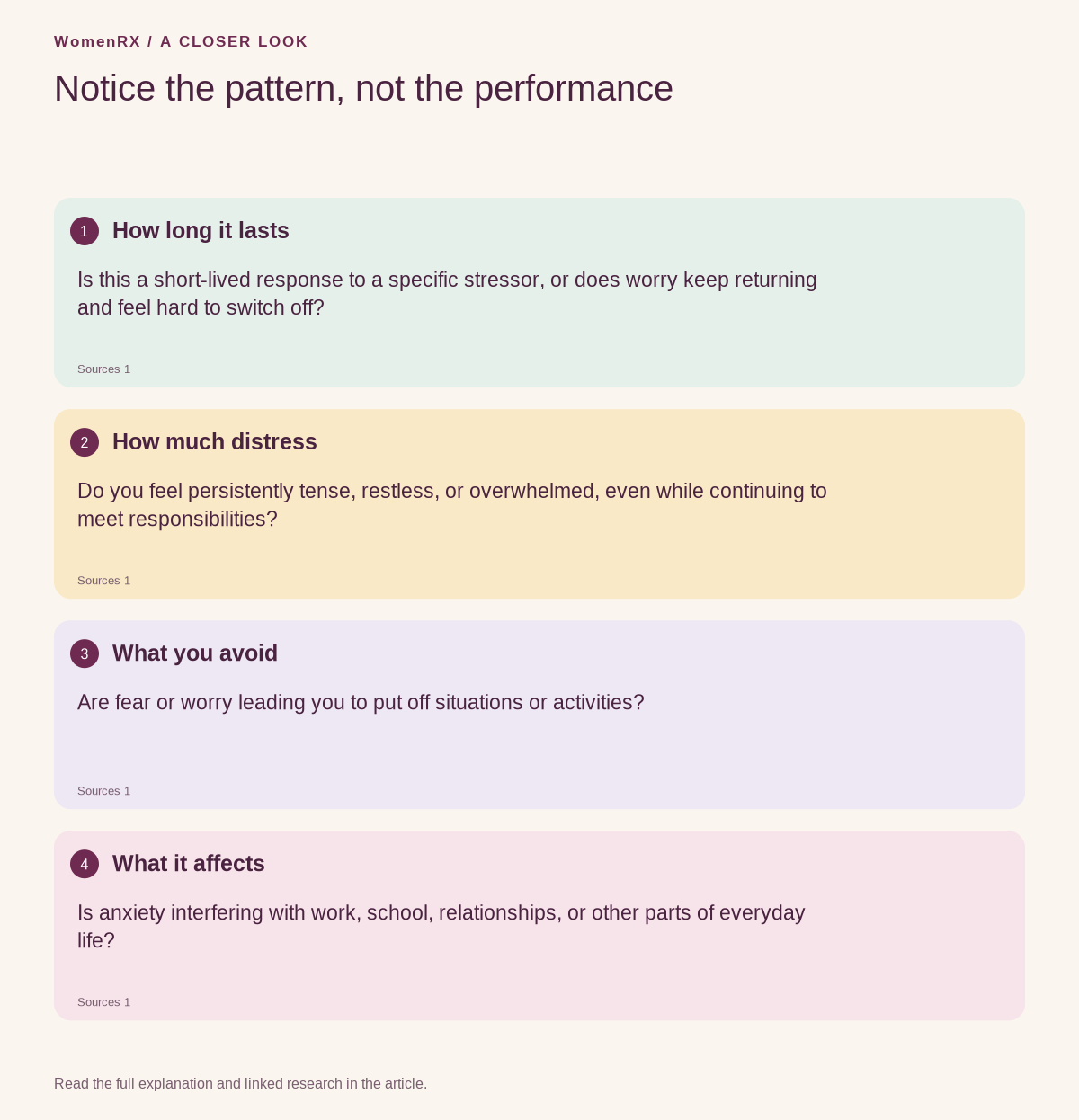
Notice the pattern, not the performance
How long it lasts: Is this a short-lived response to a specific stressor, or does worry keep returning and feel hard to switch off?1
How much distress: Do you feel persistently tense, restless, or overwhelmed, even while continuing to meet responsibilities?1
What you avoid: Are fear or worry leading you to put off situations or activities?1
What it affects: Is anxiety interfering with work, school, relationships, or other parts of everyday life?1
Read the figure as text
Use these prompts to describe what anxiety is like for you. They are reflection points, not a diagnostic checklist.- How long it lasts: Is this a short-lived response to a specific stressor, or does worry keep returning and feel hard to switch off?1
- How much distress: Do you feel persistently tense, restless, or overwhelmed, even while continuing to meet responsibilities?1
- What you avoid: Are fear or worry leading you to put off situations or activities?1
- What it affects: Is anxiety interfering with work, school, relationships, or other parts of everyday life?1
More questions, answered
Does being productive rule out an anxiety disorder?
No. Outward productivity doesn’t tell you whether you’re experiencing distress or whether anxiety is interfering with daily activities or relationships. 1
Does worrying mean I have generalized anxiety disorder?
Not necessarily. Anxiety can be a normal response to stress. Generalized anxiety disorder involves excessive worry about ordinary concerns almost every day for at least six months; that description alone isn’t a self-diagnosis test. 1
Sources you can check
- Anxiety: MedlinePlusAccessed 2026-09-25Return to first citation
- Post-COVID-19 anxiety and its impact on adults' health in Qatar in 2022.Adli N, Bala M, AlMesbah N, Ajabein M, Homaida M, Abuhashem MA, Mohamad N, Fayyaz T, Awad M, Kehyayan V, Al-Khenji AH, Al-Kuwari MG, Bougmiza I, Selim N. · Qatar medical journal · 2026Return to first citation