Can Desire Increase Immediately? What May Help in the Moment
If you’re hoping to feel interested in sex tonight, small changes to comfort and context may be worth trying, without any promise that desire will follow.
No option can guarantee that you’ll feel desire tonight, and you never owe anyone sex. If you’re curious about intimacy, try a small, reversible change: ask for privacy, say what sounds appealing, or agree to explore without a goal. This research doesn’t establish a same-night effect. If pain, dryness, or postpartum recovery is part of the picture, choose only what feels comfortable, or stop.
Think “make room,” not “make it happen”
Wanting to feel more interested in sex tonight is understandable. A change that feels inviting to one person may feel like pressure to someone else. Rather than aiming for a particular outcome, see whether anything feels welcome to you, while keeping it easy to change your mind.
Try one small adjustment at a time. You might ask for more privacy, put away a distracting phone, or tell a partner what kind of closeness sounds good. You could also agree that there’s no required next step: kissing, cuddling, touching, or stopping are all complete options. If nothing feels appealing, that’s an answer too.
These are low-pressure choices for comfort and connection; this research doesn’t establish that they increase desire the same night. In a study that followed people coping with persistent sexual interest or arousal difficulties and their partners, days when either partner reported more new and broadening experiences together than usual were also days when both reported feeling more partner responsiveness. That responsiveness was linked with higher desire and satisfaction and less sexual distress. The finding points to the possible value of feeling heard and cared for, but it doesn’t show that a particular conversation will create desire on demand. 5
Separate desire from the pressure to perform
A practical conversation can be brief: “I might be interested in closeness, but I don’t want it to come with expectations. Can we start slowly and check in?” Or: “I’m not feeling sexual tonight, but I would like to cuddle.” You don’t need to explain or negotiate your way out of sex.
If you’re on your own, you might choose something that feels pleasant or relaxing, or simply leave the question alone for tonight. A study of Spanish adults found associations between some masturbation-related measures and reported partnered arousal among women, but it was observational. It doesn’t show that masturbating will increase desire that night or work for everyone. 4
Let comfort set the limits
If sex feels uncomfortable, stop or change what you’re doing rather than trying to push through. Pain and lubrication are distinct parts of sexual function, and a trial involving women after unsuccessful fertility treatment measured both; it does not establish an instant fix for pain or dryness. 3
If you’re recovering after birth, experiencing vaginal dryness, or dealing with pain, you can choose intimacy that avoids discomfort, or decide not to be sexual. There’s no need to make penetration the goal. The right choice depends on what feels comfortable to you in that moment.
When tonight’s question may need a longer view
One evening without desire doesn’t by itself mean something is wrong. A different question arises when low desire or arousal is persistent and distressing. Research describes sexual interest/arousal disorder in those terms, rather than treating every variation in desire as a problem. 2
Desire can have more than one influence. MedlinePlus lists medicines, chronic illness, and fear of an unplanned pregnancy among factors that can affect sexual health. 1 If a change in desire keeps bothering you, consider whether it began alongside a medication or health change, or whether there’s a concern you’d like help addressing.
For tonight, the useful measure isn’t whether you managed to create desire. It’s whether you felt safe, comfortable, and free to choose what happens next.
A Low-Pressure Check-In for Tonight
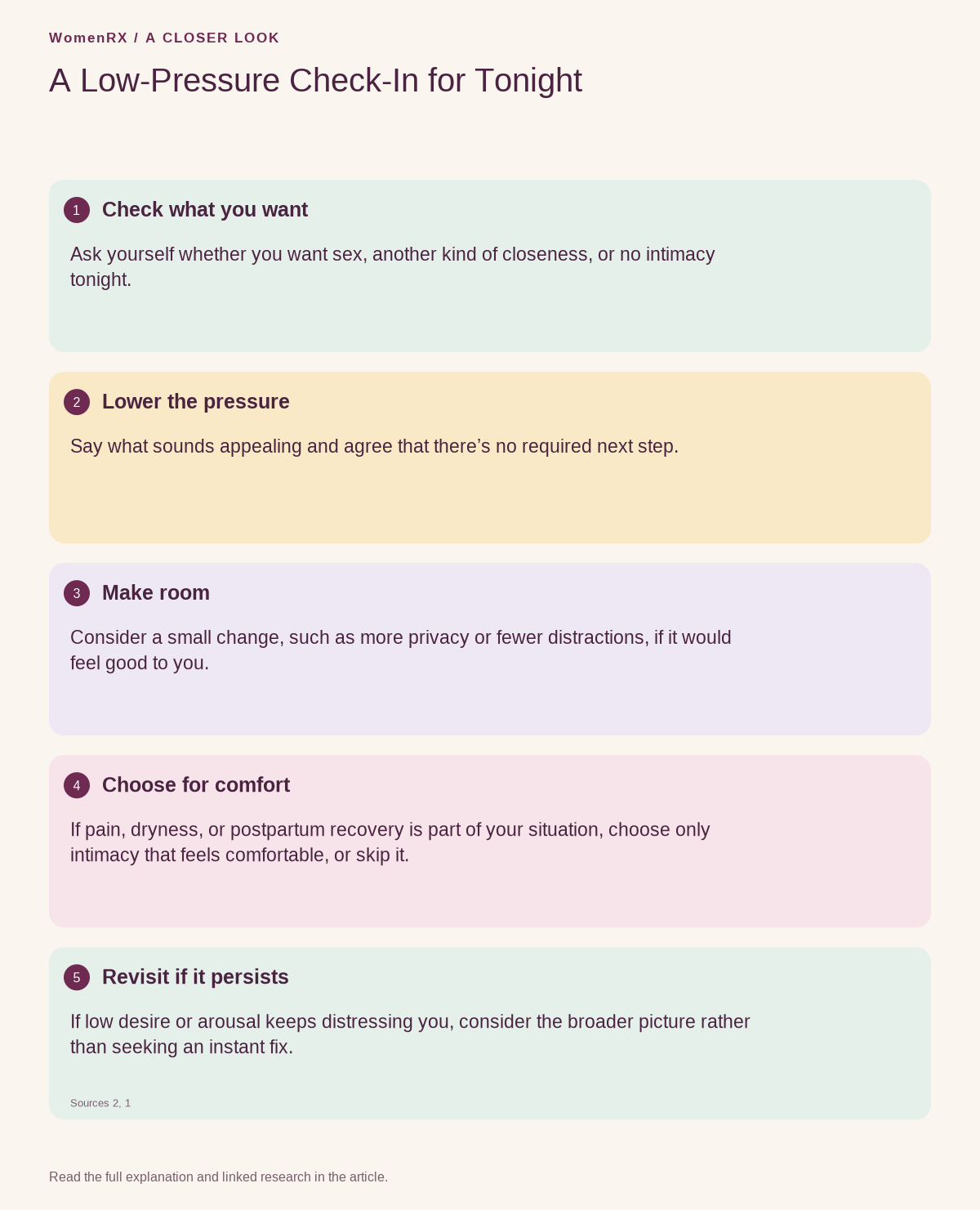
Check what you want: Ask yourself whether you want sex, another kind of closeness, or no intimacy tonight.
Lower the pressure: Say what sounds appealing and agree that there’s no required next step.
Make room: Consider a small change, such as more privacy or fewer distractions, if it would feel good to you.
Choose for comfort: If pain, dryness, or postpartum recovery is part of your situation, choose only intimacy that feels comfortable, or skip it.
Revisit if it persists: If low desire or arousal keeps distressing you, consider the broader picture rather than seeking an instant fix.21
Read the figure as text
Use these as optional choices, not steps you must complete. The point is to notice what feels welcome and keep the choice yours.- Check what you want: Ask yourself whether you want sex, another kind of closeness, or no intimacy tonight.
- Lower the pressure: Say what sounds appealing and agree that there’s no required next step.
- Make room: Consider a small change, such as more privacy or fewer distractions, if it would feel good to you.
- Choose for comfort: If pain, dryness, or postpartum recovery is part of your situation, choose only intimacy that feels comfortable, or skip it.
- Revisit if it persists: If low desire or arousal keeps distressing you, consider the broader picture rather than seeking an instant fix.21
More questions, answered
What if I start feeling interested but then change my mind?
You can stop or change course at any point. Choosing one kind of closeness doesn’t commit you to another, and you don’t owe a reason.
Does one night without desire mean I have a sexual problem?
Not by itself. The clinical description in the research concerns desire or arousal difficulties that are persistent and distressing, not simply one night when you aren’t interested. 2
Sources you can check
- Sexual Health | MedlinePlusAccessed 2026-09-25Return to first citation
- Helping with Outcomes for Low Desire (HOLD): Study protocol for a randomized clinical trial assessing a cognitive-behavioral couple therapy for sexual interest/arousal disorder.Shimizu JPK, Bouchard KN, Bergeron S, Girouard A, Popova N, Rosen NO. · Trials · 2026Return to first citation
- The effects of sexual counseling based on the EX-PLISSIT and BETTER models on female sexual function after assisted reproductive treatment failure: a randomized clinical trial.Rahimi Shandiz A, Karimi FZ, Mazloum SR, Masoumi R. · Journal of psychosomatic obstetrics and gynaecology · 2026Return to first citation
- Associations Between Solitary Masturbation Parameters and Sexual Arousal in Partnered Sexual Activity.Sánchez-Pérez GM, Sierra JC. · Behavioral sciences (Basel, Switzerland) · 2026Return to first citation
- Expanding together: How self-expansion and partner responsiveness shape sexual well-being in couples coping with sexual interest/arousal disorder.Rosen NO, Muise A, Huberman JS, Johnson M, Impett EA, Bergeron S. · Journal of psychopathology and clinical science · 2026Return to first citation