Low Sexual Desire: What May Help and What to Check First
Desire can change, and the most useful first step is to notice what else may have changed with it.
There’s no single “normal” level of sexual desire, and lower desire isn’t automatically a disorder. If a change bothers you, notice when it began and whether pain, a medicine or health change, mood, pressure, or relationship context may be involved. 1 5 6 If you feel safe doing so, you can tell a partner what feels comfortable and what feels pressured; you do not need to push through painful sex to increase desire. Pain and medicine changes call for clinical assessment rather than a generic libido booster. 1 3 6 If low desire remains distressing, care can address identified medical and psychological factors. For a diagnosed desire disorder, prescription treatments also exist, but they are not a substitute for working out what is contributing. 5 6 7 A “natural” label alone doesn’t show that a supplement improves desire; any claim of benefit needs evidence for that specific product.
Start with whether the change bothers you
Sexual desire varies from person to person and can shift over time. Lower desire on its own doesn’t mean something is wrong. Clinicians distinguish a desire concern from a level of interest someone else expects: a clinical disorder involves persistent or recurrent low desire associated with significant personal distress or interpersonal difficulty, and not better explained by another condition or medication. 5
That distinction matters. If your desire has changed but you feel okay about it, you may not need to make it a problem to solve. If it’s causing distress, curiosity about the cause is a reasonable next step. Desire, arousal, orgasm, and sexual pain can overlap, but they’re not interchangeable concerns. 3 6
Life stage can be part of that context. Sexual concerns can vary by age group, and hormonal changes are one possible factor. 6 If you noticed a change postpartum, around menopause, or at another time, note what else changed too. Neither transition, by itself, tells you why your desire changed.
A short checklist of what may have changed
Think about the timing and the context, rather than searching for one “libido” cause. You might jot down a few observations for yourself, or simply use them to guide a conversation.
- Medicines or health: Did the change begin around the time you started or changed a medicine, or as a health condition changed? Medicines and chronic conditions can affect sexual health. Depression and hormonal changes are also among the medical factors discussed in clinical reviews. Don’t assume a medicine is the cause, but do mention the timing when you discuss it. 1 6
- Comfort during sex: Is pain part of the picture? Pain is a distinct sexual-health concern and can occur alongside desire or arousal difficulties. If sex hurts, say so directly; focusing only on “boosting desire” could miss the issue that needs attention. 3 6
- Mood and pressure: Has your emotional well-being changed? Are you feeling anxious about sex or under pressure to respond a certain way? Psychological factors, including performance anxiety, can contribute to sexual concerns. 3 6
- Relationship context: Does your interest differ depending on the situation, or when there’s conflict or difficulty communicating? Relationship factors may matter, but a partner’s expectations don’t define whether your desire is a problem. 6 7
- Rest and daily demands: As a personal observation, notice whether desire seems different when you feel rested or less stretched. That can help you describe your experience, but it doesn’t establish sleep or workload as the cause.
This checklist isn’t a diagnostic test. More than one factor may be involved, and sometimes the reason isn’t obvious. A biopsychosocial approach considers the body, emotional well-being, and social or relationship context together instead of assuming a single cause. 4 7
Match the next step to the concern
If you feel safe doing so, you can tell a partner what feels welcome, what feels pressured, and whether you want to pause painful sex. A low-pressure conversation may clarify relationship strain, though it is not a guaranteed way to increase desire. 6 You can observe whether rest or daily demands seem to coincide with a change, without treating that pattern as a proven cause or a treatment. Pain or a change that followed a medicine calls for a different next step: assessment of that specific concern. 1 3 6
What may help depends on what’s contributing:
- If sex hurts, describe when it hurts and ask for the pain to be assessed as its own concern rather than pushing through it to increase desire. 3 6
- If the change followed a medicine or health change, bring the medicine name or describe the health change and when it happened. Ask a clinician to review possible contributors rather than guessing at a supplement. 1 6
- If anxiety, pressure, or relationship difficulties are prominent, a low-pressure conversation may help clarify expectations if you feel safe having one. Tell a clinician what feels prominent so psychological support can be considered alongside any relevant medical factors. 6 7
- If low desire continues to distress you without an obvious cause, ask about an assessment for a desire disorder. A clinician can consider treatment options in light of the full picture. 5 7
The approaches differ according to the concern: pain needs attention as pain; a medicine change merits a review of possible contributors; and prominent anxiety or relationship difficulties may call for psychological support alongside any relevant medical care. 1 3 6 7 For a diagnosed desire disorder, a clinical review names flibanserin as an FDA-approved treatment for HSDD and bremelanotide as an FDA-approved treatment for acquired, generalized HSDD in premenopausal women. Those are specific prescription options, not general-purpose ways to raise desire. 5
A “natural” label doesn’t establish whether a supplement improves desire. Without evidence for a particular product, it cannot be recommended as a proven way to increase desire. That is a different proposition from addressing an identified source of pain, a possible medication effect, or psychological distress. 1 3 6 7
When clinical support may be useful
Consider bringing it up with a primary care or women’s health clinician if the change is distressing, if it began alongside a health or medication change, or if pain is involved. You can say, “My desire has changed, and I’d like to look at possible contributors, including medication, health, and pain.” You don’t need to have a diagnosis or a perfect explanation before starting that conversation.
Assessment is not just about a score or how often you have sex. It should make room for your experience and consider relevant biological, psychological, and interpersonal factors. 2 7
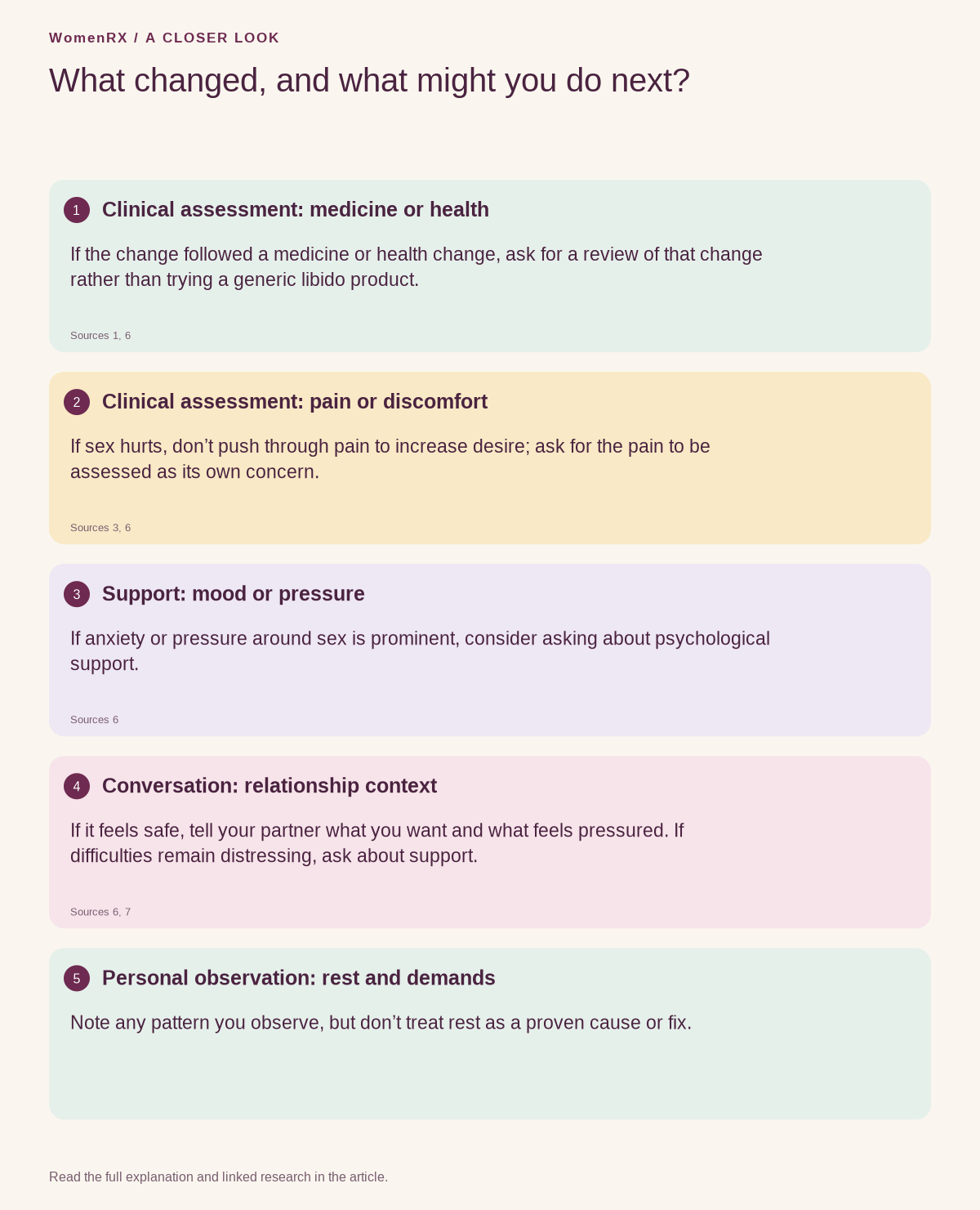
What changed, and what might you do next?
Clinical assessment: medicine or health: If the change followed a medicine or health change, ask for a review of that change rather than trying a generic libido product.16
Clinical assessment: pain or discomfort: If sex hurts, don’t push through pain to increase desire; ask for the pain to be assessed as its own concern.36
Support: mood or pressure: If anxiety or pressure around sex is prominent, consider asking about psychological support.6
Conversation: relationship context: If it feels safe, tell your partner what you want and what feels pressured. If difficulties remain distressing, ask about support.67
Personal observation: rest and demands: Note any pattern you observe, but don’t treat rest as a proven cause or fix.
Read the figure as text
Choose a next step by what stands out: pain or a medicine or health change calls for assessment of that concern; pressure or conflict may be something to discuss if it feels safe; rest is a pattern to observe, not a proven fix. If desire itself remains distressing, an assessment can also consider treatments for a desire disorder. More than one route may apply. 1 3 5 6- Clinical assessment: medicine or health: If the change followed a medicine or health change, ask for a review of that change rather than trying a generic libido product.16
- Clinical assessment: pain or discomfort: If sex hurts, don’t push through pain to increase desire; ask for the pain to be assessed as its own concern.36
- Support: mood or pressure: If anxiety or pressure around sex is prominent, consider asking about psychological support.6
- Conversation: relationship context: If it feels safe, tell your partner what you want and what feels pressured. If difficulties remain distressing, ask about support.67
- Personal observation: rest and demands: Note any pattern you observe, but don’t treat rest as a proven cause or fix.
More questions, answered
Does low desire always mean a hormone problem?
No. Hormonal changes may be one factor, but sexual desire can also be affected by health conditions, medicines, emotional well-being, pain, and relationship context. A hormone explanation shouldn’t be assumed without considering the rest of the picture. 1 6 7
When should I bring it up with a clinician?
If the change bothers you, if it followed a medicine or health change, or if sex is painful, it’s reasonable to ask about it. Pain and medicine changes deserve attention in their own right. If low desire remains distressing, assessment can also help determine whether treatment for a desire disorder is relevant. 1 3 5 6
Sources you can check
- Sexual Health | MedlinePlusAccessed 2026-09-25Return to first citation
- Hypoactive sexual desire disorder (HSDD) is not "female erectile dysfunction (ED)": challenges with the characterization of HSDD in women based on a systematic literature review.Kingsberg SA, Nambiar S, Karkare S, Hadker N, Lim-Watson M, Williams LA, Krop J. · Current medical research and opinion · 2020Return to first citation
- Older women's sexual desire problems: biopsychosocial factors impacting them and barriers to their clinical assessment.Maciel M, Laganà L. · BioMed research international · 2014Return to first citation
- Female Sexual Function, Dysfunction, and Treatment: A Biopsychosocial Multidisciplinary Approach.Myers A, Marino J, Connor K, Kelley EL, Kingsberg SA, Pope R. · Journal of minimally invasive gynecology · 2026Return to first citation
- Female Hypoactive Sexual Desire Disorder: A Practical Guide to Causes, Clinical Diagnosis, and Treatment.Kingsberg SA, Simon JA. · Journal of women's health (2002) · 2020Return to first citation
- General Management of Female Sexual Dysfunction for Urologists.Bitzer J. · Urology research & practice · 2023Return to first citation
- Female Sexual Dysfunction-Medical and Psychological Treatments, Committee 14.Kingsberg SA, Althof S, Simon JA, Bradford A, Bitzer J, Carvalho J, Flynn KE, Nappi RE, Reese JB, Rezaee RL, Schover L, Shifrin JL. · The journal of sexual medicine · 2017Return to first citation