Can Perimenopause Affect Bladder Control?
Bladder symptoms can appear during perimenopause, but the pattern of leakage matters more than timing alone.
Yes. Studies have found associations between perimenopause and some urinary symptoms, including leakage, but they don’t show that the transition is the cause of an individual’s symptoms. Leaking with a cough or workout differs from leaking after a sudden urge; frequent urination or trouble emptying is different again. Describe the pattern to a clinician rather than assuming it’s hormonal. 2 3 4
First, notice what happens before the leak
The circumstances can help distinguish common urinary symptoms. They don’t diagnose the cause on their own.
- A leak with coughing, sneezing, laughing, or exercise fits a stress-incontinence pattern. “Stress” here means pressure on the bladder, not feeling emotionally stressed. Weakness or damage in the pelvic floor muscles or the muscle that helps close the urethra can contribute. Pregnancy and childbirth can affect muscles involved in controlling urine flow, so perimenopause isn’t the only possible factor. 1 2
- A sudden, intense urge followed by a leak fits an urge-incontinence pattern. Overactive bladder can also involve frequent urination, including during the night, with or without leakage. 2
- Both kinds of leakage can occur together; this is called mixed incontinence. 2
- Frequent small trickles or a feeling that your bladder hasn’t emptied is a different pattern. It can occur with overflow incontinence, when the bladder doesn’t empty fully. An obstruction or blockage is one possible cause. Frequent urination by itself isn’t incontinence, which means urine passes unintentionally. 1 2
What research says about the menopause transition
Studies of women have found associations between menopause stage and some urinary symptoms, but findings vary by symptom and study. In the prospective Study of Women’s Health Across the Nation, women who didn’t have incontinence at the start were more likely to develop monthly-or-more-frequent leakage during early or late perimenopause than before perimenopause. Menopause stage wasn’t associated with developing leakage several times a week or more. 4
A separate British cohort found an association between the transition and stress incontinence, but not urge or severe incontinence. A 2025 study of women in the United States found that perimenopausal participants were more likely than premenopausal participants to report urgency incontinence. The studies measured symptoms differently, and their results don’t establish that hormonal changes cause a particular person’s bladder symptoms. 3 5
Age can be another part of the picture, but incontinence isn’t an inevitable part of getting older. Pregnancy and childbirth may also affect the muscles involved in bladder control. A symptom’s timing is useful context, not a diagnosis. 1
Match the next step to the symptom
If you’re leaking urine, experiencing a new or bothersome urge, or finding that frequent urination disrupts your day or sleep, bring it up with a primary care clinician or gynecologist. Urinary symptoms can be assessed rather than simply attributed to menopause. An evaluation may include questions about when symptoms happen, a diary of fluid intake and bathroom trips, and possibly a pelvic examination. 1 2 6
If it helps, note whether a leak happened with activity or after an urge, how often you urinate, and whether you feel empty afterward. For example, a leak during a workout and a leak while hurrying to the bathroom are different patterns to describe. A diary can support a conversation, but it doesn’t identify the cause by itself. 1 2
Mention frequent small trickles, a persistent sense that you can’t empty your bladder, or leakage that happens continuously. These patterns differ from an occasional leak with a cough and may need a closer look. Symptoms alone can’t show what’s causing them. 1 2
Don’t assume that hormone use is a general fix for bladder symptoms. A 2025 study found an association between hormone use and worse bladder-health scores among postmenopausal participants, but it doesn’t establish cause and effect or show whether hormone treatment improves urinary symptoms. 3
From bladder symptom to next step
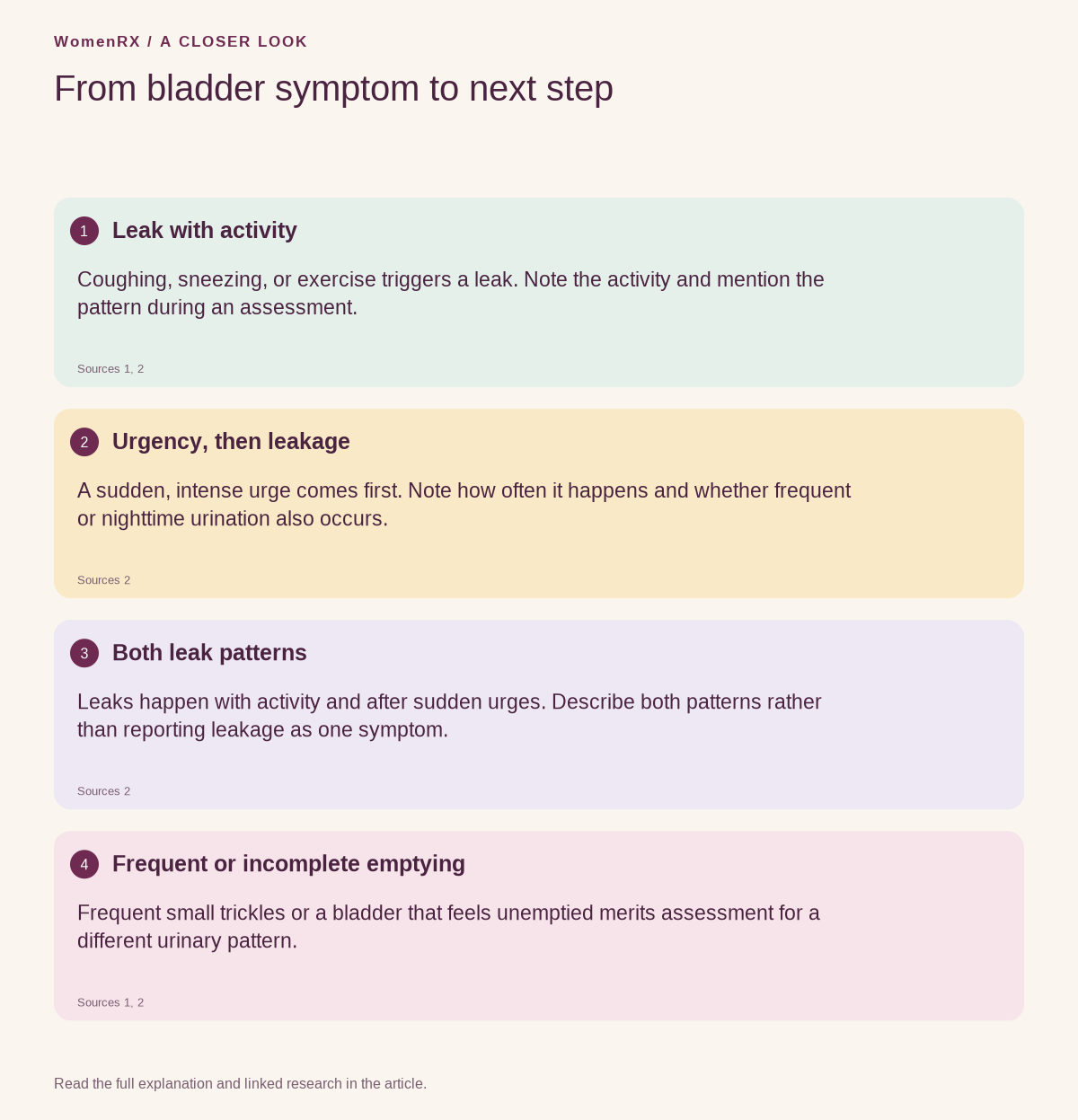
Leak with activity: Coughing, sneezing, or exercise triggers a leak. Note the activity and mention the pattern during an assessment.12
Urgency, then leakage: A sudden, intense urge comes first. Note how often it happens and whether frequent or nighttime urination also occurs.2
Both leak patterns: Leaks happen with activity and after sudden urges. Describe both patterns rather than reporting leakage as one symptom.2
Frequent or incomplete emptying: Frequent small trickles or a bladder that feels unemptied merits assessment for a different urinary pattern.12
Read the figure as text
Use the pattern to describe what’s happening and decide what to raise in an assessment. A pattern can guide the conversation, but it cannot diagnose the cause.- Leak with activity: Coughing, sneezing, or exercise triggers a leak. Note the activity and mention the pattern during an assessment.12
- Urgency, then leakage: A sudden, intense urge comes first. Note how often it happens and whether frequent or nighttime urination also occurs.2
- Both leak patterns: Leaks happen with activity and after sudden urges. Describe both patterns rather than reporting leakage as one symptom.2
- Frequent or incomplete emptying: Frequent small trickles or a bladder that feels unemptied merits assessment for a different urinary pattern.12
More questions, answered
Does frequent urination mean I have incontinence?
No. Incontinence means urine passes unintentionally. Frequent urination can occur with overactive bladder, with or without leakage; frequent small trickles and a feeling of incomplete emptying can fit a different pattern. Tell a clinician which symptoms you’re having. 1 2
Sources you can check
- Urinary incontinence - NHSAccessed 2026-09-25Return to first citation
- Urinary incontinence - Symptoms - NHSAccessed 2026-09-25Return to first citation
- Association of menopausal status and hormone use with bladder health and lower urinary tract symptoms in US women: results from the RISE FOR HEALTH study.Vaughan CP, Vaughan CP, Markland AD, McGwin G, Lukacz ES, Brady SS, Lacoursiere YD, Wyman JF, Sutcliffe S, Smith AL, Kenton K, Stapleton A, Brubaker L, Harlow BL. · Menopause (New York, N.Y.) · 2025Return to first citation
- Association between menopausal transition stages and developing urinary incontinence.Waetjen LE, Ye J, Feng WY, Johnson WO, Greendale GA, Sampselle CM, Sternfield B, Harlow SD, Gold EB, Study of Women’s Health Across the Nation (SWAN). · Obstetrics and gynecology · 2009Return to first citation
- Menopausal transition and the risk of urinary incontinence: results from a British prospective cohort.Mishra GD, Cardozo L, Kuh D. · BJU international · 2010Return to first citation
- European Association of Urology Guidelines on the Diagnosis and Management of Female Non-neurogenic Lower Urinary Tract Symptoms. Part 1: Diagnostics, Overactive Bladder, Stress Urinary Incontinence, and Mixed Urinary Incontinence.Nambiar AK, Arlandis S, Bø K, Cobussen-Boekhorst H, Costantini E, de Heide M, Farag F, Groen J, Karavitakis M, Lapitan MC, Manso M, Arteaga SM, Riogh ANA, O'Connor E, Omar MI, Peyr... · European urology · 2022Return to first citation