Bladder Leakage in Your 40s: Is It Perimenopause?
Perimenopause may be part of the picture, but the way leakage happens offers better clues about what to check next.
Possibly, but new leakage in your 40s isn’t evidence that hormones are the cause. Studies find some urinary symptoms alongside the menopausal transition, but they don’t show that the transition caused an individual woman’s leakage. Notice whether you leak with a cough or exercise, after a sudden urge, or both. Those patterns point toward different explanations and care options. 561
Why age alone can’t settle the question
If your periods are changing and you’ve started leaking urine, it’s reasonable to wonder whether the two are connected. But the timing isn’t enough to tell. In a study of 3,469 middle-aged Korean women, overactive bladder symptoms became more common across menopausal stages, yet the association with overactive bladder overall was not statistically significant after adjustment for other factors. Waking at night to urinate showed a clearer association with menopausal stage. This was a cross-sectional study, so it could not establish what caused either symptom. 5
A separate study followed women through late reproductive years, the menopausal transition, and early postmenopause. Its models linked stress leakage with factors including a history of three or more births, while urgency leakage was linked with increasing age and higher body mass index. That doesn’t rule out a menopausal contribution. It does show why attributing a new bladder symptom to hormones alone can miss other influences. 6
The moment you leak is a useful clue
Leakage with a cough, laugh, lift, or workout fits the pattern called stress incontinence. “Stress” here means physical pressure on the bladder, not emotional stress. Pelvic floor weakness or damage to the structures that help keep the urethra closed can contribute. Pregnancy and childbirth can affect those muscles, but you don’t need to have given birth to report this pattern. 123
Leakage on the way to the bathroom after a sudden, strong need to go fits urgency incontinence. It often occurs with overactive bladder symptoms, such as frequent urination or waking to urinate. Possible contributors include a urinary tract infection (UTI), constipation, some neurologic conditions, and bladder irritation associated with alcohol or caffeine. Sometimes the reason for an overactive bladder isn’t clear. 124
Both patterns can happen together. For example, you might leak during a run on one day and after an intense urge on another. That’s called mixed incontinence, and noticing both matters: a description limited to the most recent episode may leave out half the problem. 14
There are other patterns worth mentioning rather than trying to fit them into “stress” or “urgency.” Frequent small trickles along with a feeling that your bladder hasn’t emptied can suggest an emptying problem. Leakage that starts around an infection or a new medicine may have a temporary cause. These distinctions don’t diagnose the problem at home, but they help keep the conversation open to causes besides menopause. 14
What to notice before you seek care
You don’t need an elaborate log. When leakage happens, jot down what you were doing, whether you felt an urgent need to urinate first, and whether you feel fully emptied afterward. Note when it started and any change around a new medicine, constipation, or drinks that seem to bring on urgency. 124 Also note a new need to urinate frequently, so you can describe it alongside the leakage rather than assuming it’s hormonal. 4 If you have pain when you pee, see blood in your urine, or suspect an infection, seek care and mention those symptoms rather than assuming the leakage is hormonal. 78 A UTI can be a possible cause of urgency leakage, and urinary incontinence is worth having assessed. 14
The useful next move isn’t to prove or disprove perimenopause yourself. It’s to describe the leakage clearly and have it assessed. Urinary incontinence can improve with appropriate treatment, and the options depend in part on which type you have. Your menstrual changes may be relevant context, but they shouldn’t replace a look at the bladder symptom itself. 134
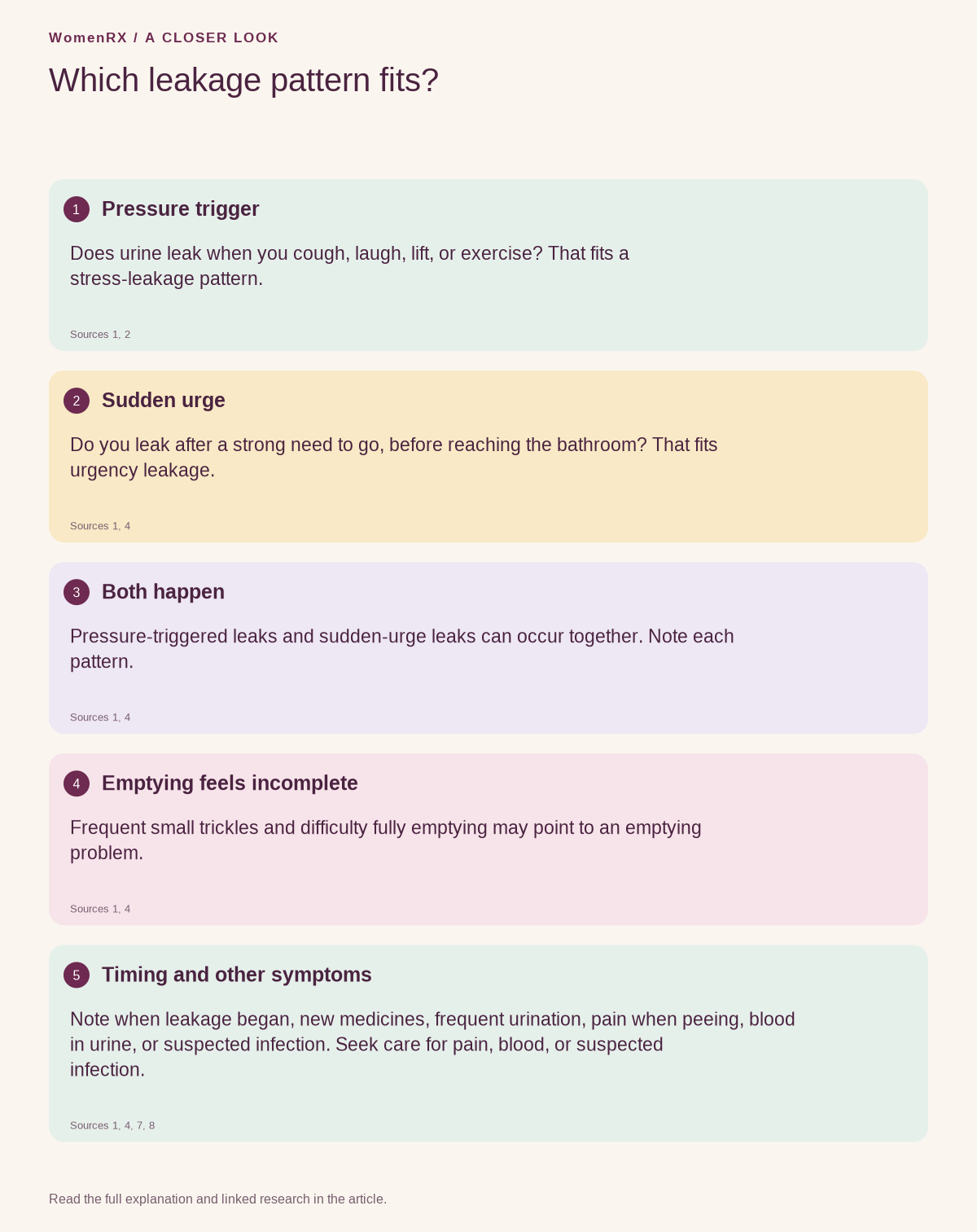
Which leakage pattern fits?
Pressure trigger: Does urine leak when you cough, laugh, lift, or exercise? That fits a stress-leakage pattern.12
Sudden urge: Do you leak after a strong need to go, before reaching the bathroom? That fits urgency leakage.14
Both happen: Pressure-triggered leaks and sudden-urge leaks can occur together. Note each pattern.14
Emptying feels incomplete: Frequent small trickles and difficulty fully emptying may point to an emptying problem.14
Timing and other symptoms: Note when leakage began, new medicines, frequent urination, pain when peeing, blood in urine, or suspected infection. Seek care for pain, blood, or suspected infection.1478
Read the figure as text
Use these prompts to describe what happens; they aren’t a diagnostic test.- Pressure trigger: Does urine leak when you cough, laugh, lift, or exercise? That fits a stress-leakage pattern.12
- Sudden urge: Do you leak after a strong need to go, before reaching the bathroom? That fits urgency leakage.14
- Both happen: Pressure-triggered leaks and sudden-urge leaks can occur together. Note each pattern.14
- Emptying feels incomplete: Frequent small trickles and difficulty fully emptying may point to an emptying problem.14
- Timing and other symptoms: Note when leakage began, new medicines, frequent urination, pain when peeing, blood in urine, or suspected infection. Seek care for pain, blood, or suspected infection.1478
More questions, answered
Does waking up to pee mean my leakage is hormonal?
No. In one cross-sectional study of middle-aged women, nighttime urination was associated with menopausal stage, but that finding cannot establish the cause of your symptom. Notice whether you also have sudden urges, leakage, or a sense that your bladder isn’t emptying. 54
Sources you can check
- Urinary Incontinence | Stress Incontinence | UI | MedlinePlusAccessed 2026-09-25Return to first citation
- Urinary incontinence - Causes - NHSAccessed 2026-09-25Return to first citation
- Urinary incontinence - NHSAccessed 2026-09-25Return to first citation
- Urinary incontinence - Symptoms - NHSAccessed 2026-09-25Return to first citation
- Menopausal stages and overactive bladder symptoms in middle-aged women: A cross-sectional study.Park J, Chang Y, Kim JH, Choi HR, Kwon R, Lim GY, Ahn J, Kim KH, Kim H, Hong YS, Zhao D, Cho J, Guallar E, Park HY, Ryu S. · BJOG : an international journal of obstetrics and gynaecology · 2024Return to first citation
- Correlates of urinary incontinence during the menopausal transition and early postmenopause: observations from the Seattle Midlife Women's Health Study.Mitchell ES, Woods NF. · Climacteric : the journal of the International Menopause Society · 2013Return to first citation
- Urinary Tract Infections | UTI | UTI Symptoms | MedlinePlusAccessed 2026-09-25Return to first citation
- Urinary tract infections (UTIs) - NHSAccessed 2026-09-25Return to first citation