When Bladder Pain Changes Around Perimenopause
A change in bladder pain or urgency deserves a closer look, even when it happens during the menopausal transition.
If you notice a change in bladder pain, urgency, or frequency during perimenopause, the timing alone doesn’t identify the cause. Research on genitourinary syndrome of menopause (GSM) in postmenopausal women does not establish a perimenopause-specific symptom pattern. Menopause-related changes may influence IC/BPS, but have not been shown to cause it. Note what changed from your usual pattern, and discuss whether urine testing and an examination could help distinguish infection, IC/BPS, or another cause. 3 4
Similar symptoms don’t always have the same cause
IC/BPS describes persistent pelvic pain perceived to be related to the bladder, along with urgency and/or frequency. Research in postmenopausal women describes urinary symptoms and vaginal dryness in genitourinary syndrome of menopause (GSM). If symptoms appear or shift during the transition, their timing alone doesn’t show whether the cause is IC/BPS, GSM, a urinary infection, or something else. 3 4
Menopause-related changes, including possible shifts in the urinary microbiome, may affect IC/BPS and recurrent urinary tract infections, but the evidence is still developing. That means menopause is a relevant context to mention, not a proven explanation for a flare or a reason to label new symptoms as IC/BPS. 4
What the symptom pattern can, and can’t, tell you
If pain feels bladder-related and persists alongside urgency or frequency, describe that pattern when asking about IC/BPS. If urinary symptoms occur alongside vaginal dryness, ask whether GSM could also be contributing. These details help frame different evaluation questions; neither pattern confirms a diagnosis. 3 4
If you’ve had repeated urinary infections, mention that history rather than assuming a change is an IC/BPS flare. Pain, urgency, or frequency alone won’t settle whether infection or IC/BPS is involved. Urinalysis and urine culture, along with medical history and examination, are important parts of assessing IC/BPS. A clinician can use that evaluation to consider infection and other explanations rather than relying on symptom overlap alone. 4
If pain seems connected to periods, describe that timing and ask whether period pain needs separate consideration rather than assuming it is a bladder flare. Endometriosis, adenomyosis, fibroids, and pelvic inflammatory disease are among the possible causes of period pain. That doesn’t mean one of them explains bladder symptoms, but it gives your clinician useful context. 1
Make the change easier to describe
Before a visit, write down what is different from your usual pattern. This isn’t a diagnostic score; it’s a way to make the conversation more specific. Include:
- When the change started and whether it is persistent or comes and goes.
- Whether pain feels pelvic or bladder-related, and whether urgency or frequency changed too.
- Any vaginal dryness, and whether pain seems connected with periods or sex.
- Whether you’ve had urine tests or cultures, and what you were told about the results.
These details won’t identify the cause by themselves. They help connect the timing and combination of symptoms to the history, examination, and urine tests used in evaluation. 1 3 4
Where vaginal estrogen fits
Low-dose vaginal estrogen is an option recommended by The North American Menopause Society for bothersome GSM symptoms not relieved by over-the-counter therapies in women without an indication for systemic hormone therapy. That recommendation addresses GSM; it doesn’t establish vaginal estrogen as a treatment for IC/BPS or as an answer to unexplained bladder pain. If vaginal dryness is part of your symptoms, ask whether GSM could be contributing and what treatment fits the assessment. 2
The useful distinction is not “menopause or bladder pain.” More than one issue may be relevant, and the symptom pattern is a starting point for evaluation, not a diagnosis.
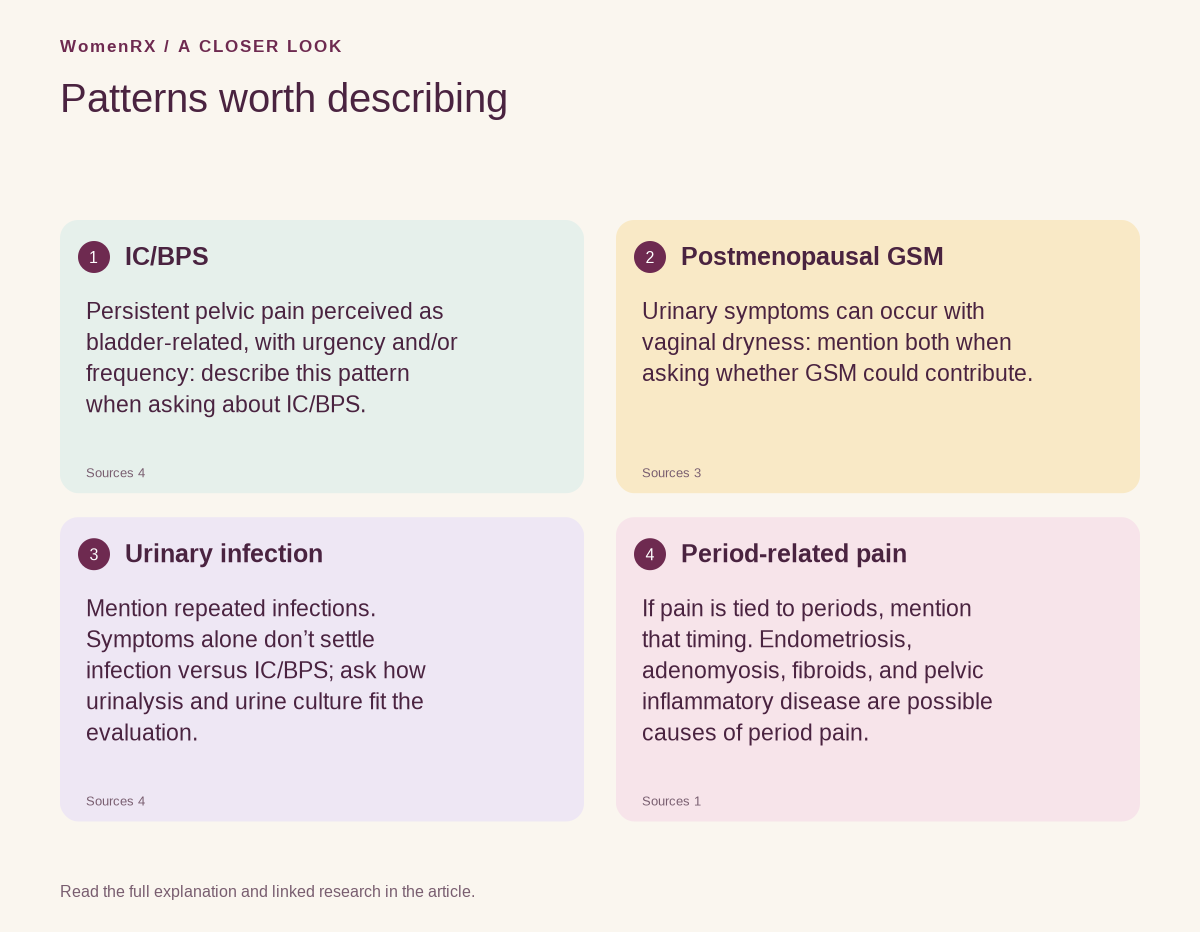
Patterns worth describing
IC/BPS: Persistent pelvic pain perceived as bladder-related, with urgency and/or frequency: describe this pattern when asking about IC/BPS.4
Postmenopausal GSM: Urinary symptoms can occur with vaginal dryness: mention both when asking whether GSM could contribute.3
Urinary infection: Mention repeated infections. Symptoms alone don’t settle infection versus IC/BPS; ask how urinalysis and urine culture fit the evaluation.4
Period-related pain: If pain is tied to periods, mention that timing. Endometriosis, adenomyosis, fibroids, and pelvic inflammatory disease are possible causes of period pain.1
Read the figure as text
These details can organize a conversation about changing symptoms. None confirms a diagnosis on its own.- IC/BPS: Persistent pelvic pain perceived as bladder-related, with urgency and/or frequency: describe this pattern when asking about IC/BPS.4
- Postmenopausal GSM: Urinary symptoms can occur with vaginal dryness: mention both when asking whether GSM could contribute.3
- Urinary infection: Mention repeated infections. Symptoms alone don’t settle infection versus IC/BPS; ask how urinalysis and urine culture fit the evaluation.4
- Period-related pain: If pain is tied to periods, mention that timing. Endometriosis, adenomyosis, fibroids, and pelvic inflammatory disease are possible causes of period pain.1
More questions, answered
Does perimenopause cause interstitial cystitis?
The cause of IC/BPS is unknown. Menopause-related changes may influence how it manifests, but this does not show that perimenopause causes IC/BPS. 4
Can vaginal estrogen treat bladder pain syndrome?
The menopause guidance supports low-dose vaginal estrogen for bothersome genitourinary symptoms of menopause in specified circumstances. It does not establish it as a treatment for IC/BPS itself. 2
Sources you can check
- Period pain - NHSAccessed 2026-09-25Return to first citation
- The 2022 hormone therapy position statement of The North American Menopause Society.“The 2022 Hormone Therapy Position Statement of The North American Menopause Society” Advisory Panel. · Menopause (New York, N.Y.) · 2022Return to first citation
- Gut, vaginal, and urinary microbiome alterations in women with genitourinary syndrome of menopause: A systematic review.Tsuboi I, Inoue S, Hirayama T, Mitsui Y, Watanabe M, Hirakawa H, Sadahira T. · Maturitas · 2026Return to first citation
- Interstitial cystitis/bladder pain syndrome and recurrent urinary tract infection and the potential role of the urinary microbiome.Bhide A, Tailor V, Khullar V. · Post reproductive health · 2020Return to first citation