Does Estrogen Face Cream Have Evidence for Menopause-Related Skin Changes?
One small study tested a specific estrogen-related skincare regimen, but it doesn’t establish that facial estrogen creams broadly work or are safe.
There’s limited, product-specific evidence: one 20-week study followed 14 postmenopausal women using a serum and night cream containing methyl estradiolpropanoate, a compound distinct from standard estradiol cream. The study reported improvements, but its small, single-site design can’t show whether the regimen caused them or whether other facial estrogen products share the results. Safety questions also remain. 2
If a facial cream promises to restore skin affected by menopause, the useful question is not just whether estrogen can affect skin. It’s whether the specific ingredient and finished product have been tested on facial skin, and what those tests can actually establish.
The short answer: a small study reported improvements with one specific regimen. That’s a reason to distinguish that product from other creams, not proof that facial estrogen is a proven menopause treatment. 2
What was actually studied
A 2019 single-site study included 14 women ages 53 to 68 who had been without periods for one to 10 years. They used a morning serum and an evening night cream containing methyl estradiolpropanoate, or MEP, for 20 weeks. This is a particular ingredient and regimen, not a study of every product described as an estrogen face cream. 2
The report described improvements in hydration, texture, and other appearance measures. For example, at week 20, all 14 participants had at least a one-grade improvement on the study’s facial hydration scale. Those results describe what happened in this small group; they don’t tell us how the regimen compared with a placebo, usual skincare, or no treatment. The abstract describes a single-site experience trial and does not report a comparison group. 2
That distinction matters. Without a comparison group, the study can’t separate a product effect from changes that might occur with a skincare routine, study participation, or other factors. And a finding for this MEP-containing regimen does not establish an effect for ordinary estradiol cream or for products with different ingredients and formulations.
Menopause is one contributor to skin changes
Estrogen changes may be part of skin aging, but they aren’t the only influence. The study’s background describes skin aging as involving both intrinsic factors, including hormones and genetics, and external factors such as ultraviolet exposure and pollution. That means a change in facial texture or appearance around menopause doesn’t, by itself, show that low estrogen is the cause. 2
The North American Menopause Society’s 2022 position statement describes hormone therapy as treatment for specific menopause-related concerns, including bothersome hot flashes and genitourinary symptoms, and discusses prevention of bone loss. Its summarized recommendations don’t establish facial estrogen cream as a standard treatment for menopause-related skin changes. 1
What the study can’t settle about safety
The study’s secondary aim included tolerability, and it followed participants during the 20-week regimen. But the abstract doesn’t provide enough detail to judge specific side effects, how often they occurred, or whether the findings apply to other products or longer use. It also doesn’t establish how much of the ingredient is absorbed through skin or answer broader safety questions for a different formulation. 2
So don’t treat “used on the face” or “estrogen-related” as a complete safety explanation. A product’s ingredient, concentration, directions, and evidence all matter. The study’s results are not a substitute for information about the particular product you’re considering.
A practical way to assess a product claim
Before relying on a claim, look for answers to these questions:
- What is the exact active ingredient? MEP and estradiol are not interchangeable study descriptions. Ask whether the cited research tested that exact ingredient.
- Was the finished facial product studied? Evidence about one serum-and-cream regimen cannot automatically be applied to another formula.
- Who took part, and how was the study designed? Here, the study included 14 postmenopausal women at one site, and the abstract doesn’t report a comparison group. 2
- What outcome improved, and how was it measured? A change on a hydration scale or an investigator rating is not the same as proof of a lasting or meaningful benefit for everyone.
- What safety information is available for this exact product? The study abstract doesn’t answer every question about absorption or longer-term use. Ask what is known for the formulation, rather than assuming results transfer from one product to another.
If you’re discussing a cream with a clinician, bring its full ingredient list and the exact claim or study it cites. That makes it easier to distinguish evidence about a specific cosmetic regimen from evidence about standard menopause hormone therapy. The current evidence supports a cautious, product-specific conclusion: one small study reported encouraging skin changes, but broad claims about facial estrogen creams go beyond what it established. 1 2
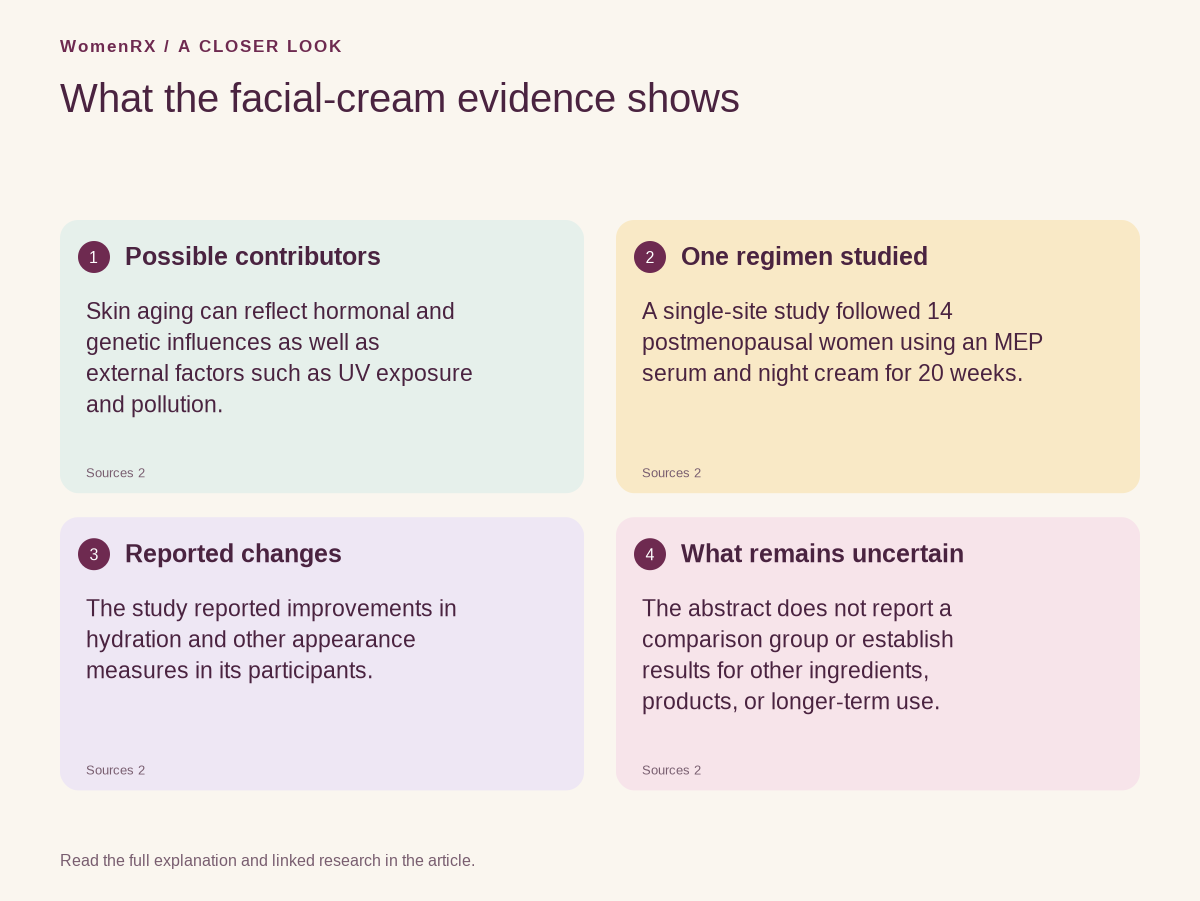
What the facial-cream evidence shows
Possible contributors: Skin aging can reflect hormonal and genetic influences as well as external factors such as UV exposure and pollution.2
One regimen studied: A single-site study followed 14 postmenopausal women using an MEP serum and night cream for 20 weeks.2
Reported changes: The study reported improvements in hydration and other appearance measures in its participants.2
What remains uncertain: The abstract does not report a comparison group or establish results for other ingredients, products, or longer-term use.2
Read the figure as text
Separate the biological rationale, the specific study, and what remains unanswered before applying a product claim to other creams.- Possible contributors: Skin aging can reflect hormonal and genetic influences as well as external factors such as UV exposure and pollution.2
- One regimen studied: A single-site study followed 14 postmenopausal women using an MEP serum and night cream for 20 weeks.2
- Reported changes: The study reported improvements in hydration and other appearance measures in its participants.2
- What remains uncertain: The abstract does not report a comparison group or establish results for other ingredients, products, or longer-term use.2
More questions, answered
Is methyl estradiolpropanoate the same as estradiol cream?
The study tested a skincare regimen containing methyl estradiolpropanoate, or MEP. It does not establish that the findings apply to estradiol cream or to products with other ingredients. 2
Does the study show facial estrogen cream is safe for long-term use?
No. It followed 14 participants using one regimen for 20 weeks, and the abstract doesn’t provide enough detail to establish longer-term safety or answer all questions about absorption. 2
Sources you can check
- The 2022 hormone therapy position statement of The North American Menopause Society.“The 2022 Hormone Therapy Position Statement of The North American Menopause Society” Advisory Panel. · Menopause (New York, N.Y.) · 2022Return to first citation
- Evaluation of Efficacy of a Skin Care Regimen Containing Methyl Estradiolpropanoate (MEP) for Treating Estrogen Deficient SkinCohen JL. · Journal of drugs in dermatology : JDD · 2019Return to first citation