Does Estrogen Cream Help Around the Eyes? Evidence and Approval
Small studies of facial skin don’t establish that estrogen creams work or are safe around the eyes.
A small trial found changes in facial skin after estradiol cream, but measured tissue from the hairline, not skin around the eyes. A separate whole-face study used a different ingredient. Neither establishes an estrogen eye product’s benefit or safety at that site. To assess a specific product, check its ingredient, intended application area, and approval status separately. 12
What facial-skin studies can tell you
The closest direct research is a randomized study of 65 postmenopausal women. For six months, participants applied creams to the face containing estradiol, glycolic acid, or both, and used a vehicle cream on the other side of the face. The researchers reported increased epidermal thickness in the treated groups. But the reported tissue measurement came from the hairline, not the eye area. A change in a skin biopsy marker also isn’t the same thing as proving a visible benefit under the eyes. 1
A separate 20-week study enrolled 14 postmenopausal women who used a whole-face skincare regimen containing methyl estradiolpropanoate, or MEP. It reported improvements in several facial assessments, but it was a small, single-site study without a comparison group described in the abstract. MEP is a different named ingredient from estradiol. 2
Skin changes during aging and menopause can have more than one contributor, including intrinsic factors and environmental exposures; noticing dryness or wrinkles doesn’t show that estrogen decline is the cause or that hormone treatment is needed. 2
The ingredient and application site matter
Eye-area use raises another question: what happens if a formula gets into the eye? Findings from these facial-skin studies don’t establish the safety or effectiveness of an estrogen product intended for use around the eyes. 12
The exact formula matters, too. The whole-face regimen study evaluated methyl estradiolpropanoate, not estradiol. Results for one named ingredient shouldn’t be assumed to apply to another. 2
Facial-skin findings also can’t tell you whether a particular estrogen eye product is approved. That’s a separate, product-specific question. 12
Before considering one, check the package for the full active-ingredient name and the intended application site. If the label doesn’t clearly say it’s meant for the specific skin area you have in mind, don’t infer that it is from general “facial” claims. You can ask the manufacturer what evidence and safety testing apply to the exact formula and application area. If the answer doesn’t address eye-area use, that question remains unanswered.
A more grounded expectation
If your goal is to improve facial hydration or texture, research on other menopause-oriented skincare regimens offers some context, but not a shortcut to proving an estrogen eye cream works. An open observational study followed 202 perimenopausal and menopausal women using skincare regimens for 56 days and reported improvements in hydration and wrinkles. Because it was open and observational, it doesn’t isolate the effect of a particular ingredient or establish that all products will have the same results. 3
A facial-skin finding, a product’s ingredient, and its intended application site are different pieces of information. Look for evidence tied to the exact formula and use being claimed.
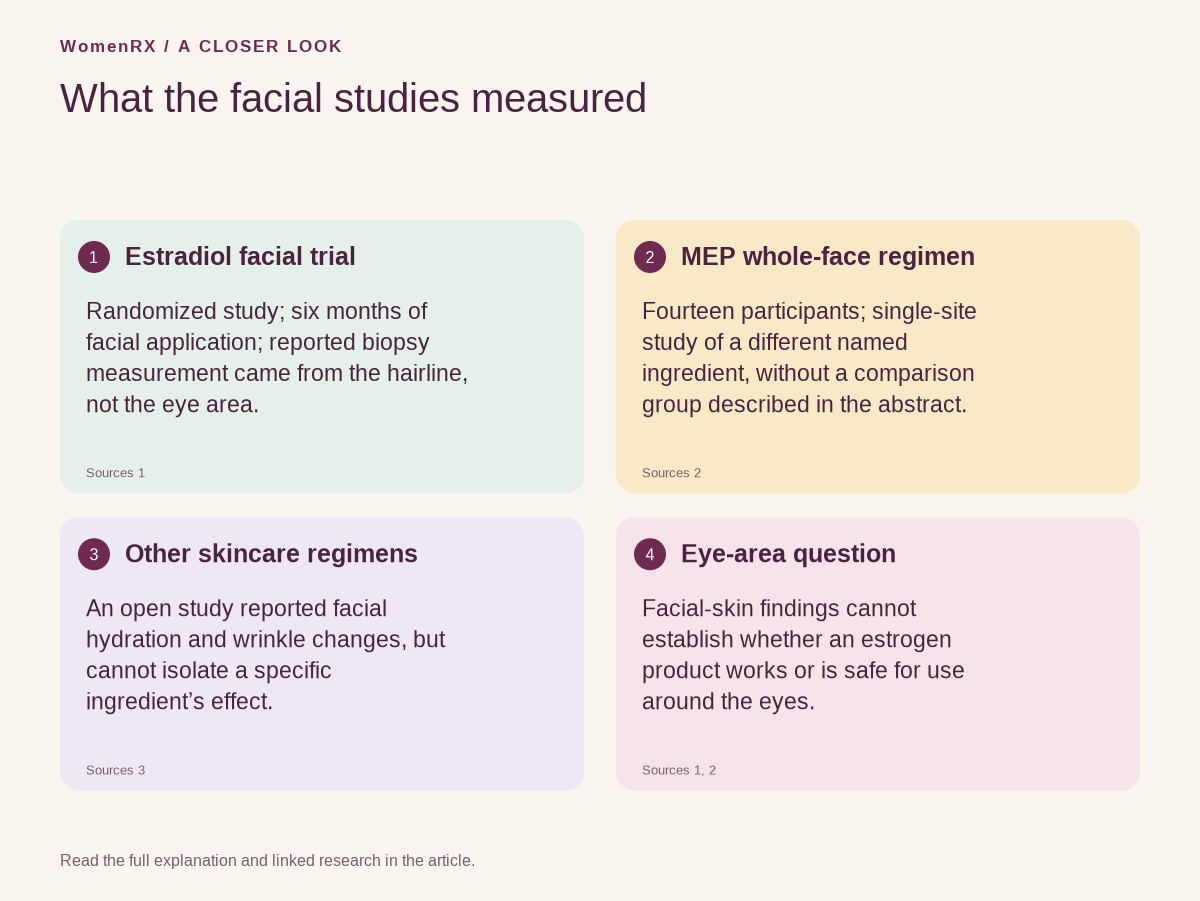
What the facial studies measured
Estradiol facial trial: Randomized study; six months of facial application; reported biopsy measurement came from the hairline, not the eye area.1
MEP whole-face regimen: Fourteen participants; single-site study of a different named ingredient, without a comparison group described in the abstract.2
Other skincare regimens: An open study reported facial hydration and wrinkle changes, but cannot isolate a specific ingredient’s effect.3
Eye-area question: Facial-skin findings cannot establish whether an estrogen product works or is safe for use around the eyes.12
Read the figure as text
Compare each study’s ingredient, design, and application area before applying its findings to an eye product.- Estradiol facial trial: Randomized study; six months of facial application; reported biopsy measurement came from the hairline, not the eye area.1
- MEP whole-face regimen: Fourteen participants; single-site study of a different named ingredient, without a comparison group described in the abstract.2
- Other skincare regimens: An open study reported facial hydration and wrinkle changes, but cannot isolate a specific ingredient’s effect.3
- Eye-area question: Facial-skin findings cannot establish whether an estrogen product works or is safe for use around the eyes.12
More questions, answered
Do menopause-related wrinkles mean you need estrogen skincare?
No. Skin aging has multiple contributors, and noticing wrinkles or dryness doesn’t identify estrogen decline as their cause or show that hormone treatment is needed. 2
Sources you can check
- The effects of an estrogen and glycolic acid cream on the facial skin of postmenopausal women: a randomized histologic study.Fuchs KO, Solis O, Tapawan R, Paranjpe J. · Cutis · 2003Return to first citation
- Evaluation of Efficacy of a Skin Care Regimen Containing Methyl Estradiolpropanoate (MEP) for Treating Estrogen Deficient SkinCohen JL. · Journal of drugs in dermatology : JDD · 2019Return to first citation
- Evaluation of adapted dermocosmetic regimens for perimenopausal and menopausal women using an artificial intelligence-based algorithm and quality of life questionnaires: An open observational study.Flament F, Jiang R, Delaunay C, Kerob D, Leclerc-Mercier S, Kosmadaki M, Roó E, Haag T, Passeron T, Zouboulis CC. · Skin research and technology : official journal of International Society for Bioengineering and the Skin (ISBS) [and] International Society for Digital Imaging of Skin (ISDIS) [and] International Society for Skin Imaging (ISSI) · 2023Return to first citation