Menopause and Dry Skin: What Hormones May Change
Falling estrogen may play a part in skin changes, but dryness has other causes and hormone therapy isn’t a proven dry-skin treatment.
Yes, hormone changes around menopause may contribute to skin dryness. Declining estrogen has been linked to changes in skin hydration and structure, but dryness alone can’t tell you whether hormones are the cause. Aging, weather, bathing habits, and skin conditions can also matter. Regular moisturizer addresses dryness directly; hormone therapy isn’t recommended solely for skin changes. 124
Where estrogen may fit in
If your skin feels tighter or rougher during perimenopause or after menopause, you’re not imagining the change. A review of menopausal skin research describes declining estrogen as a possible contributor to moisture loss, reduced elasticity, and changes in collagen. It also notes that the precise ways hormonal changes affect skin aging aren’t fully understood. That leaves room for hormones to be part of the explanation without making them the cause of every dry patch. 4
It helps to separate two things often grouped together as “skin aging.” Hydration and barrier function affect how well skin holds water. When those functions are impaired, skin can feel dry. Collagen and elasticity concern the skin’s supporting structure and how firm or supple it appears. Research on wrinkles or firmness cannot, by itself, tell us whether a treatment relieves the tight, flaky feeling of dryness. 14
Dryness has more than one possible cause
Skin can become dry with age or because of external triggers. Cold weather and frequent bathing, for example, can contribute to barrier problems. Dryness can also occur with conditions such as eczema, psoriasis, or diabetes. These possibilities don’t rule out a contribution from menopause; they mean that timing alone isn’t enough to identify the cause. 12
The pattern can offer a useful clue. For example, dry skin that becomes much worse in winter or after frequent bathing has a plausible environmental contributor, even if it first caught your attention around menopause. Itchy, scaling skin with fine cracks, particularly on the lower legs, may be a form of eczema associated with dry skin rather than ordinary dryness alone. 2
What hormone-therapy studies actually measured
Some studies have associated hormone therapy with improvements in skin quality, but the results aren’t consistent. A 2025 narrative review describes a randomized, placebo-controlled study in which 48 weeks of low-dose hormone therapy did not significantly change mild-to-moderate age-related facial skin changes in postmenopausal women. It also describes a four-year randomized study in recently menopausal women that found no statistically significant improvement in wrinkle scores or skin rigidity with hormone therapy compared with placebo. The review notes limitations in that longer study, including the possibility that it was too small to detect an effect. 4
Those studies matter, but their facial-aging measures are not the same as asking whether someone’s dry skin feels better. The review concludes that robust skin-specific trials are lacking and that clinical guidance does not support hormone therapy solely for skin changes. Hormone therapy has established uses for other menopause concerns, with benefits and risks that depend on the individual and the treatment. Dry skin alone is not a proven reason to start it. 34
A practical first step for dry skin
A basic moisturizer, also called an emollient, targets the immediate problem: helping skin retain water and supporting its barrier. A review of clinical studies recommends regular emollient use as basic care for dry skin from a range of causes. That finding is not specific to menopause, and a moisturizer won’t tell you why your skin became dry, but it gives you a way to address how your skin feels without first proving a hormonal cause. 1
If dryness persists despite that care, or your skin is itchy, scaling, or developing painful cracks, it’s worth having the skin itself assessed. Dry-skin eczema and other conditions may need a different approach than a moisturizer alone. 12
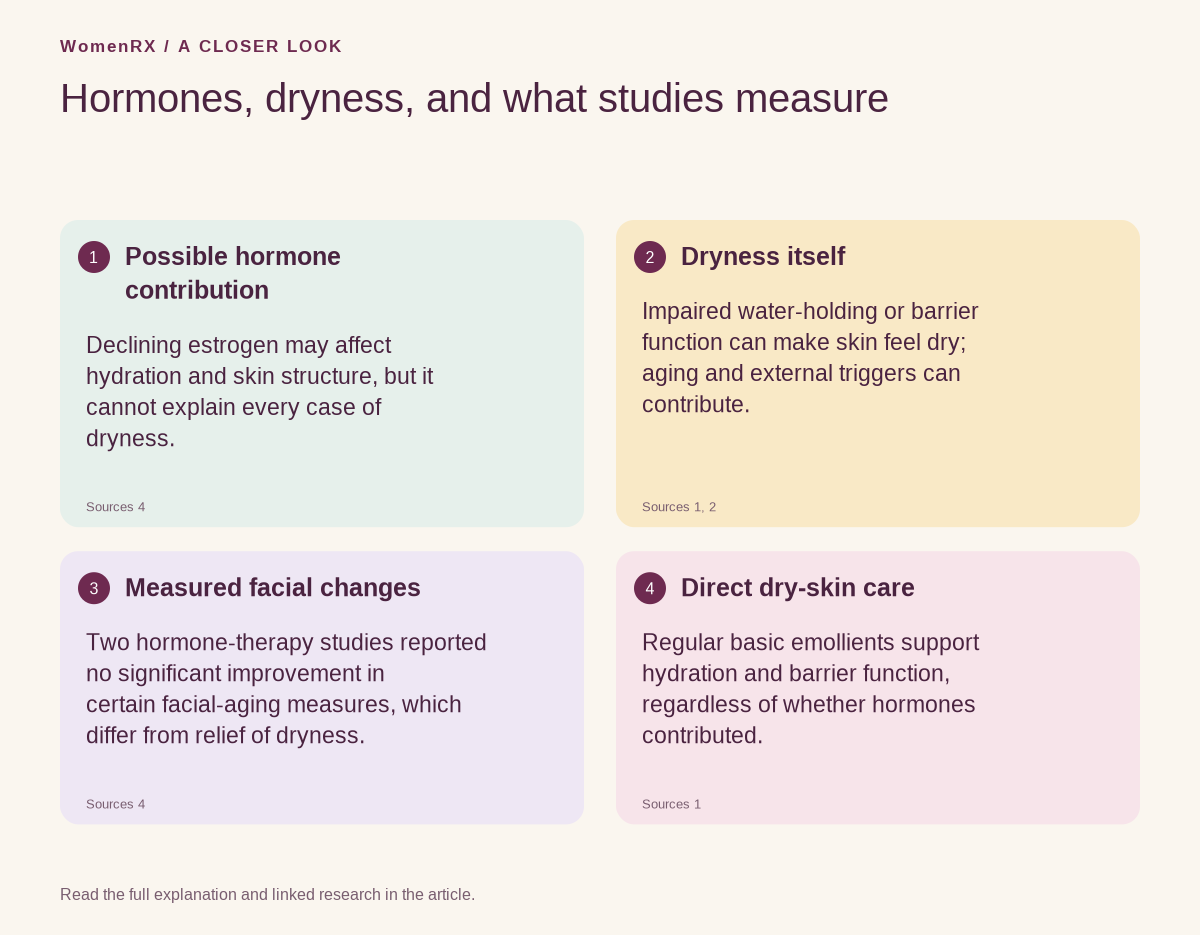
Hormones, dryness, and what studies measure
Possible hormone contribution: Declining estrogen may affect hydration and skin structure, but it cannot explain every case of dryness.4
Dryness itself: Impaired water-holding or barrier function can make skin feel dry; aging and external triggers can contribute.12
Measured facial changes: Two hormone-therapy studies reported no significant improvement in certain facial-aging measures, which differ from relief of dryness.4
Direct dry-skin care: Regular basic emollients support hydration and barrier function, regardless of whether hormones contributed.1
Read the figure as text
These distinctions help separate a possible cause, the symptom you feel, and outcomes tested in hormone-therapy research.- Possible hormone contribution: Declining estrogen may affect hydration and skin structure, but it cannot explain every case of dryness.4
- Dryness itself: Impaired water-holding or barrier function can make skin feel dry; aging and external triggers can contribute.12
- Measured facial changes: Two hormone-therapy studies reported no significant improvement in certain facial-aging measures, which differ from relief of dryness.4
- Direct dry-skin care: Regular basic emollients support hydration and barrier function, regardless of whether hormones contributed.1
More questions, answered
Does dry skin mean I’m in menopause?
No. Dryness can occur with aging, environmental triggers, and skin or other health conditions. It cannot establish menopause or pinpoint estrogen as the cause on its own. 12
Sources you can check
- Basic Emollients for Xerosis Cutis Not Associated With Atopic Dermatitis: A Review of Clinical Studies.Szepietowski JC, Tadini G. · International journal of dermatology · 2025Return to first citation
- Asteatotic EczemaSrivastava D, Sathe NC, Persaud Y. · 2026Return to first citation
- The 2022 hormone therapy position statement of The North American Menopause Society.“The 2022 Hormone Therapy Position Statement of The North American Menopause Society” Advisory Panel. · Menopause (New York, N.Y.) · 2022Return to first citation
- Managing Menopausal Skin Changes: A Narrative Review of Skin Quality Changes, Their Aesthetic Impact, and the Actual Role of Hormone Replacement Therapy in Improvement.Viscomi B, Muniz M, Sattler S. · Journal of cosmetic dermatology · 2025Return to first citation