Dry Skin in Your 40s: Is Perimenopause Involved?
Hormonal changes can affect skin, but the timing of dryness, your skin-care products, and any irritation may tell you more than your age alone.
Perimenopause could be one factor in dry skin during your 40s: changing hormones are associated with changes in skin structure. Research hasn’t established dryness alone as a way to identify the menopause transition or determine that hormones caused it. Look at what changed around the same time, including your cycles, cleansers, active skin-care products, and medicines.1245
Why the hormone connection is plausible
Your skin changes for many reasons over time. Hormones are one of them. Estrogen receptors are present in several parts of the skin, and research on menopausal skin has examined changes in collagen, thickness, and elasticity as hormone levels decline. A review focused on perimenopausal and menopausal skin also describes roles for progesterone and testosterone in skin function. That makes the connection more complicated than simply saying “dry skin means low estrogen.”12
It’s also worth separating skin changes around menopause from proof about your dry skin today. A systematic review of menopausal hormone therapy included 15 studies with 1,589 women aged 45 to 55. It found improvements in some measured skin features, including thickness and elasticity, but its combined result for skin dryness did not show a clear benefit. The studies included randomized and nonrandomized trials in menopausal women; they don’t establish how to identify the cause of dryness in a cycling woman in her 40s.1
Compare what happened, not just how old you are
Start with timing. If your periods have changed, or you’ve noticed other changes you want to discuss, mention them alongside the skin symptoms. That gives a fuller picture of what’s happening. It doesn’t prove that the dryness is hormonal, even if the changes began around the same time.
Then look at the skin itself. Is it mainly tight or flaky, or is it also itchy, red, or developing distinct patches? Eczema can involve dryness and itch because the skin barrier isn’t working as well and more moisture escapes. Environmental factors are linked to eczema.4 Skin-care products can also matter: cleanser choice affected dryness in studies of older adults.5 For example, dryness that appears after adding a retinoid deserves a look at that product: retinoids can cause irritation and peeling.2
Think beyond facial skin care as well. A review of basic skin-care studies in older adults found that gentler cleansers performed better for dryness than standard soap and water, and that certain leave-on moisturizers reduced dryness and itching. Those studies weren’t specifically in perimenopausal women, but they offer a practical reason to check whether your cleansing routine is making already-dry skin feel worse.5
Medicines can be another clue, though the relevant ones depend on what you actually take. Dry skin was reported frequently with flutamide in a review of hirsutism treatment, and a systematic review found increased dry-skin risk with targeted anticancer therapies. Neither finding means you should change a prescribed medicine on your own. It means a new symptom is worth raising with the team managing that treatment rather than automatically attributing it to perimenopause.36
What’s a useful next move?
If the main problem is uncomplicated dryness, consider whether a less irritating cleanser and a leave-on moisturizer help, particularly if your current routine includes standard soap or products that leave your skin stinging or peeling. Evidence for these basic approaches comes largely from studies in older adults, not a trial designed for women in their 40s.5 If you’ve recently added a retinoid, factor its potential for irritation into that comparison.2
If the skin is persistently itchy or has inflamed patches, don’t assume it’s just a menopause symptom. Eczema is one possible explanation, and identifying a skin condition matters because it changes what you’re trying to treat.4 When you describe the problem at an appointment, the most useful details are where the dryness is, whether it itches or looks inflamed, when it began, what touches that skin, and whether your medicines or cycles have changed. These details haven’t been established as a home test for perimenopause. Together, they make the question much more specific than “Is this my age?”
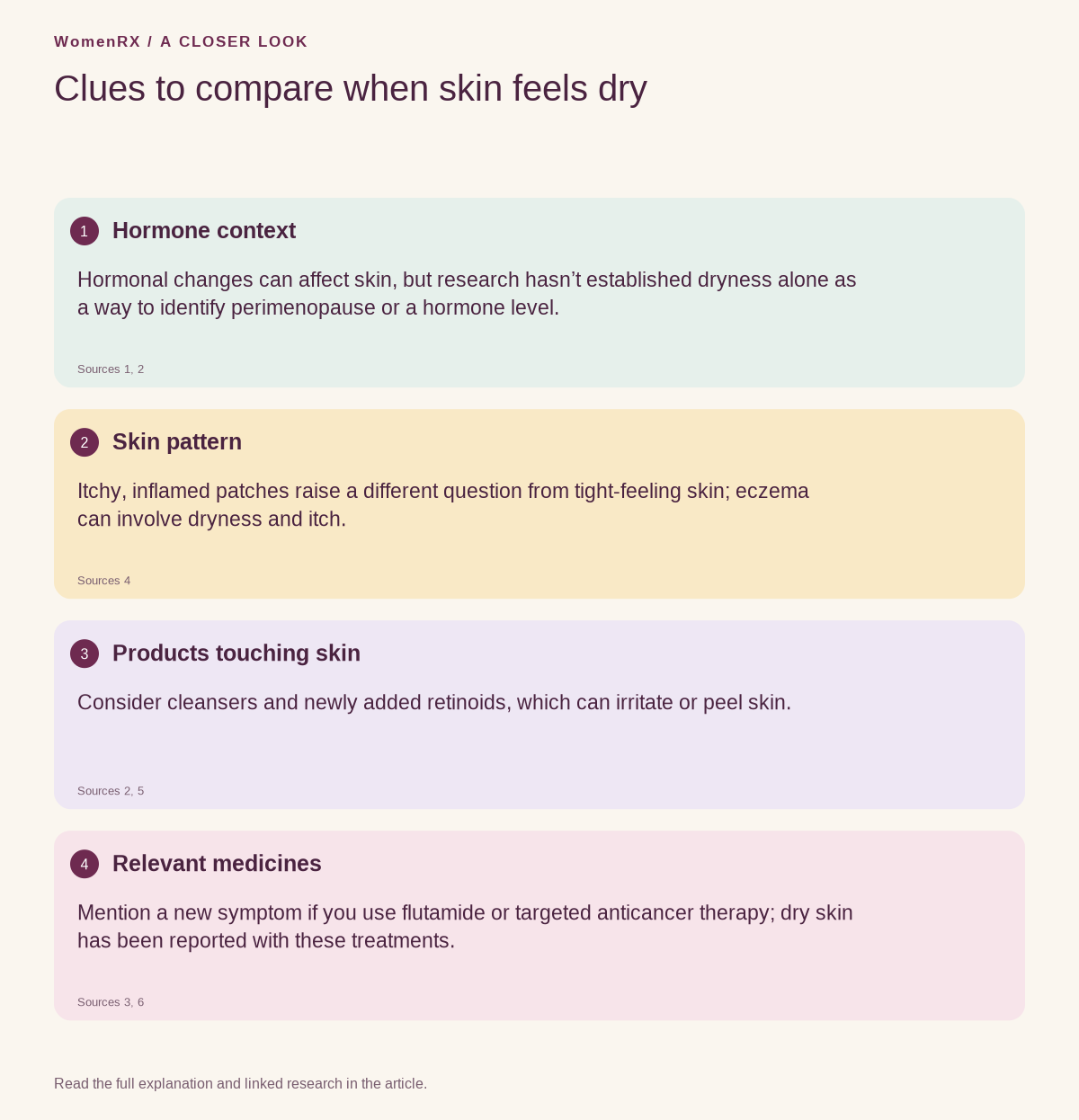
Clues to compare when skin feels dry
Hormone context: Hormonal changes can affect skin, but research hasn’t established dryness alone as a way to identify perimenopause or a hormone level.12
Skin pattern: Itchy, inflamed patches raise a different question from tight-feeling skin; eczema can involve dryness and itch.4
Products touching skin: Consider cleansers and newly added retinoids, which can irritate or peel skin.25
Relevant medicines: Mention a new symptom if you use flutamide or targeted anticancer therapy; dry skin has been reported with these treatments.36
Read the figure as text
These are details to compare, not a score or a way to diagnose perimenopause.- Hormone context: Hormonal changes can affect skin, but research hasn’t established dryness alone as a way to identify perimenopause or a hormone level.12
- Skin pattern: Itchy, inflamed patches raise a different question from tight-feeling skin; eczema can involve dryness and itch.4
- Products touching skin: Consider cleansers and newly added retinoids, which can irritate or peel skin.25
- Relevant medicines: Mention a new symptom if you use flutamide or targeted anticancer therapy; dry skin has been reported with these treatments.36
More questions, answered
Would improvement with hormone therapy prove my dry skin was hormonal?
Not necessarily. Skin can change for several reasons, and the hormone-therapy studies weren’t designed to establish what originally caused an individual woman’s dryness. In a review of studies in menopausal women, the combined result for skin dryness did not show a clear benefit, even though some other skin measures improved.1
Sources you can check
- Skin Rejuvenation in Women using Menopausal Hormone Therapy: A Systematic Review and Meta-Analysis.Pivazyan L, Avetisyan J, Loshkareva M, Abdurakhmanova A. · Journal of menopausal medicine · 2023Return to first citation
- Round Table Discussion: Aesthetic Treatment Considerations for the Perimenopausal & Menopausal Patient.Fabi SG, Firsowicz M, Kamrani P, Draelos ZD, Dayan SH. · Journal of cosmetic dermatology · 2026Return to first citation
- Management of hirsutism.Falsetti L, Gambera A, Platto C, Legrenzi L. · American journal of clinical dermatology · 2000Return to first citation
- ECZEMA AND TRANSEPIDERMAL MOISTURE LOSS: A SYSTEMATIC REVIEW AND META-ANALYSIS (REVIEW).Ibrayeva T, Iskakova A, Algazina T, Batpenova G, Azanbayeva D, Touir G, Ardakuly I, Shakhanova A. · Georgian medical news · 2026Return to first citation
- Maintaining skin integrity in the aged: A systematic review.Lichterfeld-Kottner A, El Genedy M, Lahmann N, Blume-Peytavi U, Büscher A, Kottner J. · International journal of nursing studies · 2020Return to first citation
- Incidence and risk of xerosis with targeted anticancer therapies.Valentine J, Belum VR, Duran J, Ciccolini K, Schindler K, Wu S, Lacouture ME. · Journal of the American Academy of Dermatology · 2015Return to first citation