Bloating Around Menopause: What Might Be Going On
Menopause can coincide with bloating, but your symptom pattern is more useful than your menopause stage for choosing what to do next.
Bloating during perimenopause or after periods stop isn’t necessarily caused by menopause. Swallowed air or a food intolerance may contribute; bloating with recurring abdominal pain and changes in bowel habits may point toward irritable bowel syndrome (IBS). Hormone changes may play a part for some women, but the evidence is mixed. Simple measures are reasonable for mild, occasional bloating. Get persistent, frequent, or concerning symptoms assessed. 1 2 3 4
What the pattern can tell you
Bloating may feel like uncomfortable fullness, or your belly may look bigger than usual. It can happen around a period, and some women notice digestive symptoms during perimenopause. But research comparing gastrointestinal symptoms across menopausal stages has produced conflicting results, including studies that found no clear difference in bloating. After periods stop, it’s still worth looking for an explanation rather than treating bloating as an inevitable menopause symptom. 1 3
A few possibilities are worth separating:
- Swallowed air: Chewing with your mouth closed is one simple way to reduce it. If bloating is mild and occasional, this is a low-effort place to start. 1
- Food intolerance or an individual food pattern: A food you know you don’t tolerate may contribute to bloating. That’s different from assuming you need to cut out whole food groups. 1
- IBS-like symptoms: IBS involves recurring abdominal pain and changes in bowel habits, such as stool consistency or frequency. Bloating can occur alongside those symptoms, but bloating alone doesn’t establish IBS. 2
- A possible hormonal contribution: A review reported digestive symptoms around menstruation and during perimenopause and proposed that changing ovarian hormone levels might contribute. It also called for more research. If your symptoms seem to come and go with periods, that pattern is useful to notice, but it doesn’t prove hormones are the cause. 4
These possibilities aren’t a way to diagnose yourself. They’re a way to avoid two unhelpful assumptions: that every episode needs a restrictive diet, or that ongoing bloating is simply menopause.
Start small when symptoms are mild
For occasional bloating without other concerning symptoms, try chewing with your mouth closed to avoid swallowing air and moving regularly. Exercise may help digestion and may also help when you feel bloated. If you already know you’re intolerant to a food, avoiding that food is more targeted than cutting out many foods at once. 1
If abdominal pain and altered bowel habits keep recurring, a conversation about IBS may be more useful than guessing at a trigger. A low-FODMAP diet has evidence for IBS symptoms, but it begins with substantial food restriction followed by gradual, personalized reintroduction. It isn’t a default treatment for unexplained bloating during menopause. 2
Know when self-care isn’t enough
Arrange a medical assessment if bloating keeps returning, doesn’t go away, or is very pronounced. Do so particularly if you’re losing weight without trying or notice blood in your stool. Persistent bloating sometimes has a more serious cause, including ovarian cancer; that possibility is a reason to check ongoing symptoms, not a reason to assume the worst from a single episode. 1
Get prompt medical advice if bloating comes with vomiting, diarrhea or constipation, a stomach ache, fever, a lump or swelling in your abdomen, or an inability to pass urine, stool, or gas. If your belly is swollen and you have a stomach ache that is severe and came on very suddenly, vomit blood or material that looks like coffee grounds, or have severe difficulty breathing, seek emergency care. 1
You don’t have to establish whether menopause, food, or your bowel is responsible before asking for help. For mild symptoms, a small change may be enough. For symptoms that persist or come with other symptoms, finding the cause matters more than finding a menopause-specific remedy.
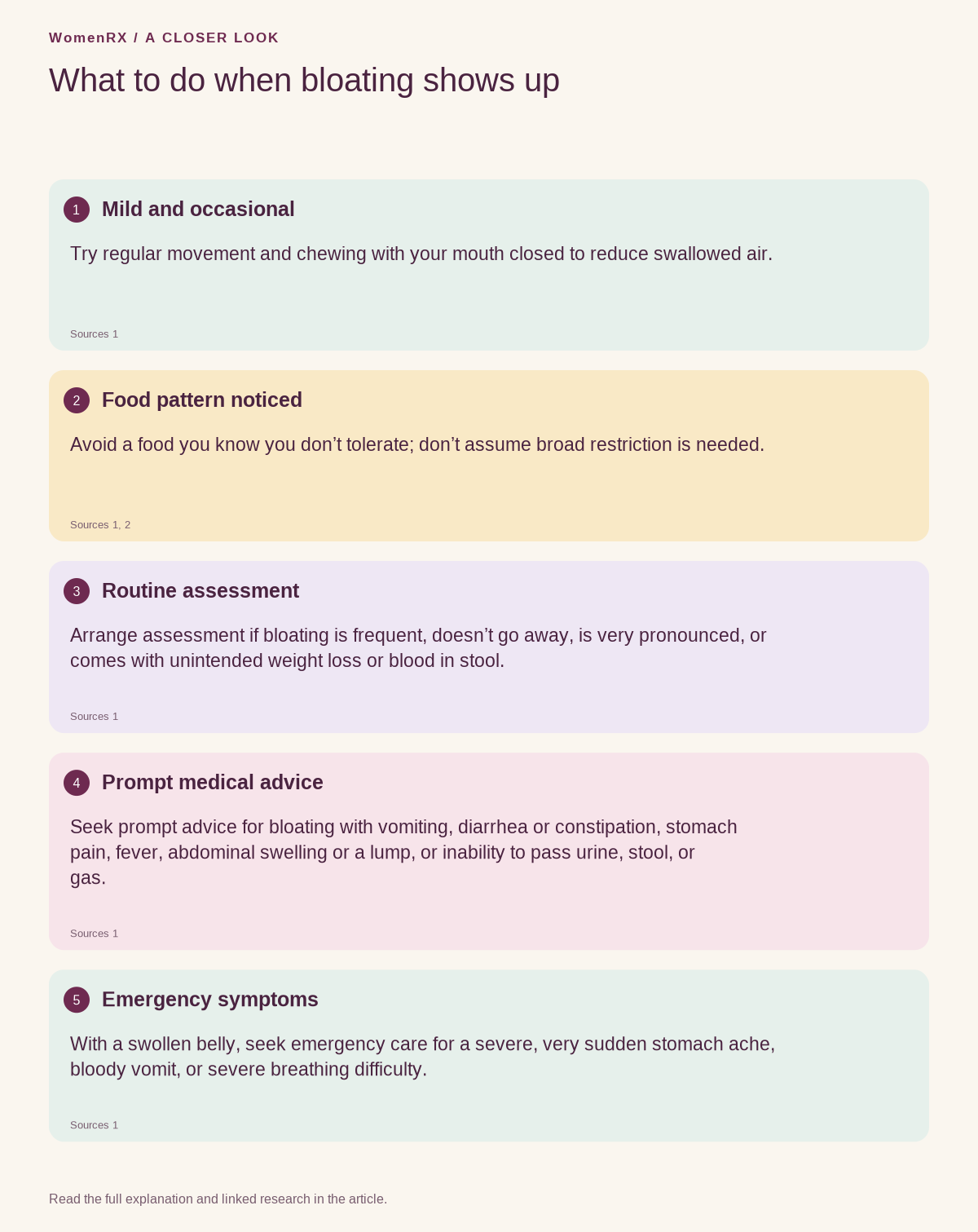
What to do when bloating shows up
Mild and occasional: Try regular movement and chewing with your mouth closed to reduce swallowed air.1
Food pattern noticed: Avoid a food you know you don’t tolerate; don’t assume broad restriction is needed.12
Routine assessment: Arrange assessment if bloating is frequent, doesn’t go away, is very pronounced, or comes with unintended weight loss or blood in stool.1
Prompt medical advice: Seek prompt advice for bloating with vomiting, diarrhea or constipation, stomach pain, fever, abdominal swelling or a lump, or inability to pass urine, stool, or gas.1
Emergency symptoms: With a swollen belly, seek emergency care for a severe, very sudden stomach ache, bloody vomit, or severe breathing difficulty.1
Read the figure as text
Start with the symptom pattern, then check for accompanying changes. This is a next-step guide, not a diagnostic test.- Mild and occasional: Try regular movement and chewing with your mouth closed to reduce swallowed air.1
- Food pattern noticed: Avoid a food you know you don’t tolerate; don’t assume broad restriction is needed.12
- Routine assessment: Arrange assessment if bloating is frequent, doesn’t go away, is very pronounced, or comes with unintended weight loss or blood in stool.1
- Prompt medical advice: Seek prompt advice for bloating with vomiting, diarrhea or constipation, stomach pain, fever, abdominal swelling or a lump, or inability to pass urine, stool, or gas.1
- Emergency symptoms: With a swollen belly, seek emergency care for a severe, very sudden stomach ache, bloody vomit, or severe breathing difficulty.1
Sources you can check
- Bloating - NHSAccessed 2026-09-25Return to first citation
- Nutritional Management of Irritable Bowel Syndrome.Colecchia L, Marasco G, Meacci D, Cremon C, Pivetti A, Manni G, Gobbato A, Xhuveli M, Di Biase AR, Colecchia A, Barbara G. · Nutrients · 2026Return to first citation
- The volume and characteristics of research on gastrointestinal symptoms in 'natural' peri- and postmenopause: A scoping review.Shaw N, Abbott R, Pettinger C. · Women's health (London, England) · 2025Return to first citation
- Do fluctuations in ovarian hormones affect gastrointestinal symptoms in women with irritable bowel syndrome?Heitkemper MM, Chang L. · Gender medicine · 2009Return to first citation