Panic Symptoms Around Menopause: What Else Could Be Going On?
A sudden wave of fear may happen alongside hot flashes, but the timing alone can’t tell you what caused it.
Menopause symptoms and anxiety can overlap, but research hasn’t established that the menopause transition directly causes panic disorder. A panic attack involves sudden intense fear; anxiety can also bring sweating or a rapid heartbeat. If episodes are new or changing, describe both the fear and the physical sensations so an assessment can consider menopause symptoms, anxiety, and other health conditions. 1 5

Start with what happened, not what to call it
A sudden episode of intense fear can feel alarming, especially if it comes with sweating or a racing heart. Panic attacks come on quickly and can last several minutes or more. Panic disorder involves repeated attacks; one frightening episode doesn’t establish that diagnosis. Anxiety itself can also cause sweating and a rapid heartbeat, so those sensations don’t identify the cause on their own. 1
If this started around perimenopause, that timing is worth mentioning. It isn’t proof that hormones caused it. Likewise, a past history of anxiety shouldn’t automatically settle the explanation for a new or different physical symptom.
Why hot flashes complicate the picture
Hot flashes and night sweats are recognized menopause symptoms. Research into their relationship with anxiety has not settled whether anxiety tends to come before a hot flash or follow it. Studies have also struggled to separate bodily symptoms from psychological ones when measuring anxiety during the menopause transition. 2 5
That makes the order of events useful to describe, even though it isn’t a home diagnostic test. For example, did you first notice heat, then fear? Did fear come on suddenly without a noticeable hot flash? Do night sweats happen at other times too? These details give a clinician more to work with than the phrase “menopause panic.”
A systematic review found that studies of anxiety during the menopause transition often used weak measures of anxiety or menopause status. It found no solid data on how often women in those studies met diagnostic criteria for anxiety disorders. That’s why a possible connection between menopause and anxiety shouldn’t be presented as proof that menopause causes panic disorder. 5
Keep more than one explanation in view
Stress and other life circumstances may play a part in anxiety. Physical health conditions can matter too: MedlinePlus names thyroid problems and heart rhythm problems, or arrhythmias, among conditions relevant to an anxiety assessment. A clinician may ask about the episodes and your health history, examine you, and use tests when needed to check for another health problem. 1
When you describe an episode, include what came on first, whether there was sudden intense fear, what your heartbeat and sweating felt like, and whether you noticed heat or night sweats. Mention if the pattern is new or has changed. This isn’t about collecting enough clues to diagnose yourself. It helps keep an assessment open to both physical and psychological possibilities. If you think an episode may be a medical emergency, seek immediate care rather than waiting to see whether it passes as a menopause symptom.
Match the help to what’s actually happening
If an anxiety disorder is identified, treatment may include psychotherapy, medication, or both. Cognitive behavioral therapy (CBT) is one form of psychotherapy that works on thoughts and behaviors involved in fear and avoidance. 1
If hot flashes or night sweats are also disrupting your life, they deserve their own treatment conversation. Menopause guidance identifies hormone therapy as the most effective treatment for hot flashes and related vasomotor symptoms, while also identifying evidence-supported nonhormone options. Those recommendations address vasomotor symptoms, not panic disorder. 3 4
You don’t have to decide in advance whether an episode was “hormonal” or “anxiety.” Describing what changed and what happened during it is a useful first step toward finding out which concerns need attention.
What an episode might involve
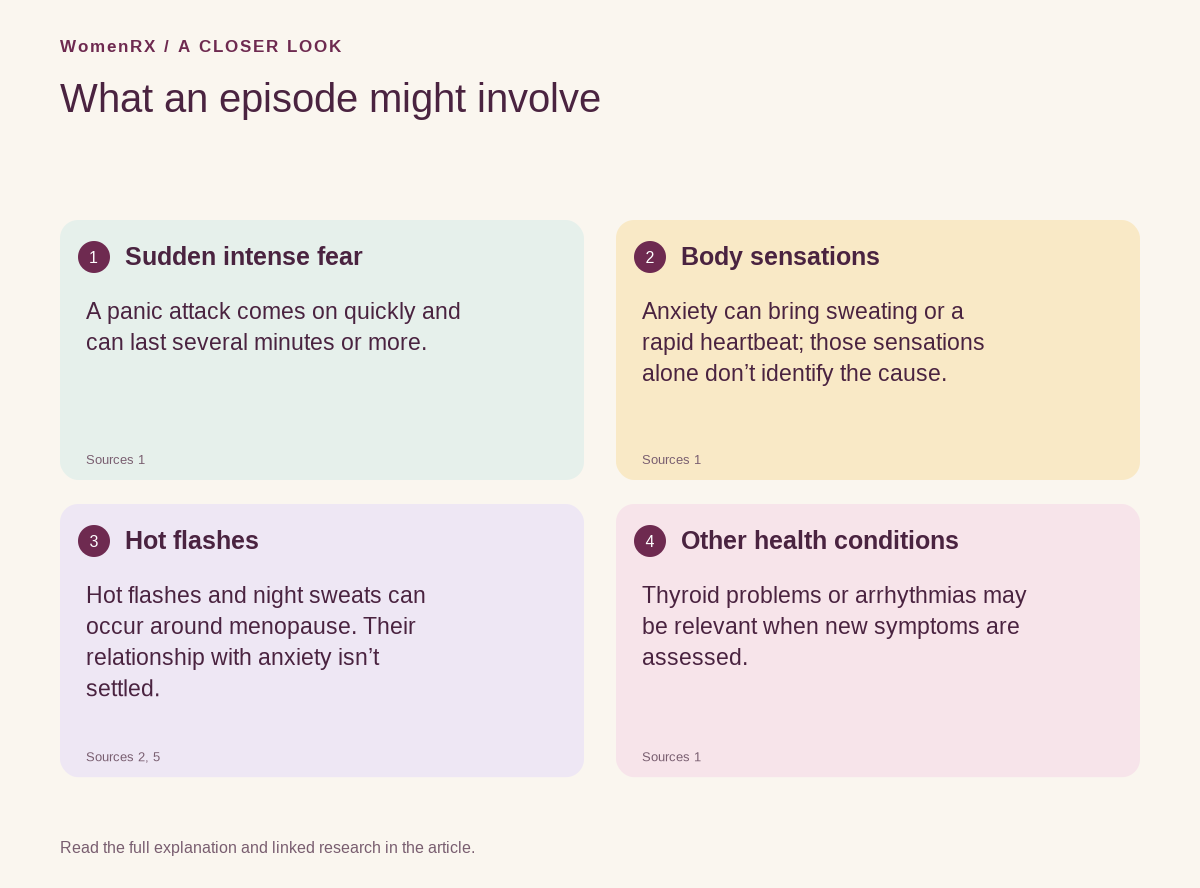
Sudden intense fear: A panic attack comes on quickly and can last several minutes or more.1
Body sensations: Anxiety can bring sweating or a rapid heartbeat; those sensations alone don’t identify the cause.1
Hot flashes: Hot flashes and night sweats can occur around menopause. Their relationship with anxiety isn’t settled.25
Other health conditions: Thyroid problems or arrhythmias may be relevant when new symptoms are assessed.1
Read the figure as text
These experiences can overlap. The comparison helps you describe what happened, not diagnose its cause.- Sudden intense fear: A panic attack comes on quickly and can last several minutes or more.1
- Body sensations: Anxiety can bring sweating or a rapid heartbeat; those sensations alone don’t identify the cause.1
- Hot flashes: Hot flashes and night sweats can occur around menopause. Their relationship with anxiety isn’t settled.25
- Other health conditions: Thyroid problems or arrhythmias may be relevant when new symptoms are assessed.1
Sources you can check
- Anxiety: MedlinePlusAccessed 2026-09-25Return to first citation
- Other medicines for menopause symptoms - NHSAccessed 2026-09-25Return to first citation
- The 2022 hormone therapy position statement of The North American Menopause Society.“The 2022 Hormone Therapy Position Statement of The North American Menopause Society” Advisory Panel. · Menopause (New York, N.Y.) · 2022Return to first citation
- The 2023 nonhormone therapy position statement of The North American Menopause Society.Menopause (New York, N.Y.) · 2023Return to first citation
- Anxiety during the menopausal transition: a systematic review.Bryant C, Judd FK, Hickey M. · Journal of affective disorders · 2012Return to first citation