When Panic Attacks May Suggest Panic Disorder
One panic attack doesn’t mean you have panic disorder; the pattern that follows matters.
Panic disorder may be considered when unexpected panic attacks recur and are followed by at least a month of persistent concern about more attacks, along with a behavior change to avoid situations associated with them. You don’t need to wait a month to seek help if an episode concerns you or fear is changing what you do. An assessment also checks for other possible explanations. 1 2 3

Look at what happens between attacks
A panic attack can feel intensely physical. Your heart may race; you may shake, feel short of breath or dizzy, or have chest discomfort. Fear of dying or losing control can come with those sensations. An attack begins abruptly and can peak within minutes. Its intensity alone, though, doesn’t tell you whether you have panic disorder. Many people have an attack without developing the disorder. 1 2
The distinction is a recurring pattern. Clinicians look for repeated, unexpected attacks, followed by at least one month of persistent concern about having more attacks, along with a behavior change to avoid a situation associated with the attacks. For example, avoiding a route because you fear having another attack there is the kind of change worth mentioning. It isn’t, by itself, a diagnosis. 1 2
“Unexpected” matters, too. A panic attack can occur in another mental health condition. If attacks happen only in a particular feared situation, such as public speaking, a clinician needs to consider that context rather than assume panic disorder. There’s no single number of attacks you can count to settle the question yourself. 2
Why an assessment looks beyond panic
The conversation usually covers what happens during an episode, whether attacks seem to come without warning, and whether worry or avoidance has begun to affect daily life. A screening questionnaire may help identify symptoms, but it doesn’t replace an assessment of the whole pattern. 2 3
Some medical conditions can cause similar sensations. Clinical reviews identify thyroid conditions and heart rhythm abnormalities among the possibilities to assess. Medications and substance use can also be relevant. This doesn’t mean those causes are likely in your case; it means new or concerning symptoms shouldn’t automatically be dismissed as “just panic.” 2 3
You can seek help before the one-month mark. That duration helps define the pattern used in diagnosis, not how long you must put up with frightening episodes or wait while they disrupt your life. If you’re avoiding ordinary activities, worrying often about another attack, or unsure what caused an episode, those are useful reasons to talk with a clinician. 1 2
Treatment addresses the fear around attacks, too
Cognitive behavioral therapy, or CBT, is an established psychotherapy option for panic disorder. It works with the thoughts and responses that can keep fear going, including avoidance after an attack. A systematic review of psychological therapies for adults with panic disorder found repeated evidence favoring CBT on several short-term outcomes. The review rated the overall evidence quality as low, however, so it doesn’t establish CBT as better than every other therapy for every person. 1 4
Medication is another option that may be discussed. A clinical review describes selective serotonin reuptake inhibitors (SSRIs) and selective norepinephrine reuptake inhibitors (SNRIs), alongside psychotherapy, as effective approaches. That doesn’t mean everyone needs medication or a combination of treatments. The first useful step is working out what the episodes are and how they’re affecting you. 3
What one small study found about women
Panic disorder isn’t unique to women. In one study of 80 people with panic disorder, including 56 women, researchers reported better outcomes with acceptance and commitment therapy (ACT) than CBT among women. The study also examined age and duration of panic disorder, and its authors said the findings need further study. It doesn’t tell us whether the results apply during pregnancy, postpartum, perimenopause, or after menopause, so it isn’t a reason to assume ACT will work better for you. 5
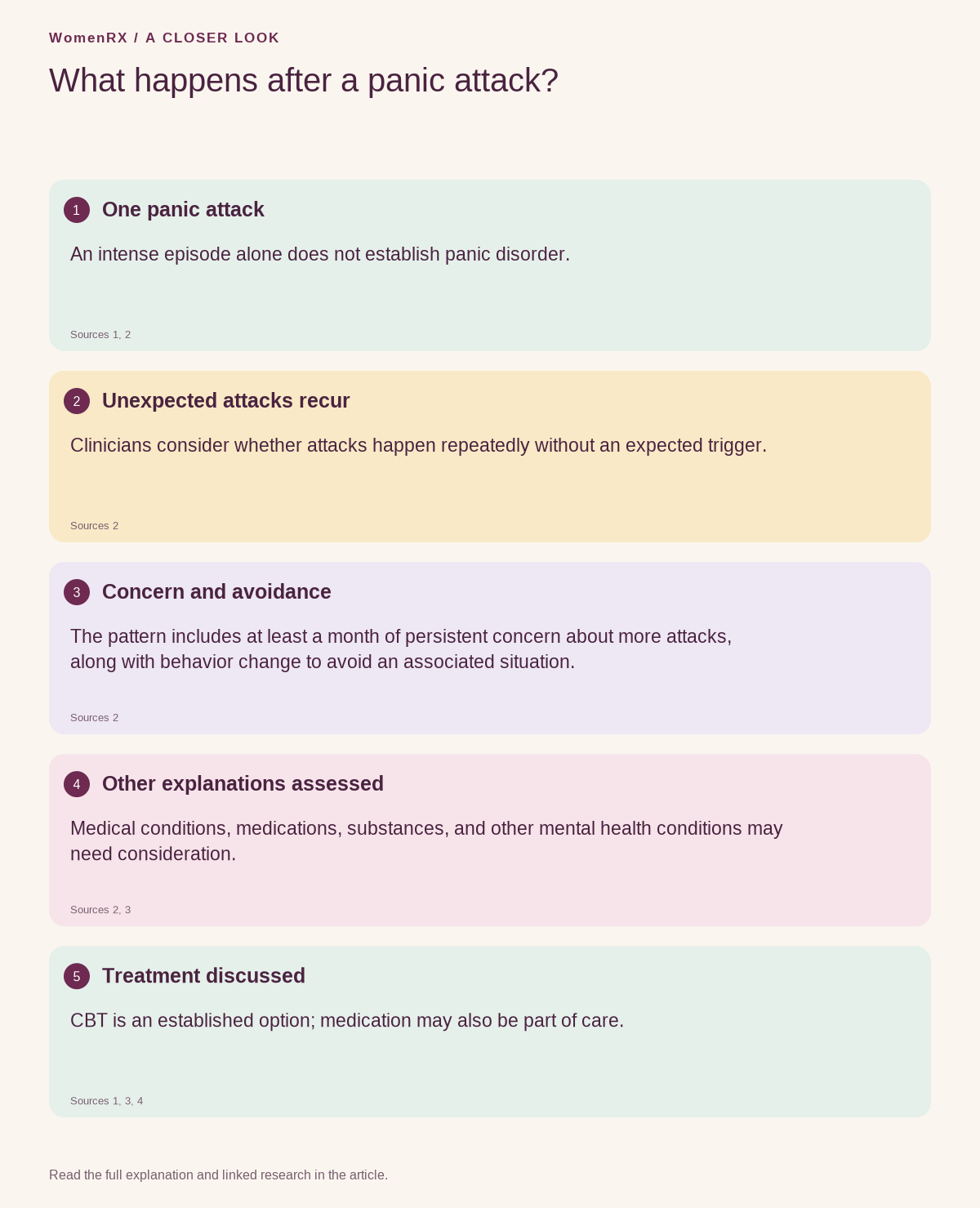
What happens after a panic attack?
One panic attack: An intense episode alone does not establish panic disorder.12
Unexpected attacks recur: Clinicians consider whether attacks happen repeatedly without an expected trigger.2
Concern and avoidance: The pattern includes at least a month of persistent concern about more attacks, along with behavior change to avoid an associated situation.2
Other explanations assessed: Medical conditions, medications, substances, and other mental health conditions may need consideration.23
Treatment discussed: CBT is an established option; medication may also be part of care.134
Read the figure as text
A single episode starts the question; recurrence, what follows, and other possible causes shape the assessment.- One panic attack: An intense episode alone does not establish panic disorder.12
- Unexpected attacks recur: Clinicians consider whether attacks happen repeatedly without an expected trigger.2
- Concern and avoidance: The pattern includes at least a month of persistent concern about more attacks, along with behavior change to avoid an associated situation.2
- Other explanations assessed: Medical conditions, medications, substances, and other mental health conditions may need consideration.23
- Treatment discussed: CBT is an established option; medication may also be part of care.134
Sources you can check
- Panic Disorder: MedlinePlusAccessed 2026-09-25Return to first citation
- Panic DisorderCackovic C, Nazir S, Marwaha R. · 2023Return to first citation
- Mood and Anxiety Disorders: Generalized Anxiety and Panic Disorders.Joseph R, Falk A, Smith S, Wilk A. · FP essentials · 2023Return to first citation
- Psychological therapies for panic disorder with or without agoraphobia in adults: a network meta-analysis.Pompoli A, Furukawa TA, Imai H, Tajika A, Efthimiou O, Salanti G. · The Cochrane database of systematic reviews · 2016Return to first citation
- Predictors and Moderators of Panic Disorder: Cognitive Behavioral Therapy vs. Acceptance and Commitment Therapy.León-Quismondo L, Fernández-Liria A, López-Ríos F, Saiz-Ruiz J, García-Montes JM, Ibáñez Á, Stiles BJ, Lahera G. · Psicothema · 2024Return to first citation