Low Desire After Menopause: What May Help
Low desire doesn’t automatically need treatment; if it bothers you, start by separating desire itself from pain, health, mood, medicines, and relationship factors.
After menopause, low desire may reflect several things at once, including vaginal or pelvic pain, a health condition, medicines, mood, or relationship circumstances. If the change doesn’t trouble you, there’s no need to make increasing desire the goal. If it does, treating pain or dryness and considering therapy are nonhormonal paths, though evidence for restoring desire specifically after menopause is limited. 1 2 4 5
First, decide whether low desire is a problem for you
There’s no single level of sexual desire that every woman should have after menopause. A change matters most when it causes personal distress or gets in the way of what you want from intimacy. Clinical definitions of a desire disorder include distress, not just having sex less often. If your desire differs from a partner’s, that mismatch may still be part of the relationship context to consider. Desire can also arise before sexual activity or in response to wanted closeness and stimulation. 5 4
That distinction can change the next step. If you feel content, you don’t need to pursue treatment simply to meet someone else’s expectations. If you miss feeling interested, feel pressured or upset, or want intimacy but find that something is getting in the way, it may help to identify what that “something” is before treating libido as a standalone problem.
Check whether pain or dryness is taking desire off the table
After menopause, genitourinary syndrome of menopause (GSM) can involve vulvovaginal and urinary symptoms, including dryness and pain with sex. But pain with penetration isn’t always caused by GSM: pelvic floor tension, skin or inflammatory conditions, and other pelvic causes may also play a part. 2 3
If sex hurts, it’s reasonable to focus on comfort first rather than pushing through or expecting a libido treatment to solve the pain. Vaginal moisturizers may help dryness; lubricants can reduce friction during sexual activity. Persistent or significant pain deserves attention to its cause, since the right approach depends on what’s behind it. A systematic review of trials in postmenopausal women found that moisturizers may improve dryness, but the evidence was low certainty and mostly short term. That finding is about dryness, not proof that moisturizers increase desire. 2 3
Consider health and medicines, not only hormones
Chronic health conditions can affect sexual health, and medicines can affect sexual desire or performance. They may be one part of the picture when desire changes, rather than the only explanation. 1
There may be more than one contributor. For example, pain may make intimacy less appealing, while stress or a relationship concern affects how easy it feels to talk about it. Menopause-related sexual concerns are described as involving biological, psychological, and relational factors, so it can help to consider all three rather than assuming one cause. 2 4
Nonhormonal options depend on what you want to change
If discomfort is the main barrier: Try a vaginal moisturizer for ongoing dryness or lubricant during sexual activity. If pain continues, a focused assessment can help distinguish GSM from pelvic floor, skin, or other causes. Pelvic floor physiotherapy may be considered when tenderness, guarding, or muscle tightness contributes to pain. These steps target comfort; they aren’t established as direct treatments for low desire. 2 3
If distress about desire is the main concern: Cognitive behavioral therapy (CBT), sex therapy, mindfulness-based approaches, or couples therapy may be worth considering, depending on what feels relevant to you. A small pilot randomized trial of 106 women diagnosed with hypoactive sexual desire disorder found better sexual-function scores after group CBT than in a waiting-list group. The trial did not report results for a postmenopausal subgroup, so it suggests a possible option rather than establishing how well CBT works specifically after menopause. 4 5
If context is part of the problem: You might want to address relationship tension, pressure to have sex, or a mismatch between what you want and what a partner expects. That doesn’t mean the issue is “all in your head.” It means the plan can include emotional and relational needs alongside physical comfort. Therapy focused on sexuality or couples may help you explore those concerns, although the evidence for a particular approach in postmenopausal women remains limited. 4
Make the goal yours
A useful starting question is: “What would I like to be different?” The answer might be less pain, more ease with touch, a better conversation with a partner, or feeling more interested in sex. It might also be accepting that your desire has changed and choosing not to treat it. Each points to a different plan, and none requires assuming that your desire should match someone else’s.
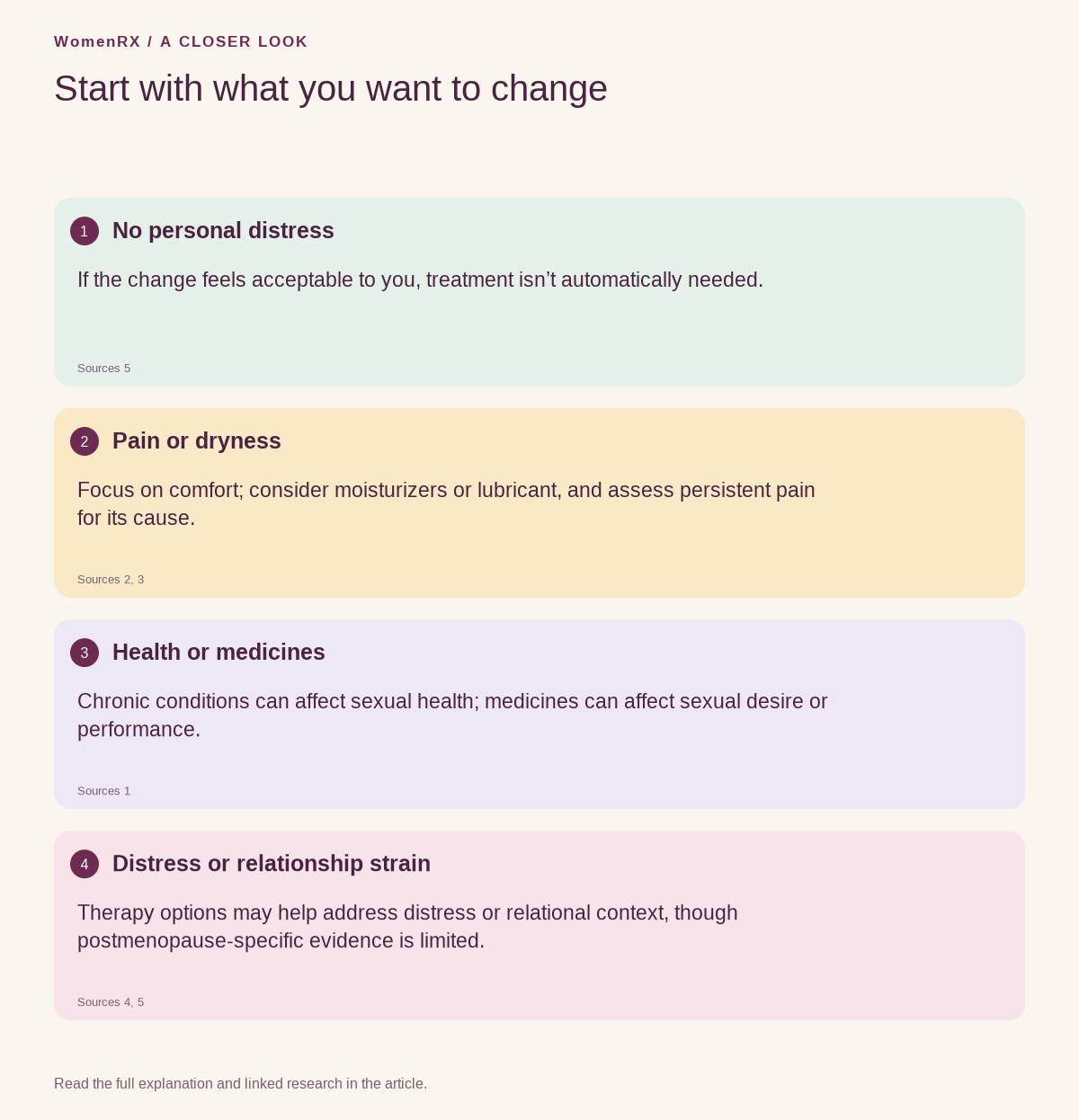
Start with what you want to change
No personal distress: If the change feels acceptable to you, treatment isn’t automatically needed.5
Pain or dryness: Focus on comfort; consider moisturizers or lubricant, and assess persistent pain for its cause.23
Health or medicines: Chronic conditions can affect sexual health; medicines can affect sexual desire or performance.1
Distress or relationship strain: Therapy options may help address distress or relational context, though postmenopause-specific evidence is limited.45
Read the figure as text
Low desire can have several contributors. This flow connects the concern that matters most to a reasonable first direction, without assuming every woman wants more desire.- No personal distress: If the change feels acceptable to you, treatment isn’t automatically needed.5
- Pain or dryness: Focus on comfort; consider moisturizers or lubricant, and assess persistent pain for its cause.23
- Health or medicines: Chronic conditions can affect sexual health; medicines can affect sexual desire or performance.1
- Distress or relationship strain: Therapy options may help address distress or relational context, though postmenopause-specific evidence is limited.45
More questions, answered
Can vaginal moisturizers bring back libido?
The review found low-certainty evidence that vaginal moisturizers may improve dryness in postmenopausal women, but it did not establish that they increase sexual desire. 3
Does low desire mean I have a sexual disorder?
Not by itself. A clinical desire disorder involves distress, not simply a lower level of interest. Your own wishes and whether the change bothers you matter. 5
Sources you can check
- Sexual Health | MedlinePlusAccessed 2026-09-25Return to first citation
- Assessment and management of dyspareunia in peri- and postmenopausal women: A phenotype-based gynecologic approach.Broul M, Vančo M, Banýrová J, Hujová A. · International journal of gynaecology and obstetrics: the official organ of the International Federation of Gynaecology and Obstetrics · 2026Return to first citation
- Hormonal Treatments and Vaginal Moisturizers for Genitourinary Syndrome of Menopause : A Systematic Review.Danan ER, Sowerby C, Ullman KE, Ensrud K, Forte ML, Zerzan N, Anthony M, Kalinowski C, Abdi HI, Friedman JK, Landsteiner A, Greer N, Nardos R, Fok C, Dahm P, Butler M, Wilt TJ, Die... · Annals of internal medicine · 2024Return to first citation
- Management of sexual dysfunction in menopause: an update on evidence-based strategies.Parrotta GE, Cucinella L, Nappi RE. · Expert review of endocrinology & metabolism · 2026Return to first citation
- Cognitive-behavioral group therapy for women with hypoactive sexual desire: A pilot randomized study.Lerner T, Bagnoli VR, de Pereyra EAG, Fonteles LP, Sorpreso ICE, Júnior JMS, Baracat EC. · Clinics (Sao Paulo, Brazil) · 2022Return to first citation