Which Nonhormonal Menopause Treatments Fit Your Symptoms?
The best-supported nonhormonal option depends on whether you want fewer hot flashes, better sleep, relief from vaginal dryness, or help with leakage.
Match the treatment to the symptom. Prescription nonhormonal medicines can reduce hot flashes, while menopause-specific CBT can make them less bothersome. CBT for insomnia has evidence for persistent sleep trouble. Vaginal moisturizers and lubricants address dryness, but not urine leakage; leakage options depend on whether pressure or a sudden urge triggers it. Mood symptoms have their own psychological treatment evidence. 10 11 4 9 12 13 1 8
Start with the symptom, not the menopause label
Hot flashes, sleeplessness, vaginal dryness, mood changes, and urine leakage can overlap, but they aren’t one condition. An option with evidence for one symptom may do little for another. The useful first distinction is what you want to change: the number of hot flashes, how disruptive they feel, your sleep, vaginal discomfort, or a particular pattern of leakage. 4 10 12 1
That distinction matters during perimenopause as well as after menopause. Sleep problems can persist after the transition, and they can occur even when hot flashes aren’t present. So persistent insomnia deserves attention in its own right, rather than being assumed to be just a side effect of night sweats. 5
Hot flashes: fewer episodes or less disruption?
If your main goal is fewer hot flashes or night sweats, there are nonhormonal prescription options with evidence for that specific outcome. The North American Menopause Society’s 2023 position statement recommends certain SSRIs and SNRIs, gabapentin, and fezolinetant for vasomotor symptoms. It also recommends CBT and clinical hypnosis, and lists oxybutynin as an option with somewhat less consistent evidence. Those are hot-flash recommendations, not treatments for every menopause symptom. 10
Fezolinetant offers a concrete example of the difference between reducing episodes and coping with them. In two placebo-controlled trials of postmenopausal women with frequent moderate-to-severe vasomotor symptoms, it reduced hot-flash frequency and severity more than placebo at weeks 4 and 12. Its US prescribing information also requires liver blood tests before and during treatment because liver injury has occurred after approval. It’s a choice to weigh with a prescriber, particularly if you take other medicines: fezolinetant must not be used with CYP1A2-inhibiting drugs. If you’re taking it and develop symptoms such as dark urine or yellowing skin or eyes, the patient instructions say to stop it and seek medical attention immediately. 11
CBT answers a related but different need. A systematic review and meta-analysis of randomized trials involving 2,887 women found that psychosocial approaches, particularly CBT, reduced how bothersome hot flashes and night sweats felt in the short and medium term. The effects on symptom frequency and severity were smaller. In everyday terms, the strongest evidence is for changing the impact these symptoms have on you, not necessarily stopping them from happening. 4 Menopause-specific CBT is also an option in clinical guidance for people who prefer not to use hormone therapy. 13
Soy isoflavones are sometimes promoted for menopause symptoms, but a meta-analysis of studies in perimenopausal women did not find a significant effect on hot flashes, excessive sweating, insomnia, or vasomotor symptoms, despite an effect on its overall menopause-symptom measure. The authors cautioned that samples were small. 7 The North American Menopause Society does not recommend soy foods or extracts as hot-flash treatments, while NICE notes some evidence that isoflavones may relieve vasomotor symptoms and reports interactions with other medicines. The soy review’s symptom-specific findings leave the benefit for hot flashes uncertain. 10 13 7 That mixed picture makes soy a less dependable hot-flash choice than the recommended options above. 7 10 13
Sleep: treat insomnia as a symptom of its own
If sleep trouble continues, including when hot flashes aren’t part of the picture, CBT for insomnia (CBT-I) has evidence for chronic insomnia in peri- and postmenopausal women. A systematic review and meta-analysis of trials in perimenopausal and postmenopausal women found that nonpharmacological treatments improved scores on measures of sleep quality and insomnia. The review identified CBT-I among the most robust options. The treatments did not change total sleep time in the analysis, so improved sleep scores don’t necessarily mean more hours asleep. 5 9
A separate review of 12 studies found the most consistent sleep-related effects with CBT and CBT-I; acceptance- and mindfulness-based approaches also showed promise, but results varied more. 8 Physical activity may still suit you for general health, but in a meta-analysis of nine trials involving 1,579 women with vasomotor symptoms, it did not significantly improve sleep quality or insomnia; the improvement in sleep problems was small. 6
Mood: psychological approaches look promising, not settled
A systematic review of randomized and quasi-experimental studies in peri- and postmenopausal women found that CBT and other psychological approaches were generally associated with reduced depression and anxiety symptoms. The review found the most consistent effects with CBT and CBT-I particularly for insomnia; it did not establish which psychological approach works best for mood symptoms. Because the studies differed in format, outcomes, and follow-up, this is encouraging evidence rather than a guarantee that one approach will work for everyone. 8
Soy isoflavones are not a proven substitute for mood treatment. A meta-analysis of studies in perimenopausal women found a reduction in depression scores across four studies with 748 participants. The authors cautioned that the review’s results should be interpreted carefully because of sample size and called for more trials. A finding on a symptom scale does not establish that a supplement treats clinical depression, including after menopause. 7
Vaginal dryness needs a local approach
For dryness or discomfort during sex, a vaginal moisturizer and a lubricant have different jobs: a moisturizer is used to relieve dryness, while a lubricant reduces friction during sex. Both are nonhormonal options in menopause guidance for people who prefer not to use vaginal estrogen or cannot use it. They’re aimed at vaginal symptoms, not hot flashes or every kind of urinary problem. 12 13
Dryness isn’t always due to menopause. Pregnancy, breastfeeding, certain medicines, cancer treatment, and other conditions can also contribute. If dryness persists despite what you’ve tried, affects daily life, or comes with unusual discharge, get it assessed rather than assuming another moisturizer is the answer. Bleeding after sex or after menopause also needs assessment. 12 A review finding that psychosocial approaches did not improve urogenital symptoms is another reason not to expect hot-flash CBT to relieve dryness. 4
Urinary leakage has different patterns
With urinary leakage, the pattern gives you a more useful starting point than the menopause label. Leaking during a cough, sneeze, laugh, or exercise is characteristic of stress incontinence, which can involve weak pelvic-floor muscles. A sudden, hard-to-delay urge with leakage is urge incontinence, and some people have both leakage patterns. 1 3
Pelvic-floor strengthening aims to improve the muscles that help hold urine in, a relevant approach when pressure triggers leaks. Bladder training gradually extends the time between bathroom trips, addressing a different part of the problem when urgency is prominent. These are general incontinence options, not a menopause-specific comparison showing which works better for women at a particular stage. A vaginal moisturizer may help dryness, but it is not the same treatment as bladder training or pelvic-floor strengthening. 1 2 12
New leakage can sometimes relate to a temporary cause such as an infection or a new medicine, so it shouldn’t automatically be attributed to menopause. See a clinician about urinary leakage; an assessment can help identify the pattern and a way to manage it. 1 2
Make the choice that matches your goal
For hot flashes, decide whether fewer episodes or less bother is your priority: prescription options have evidence for reducing vasomotor symptoms, while CBT’s clearest benefit is reducing their impact. For ongoing insomnia, look at CBT-I rather than assuming a hot-flash treatment will solve every awakening. For dryness, start with dryness-specific options; for leakage, distinguish pressure-related leaks from sudden-urge leaks. Mood symptoms merit their own attention, too. A single product labeled “for menopause” doesn’t make those different jobs interchangeable. 10 11 4 9 12 1 8
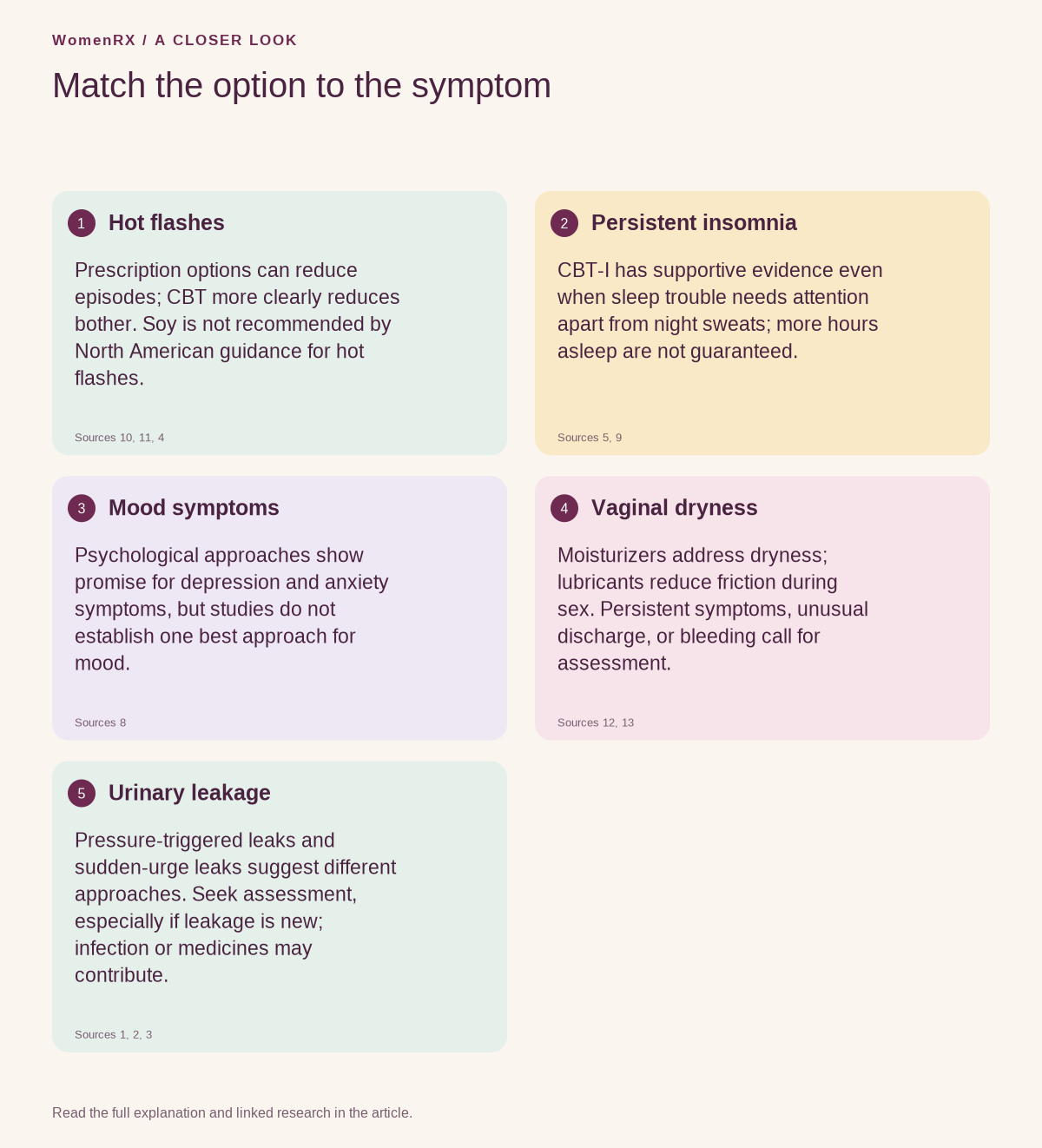
Match the option to the symptom
Hot flashes: Prescription options can reduce episodes; CBT more clearly reduces bother. Soy is not recommended by North American guidance for hot flashes.10114
Persistent insomnia: CBT-I has supportive evidence even when sleep trouble needs attention apart from night sweats; more hours asleep are not guaranteed.59
Mood symptoms: Psychological approaches show promise for depression and anxiety symptoms, but studies do not establish one best approach for mood.8
Vaginal dryness: Moisturizers address dryness; lubricants reduce friction during sex. Persistent symptoms, unusual discharge, or bleeding call for assessment.1213
Urinary leakage: Pressure-triggered leaks and sudden-urge leaks suggest different approaches. Seek assessment, especially if leakage is new; infection or medicines may contribute.123
Read the figure as text
A symptom-led map of supported nonhormonal options, their limits, and signs that a different assessment may be needed.- Hot flashes: Prescription options can reduce episodes; CBT more clearly reduces bother. Soy is not recommended by North American guidance for hot flashes.10114
- Persistent insomnia: CBT-I has supportive evidence even when sleep trouble needs attention apart from night sweats; more hours asleep are not guaranteed.59
- Mood symptoms: Psychological approaches show promise for depression and anxiety symptoms, but studies do not establish one best approach for mood.8
- Vaginal dryness: Moisturizers address dryness; lubricants reduce friction during sex. Persistent symptoms, unusual discharge, or bleeding call for assessment.1213
- Urinary leakage: Pressure-triggered leaks and sudden-urge leaks suggest different approaches. Seek assessment, especially if leakage is new; infection or medicines may contribute.123
More questions, answered
Does exercise reliably improve menopause-related insomnia?
Not based on one meta-analysis of nine trials involving 1,579 women with vasomotor symptoms: exercise did not significantly improve sleep quality or insomnia, although it produced a small improvement in sleep problems. That doesn’t mean exercise has no health benefits; it means it isn’t a reliably demonstrated insomnia treatment in that analysis. 6
Do soy supplements help hot flashes?
A meta-analysis of studies in perimenopausal women found no significant effect of soy isoflavones on hot flashes, excessive sweating, or vasomotor symptoms. Clinical guidance differs in how it describes the evidence, but the North American Menopause Society does not recommend soy foods or extracts to treat hot flashes. 7 10 13
Sources you can check
- Urinary Incontinence | Stress Incontinence | UI | MedlinePlusAccessed 2026-09-25Return to first citation
- Urinary incontinence - NHSAccessed 2026-09-25Return to first citation
- Urinary incontinence - Symptoms - NHSAccessed 2026-09-25Return to first citation
- The effectiveness of psychosocial interventions on physiological symptoms of menopause: a systematic review and meta-analysis.Robinson K, Hardy R, Melville M, Saidel S, Desai R, Spector A. · BMC women's health · 2026Return to first citation
- Impact of sleep disturbances on health-related quality of life in postmenopausal women: a systematic review.Soares CN, Bajbouj M, Schoof N, Kishore A, Caetano C. · Menopause (New York, N.Y.) · 2026Return to first citation
- Effect of physical activity on sleep in women experiencing vasomotor symptoms during menopause: a systematic review and meta-analysis.Corrêa AB, Bardella MDC, da Silva AP, Moreira MM, Leite LFPA, de Moraes C. · Maturitas · 2025Return to first citation
- Effects of soy isoflavones on menopausal symptoms in perimenopausal women: a systematic review and meta-analysis.Luan H, Liu Q, Guo Y, Fan H, A S, Lin J. · PeerJ · 2025Return to first citation
- Cognitive-behavioral, acceptance-based, and mindfulness-based interventions for psychological and sleep-related symptoms during menopause: a systematic review.de Dios Tapia A, Rueda-Extremera M, Cantero-García M. · Acta psychologica · 2026Return to first citation
- Pharmacological and non-pharmacological treatments for chronic insomnia in perimenopausal and postmenopausal women: a systematic review and meta-analysis.Bruyneel M, Rozenberg S, Sanida C, Demaeyer N, Castermans E, Bruyneel AV. · Sleep medicine · 2026Return to first citation
- The 2023 nonhormone therapy position statement of The North American Menopause Society.Menopause (New York, N.Y.) · 2023Return to first citation
- VEOZAH (FEZOLINETANT) TABLET, FILM COATED [ASTELLAS PHARMA US, INC.] | US prescribing information and patient instructionsAccessed 2026-09-25Return to first citation
- Vaginal dryness - NHSAccessed 2026-09-25Return to first citation
- Recommendations | Menopause: identification and management | Guidance | NICEAccessed 2026-09-25Return to first citation