PTSD Signs and Support: What to Know
Intrusive memories, avoidance, and feeling on guard can be signs of PTSD when they persist and disrupt daily life.
PTSD can involve reliving a traumatic event, avoiding reminders, lasting changes in mood or thoughts, and feeling persistently on guard. Distress after trauma is common, and many people recover over time; PTSD is a diagnosis made through assessment, not a label for every painful reaction. If symptoms last more than a month, cause significant distress, or interfere with daily life, an assessment may help. 1 4 5
When distress may be more than a short-term reaction
After a frightening or overwhelming event, feeling shaken or having frightening thoughts about what happened can be part of the body’s response to danger. Many people recover over time. PTSD is different from simply having experienced trauma: it involves a continuing pattern of symptoms that can remain distressing or interfere with everyday life. Symptoms can also begin later or come and go. 1 5
A traumatic experience doesn’t inevitably lead to PTSD. Sexual assault is one example of an event that can precede PTSD, but people respond differently, and an event alone doesn’t establish a diagnosis. 1
Four patterns worth noticing
PTSD symptoms are often described in four clusters. You don’t need to match every example below to consider getting support, and this list isn’t a diagnostic test. 1 4
- Reliving the event: unwanted memories, nightmares, or flashbacks that make it feel as if the event is happening again.
- Avoiding reminders: steering clear of thoughts, places, people, or situations connected with what happened.
- Changes in mood or thinking: ongoing distressing thoughts or feelings related to the trauma.
- Feeling on guard: persistent threat responses, such as hypervigilance.
These patterns can look different from person to person. For example, someone might avoid a particular kind of appointment because it brings back memories, while another person may notice nightmares or feel constantly alert. Those examples describe possible experiences, not proof of PTSD. 1 4
Women’s experiences aren’t all the same
Sexual assault can be a trauma context for PTSD. Traumatic childbirth is another possible context: a systematic review found an association between traumatic childbirth experiences and postpartum psychiatric disorders, including PTSD, while also reporting substantial differences across studies and assessment methods. That association doesn’t mean every difficult birth causes PTSD, or that every woman experiences it the same way. 1 2
Research on care related to childbirth is still developing. A review identified 12 antenatal intervention studies and described promising approaches, but also noted methodological limitations and gaps in including women with perinatal mental health difficulties. 3
What an assessment can clarify
A mental health professional experienced in PTSD can assess symptoms. MedlinePlus says PTSD diagnosis involves symptoms lasting at least a month; it also suggests seeking assessment when symptoms cause great distress or interfere with work or home life. You don’t have to decide for yourself whether what happened “counts” or try to diagnose yourself from a checklist. 1
If talking about the event feels difficult, you can begin with what’s affecting you now: for example, nightmares, feeling on guard, or avoiding reminders. You can also say what you do and don’t feel ready to discuss. That gives you a way to ask for help without starting by recounting details.
Which treatments can you ask about?
Trauma-focused psychotherapies are the first-line treatments recommended in the VA/DoD and American Psychological Association guidelines summarized in a 2025 review. Options named in those guidelines include prolonged exposure, cognitive processing therapy, cognitive therapy, trauma-focused cognitive behavioral therapy, and eye movement desensitization and reprocessing (EMDR). 5
A useful first question is: “Which of these approaches do you offer, and how would we decide what fits my situation?” You can also ask what sessions involve and how you can communicate if the pace feels too fast. PTSD care can include medication, therapy, or both, but the guidelines summarized in the review recommend trauma-focused psychotherapy as the first-line approach. 1 5
If you’re dealing with symptoms after sexual assault or childbirth, you can name the connection if you feel comfortable, or simply describe the symptoms and what situations feel difficult. The goal is to find support that addresses what you’re experiencing, without assuming that one kind of trauma or treatment fits everyone.
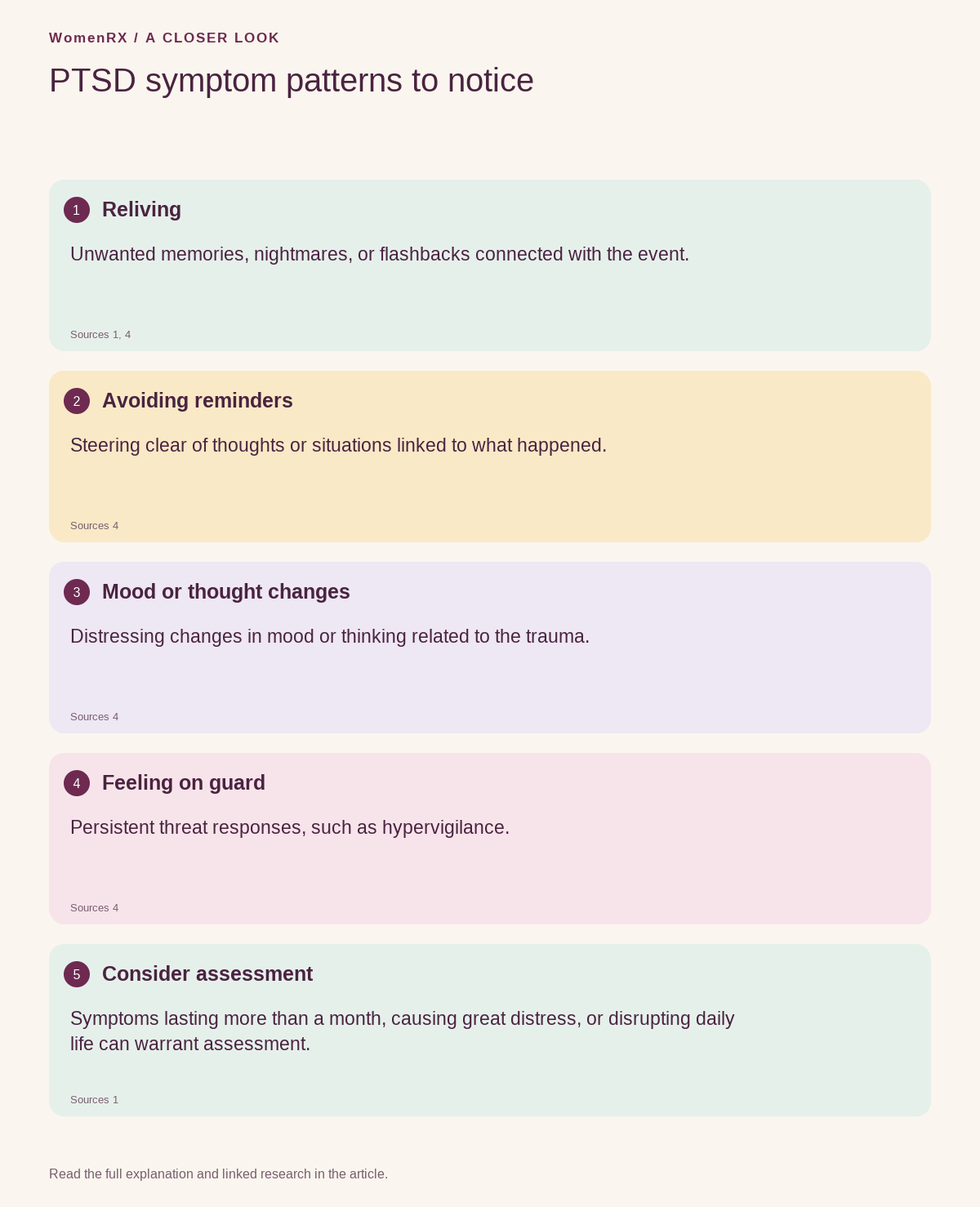
PTSD symptom patterns to notice
Reliving: Unwanted memories, nightmares, or flashbacks connected with the event.14
Avoiding reminders: Steering clear of thoughts or situations linked to what happened.4
Mood or thought changes: Distressing changes in mood or thinking related to the trauma.4
Feeling on guard: Persistent threat responses, such as hypervigilance.4
Consider assessment: Symptoms lasting more than a month, causing great distress, or disrupting daily life can warrant assessment.1
Read the figure as text
These four symptom clusters can help organize what you’ve been experiencing. They’re prompts for reflection, not a diagnostic test.- Reliving: Unwanted memories, nightmares, or flashbacks connected with the event.14
- Avoiding reminders: Steering clear of thoughts or situations linked to what happened.4
- Mood or thought changes: Distressing changes in mood or thinking related to the trauma.4
- Feeling on guard: Persistent threat responses, such as hypervigilance.4
- Consider assessment: Symptoms lasting more than a month, causing great distress, or disrupting daily life can warrant assessment.1
More questions, answered
Do PTSD symptoms have to start right after trauma?
No. Symptoms may start later, and they can come and go over time. If they persist, cause substantial distress, or affect daily life, an assessment can help clarify what’s going on. 1
Does a traumatic birth automatically mean someone has PTSD?
No. Research has found an association between traumatic childbirth experiences and postpartum psychiatric disorders, including PTSD, but studies vary and an individual’s experience needs its own assessment. 2
Sources you can check
- Post-Traumatic Stress Disorder: MedlinePlusAccessed 2026-09-25Return to first citation
- Traumatic Childbirth Experiences and their Association with Postpartum Psychiatric Disorders: A Systematic Review.Baldini V, Gnazzo M, De Ronchi D, Carotenuto M, Pera MC, Fiorillo A. · The Psychiatric quarterly · 2026Return to first citation
- Childbirth Related Post-Traumatic Stress Disorder and Childbirth Trauma: A Systematic Review of Available Primary Antenatal Intervention.MacMillan KK, Greenhalgh CF, Cleary DB, Cahill J, Dedman K, Bright C, Watson SJ. · Birth (Berkeley, Calif.) · 2026Return to first citation
- Scoping review protocol of the use of eye movement desensitisation and reprocessing in the treatment of birth trauma.O'Donovan S, Ward L, Melia R. · BMJ open · 2025Return to first citation
- An Update on Psychotherapy for the Treatment of PTSD.Rothbaum BO, Watkins LE. · The American journal of psychiatry · 2025Return to first citation