What OCD Can Look Like, and How ERP Helps
OCD is more than a preference for order: it involves recurring thoughts or rituals that cause significant distress or interfere with daily life.
OCD can involve repeated, distressing thoughts (obsessions), repeated behaviors or rituals (compulsions), or both. A habit or an upsetting thought alone doesn’t establish OCD; the pattern and its effect on daily life matter. A mental health specialist can assess what’s happening, and exposure and response prevention (ERP), a form of cognitive behavioral therapy, is a main treatment option. 1

When a thought or habit may be part of OCD
OCD involves obsessions, compulsions, or both. Obsessions are recurring thoughts; compulsions are repeated behaviors or rituals that a person feels driven to do, often to try to reduce anxiety or stop the thoughts. Examples can include repeated checking or washing, counting, and arranging. OCD isn’t simply liking things neat or having routines. The key question is whether the thoughts or behaviors create significant problems in everyday life. 1
A repeated habit by itself doesn’t tell you that you have OCD. Nor does one intrusive or upsetting thought. Assessment looks at the wider pattern: what keeps recurring, whether rituals or other responses follow, how much distress is involved, and whether daily life is affected. OCD symptoms can also resemble or occur alongside other mental health conditions, so getting the full picture matters. 1
Pregnancy and postpartum deserve careful attention
OCD may develop or worsen during the perinatal period, which includes pregnancy and the time after birth. That makes it worth bringing new or intensified symptoms to a clinician’s attention, particularly if they’re taking up time or disrupting daily life. A review of research on anxiety-related disorders reported evidence of increased risk of OCD developing or worsening during this period. 3
If a frightening thought involves harm to you or a baby, share the thought and the surrounding experience plainly when seeking an assessment. The thought’s content alone doesn’t establish OCD; the recurring pattern, distress, rituals, impact, and any other symptoms help distinguish what may be going on. An assessment matters rather than trying to diagnose yourself from one thought. 1
Pregnancy isn’t automatically a reason to rule out therapy. A review covering anxiety-related disorders during pregnancy and parenthood describes psychotherapy, including exposure therapy, as generally beneficial during pregnancy, while noting that treatment decisions can require individual consideration. The review addresses anxiety-related disorders broadly, not OCD alone. 2
What ERP asks you to practice
Exposure and response prevention is a specific type of cognitive behavioral therapy. In ERP, you gradually face a feared situation or thought and learn ways to handle the anxiety it brings. The “response prevention” part means working on not completing the usual ritual or compulsion in response. The steps are planned around the person’s fears, rather than requiring every fear to be faced at once. 1
ERP is a main treatment for OCD. Treatment can also include certain antidepressant medicines, or a combination of therapy and medicine. Which approach fits depends on the individual; the available information doesn’t support a single choice for everyone. 1
It’s also reasonable to ask how progress will be reviewed. People don’t all respond in the same way: a study of adults in an intensive outpatient ERP program found different patterns of symptom change over eight weeks, including gradual improvement, faster improvement, and worsening. Those results describe that particular treatment setting and aren’t a forecast for any one person. 4
Finding a useful starting point
You can start by telling your health care provider what thoughts or rituals are recurring and how they affect your day. MedlinePlus describes this as a first step in assessment and notes that a provider may refer someone to a mental health specialist. 1
When contacting a therapist or specialist, ask directly: “Do you assess and treat OCD with CBT that includes ERP?” You can also ask what the first steps would involve and how treatment would be adjusted if it feels too difficult. These questions help clarify whether the clinician’s approach matches the treatment being discussed, without requiring you to decide for yourself whether you have OCD.
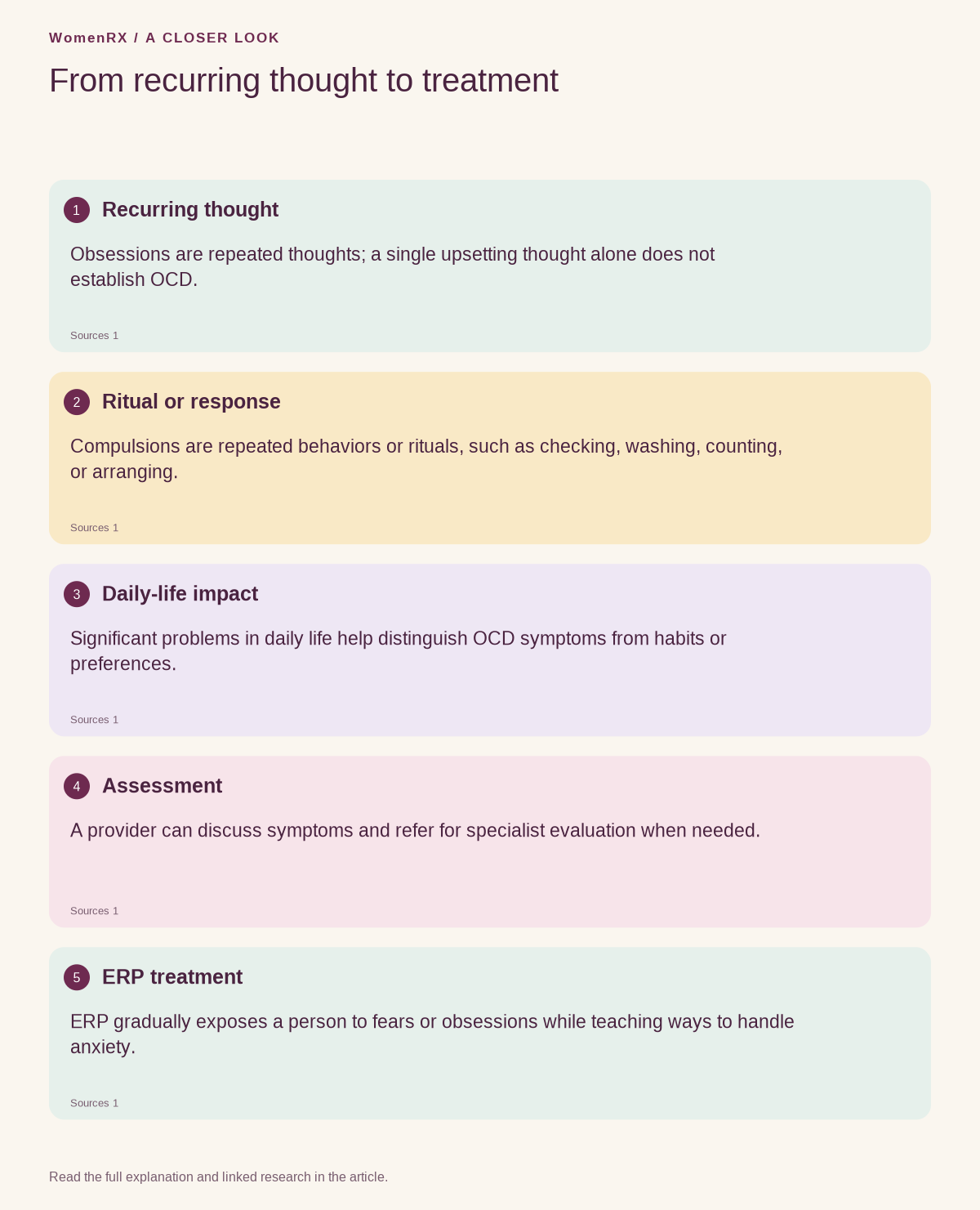
From recurring thought to treatment
Recurring thought: Obsessions are repeated thoughts; a single upsetting thought alone does not establish OCD.1
Ritual or response: Compulsions are repeated behaviors or rituals, such as checking, washing, counting, or arranging.1
Daily-life impact: Significant problems in daily life help distinguish OCD symptoms from habits or preferences.1
Assessment: A provider can discuss symptoms and refer for specialist evaluation when needed.1
ERP treatment: ERP gradually exposes a person to fears or obsessions while teaching ways to handle anxiety.1
Read the figure as text
This flow separates a recurring OCD pattern from an isolated thought and shows where assessment and ERP fit.- Recurring thought: Obsessions are repeated thoughts; a single upsetting thought alone does not establish OCD.1
- Ritual or response: Compulsions are repeated behaviors or rituals, such as checking, washing, counting, or arranging.1
- Daily-life impact: Significant problems in daily life help distinguish OCD symptoms from habits or preferences.1
- Assessment: A provider can discuss symptoms and refer for specialist evaluation when needed.1
- ERP treatment: ERP gradually exposes a person to fears or obsessions while teaching ways to handle anxiety.1
More questions, answered
Does being very tidy mean I have OCD?
No single preference, including liking things arranged a certain way, establishes OCD. The concern is a recurring pattern of obsessions or compulsions that causes significant problems in daily life. 1
Is ERP the same as being forced to face a fear?
ERP is described as gradually facing fears or obsessions and learning ways to manage the anxiety they bring. If you’re considering it, ask the therapist how they plan and adjust those steps. 1
Sources you can check
- Obsessive-Compulsive Disorder: MedlinePlusAccessed 2026-09-25Return to first citation
- Managing anxiety-related disorders from pregnancy to parenthood.Scholten W, Saris I, Eigenhuis E, de Koning L, Muntingh A, Schut B, Seldenrijk A, van Oppen P, Batelaan N. · Archives of gynecology and obstetrics · 2026Return to first citation
- Anxiety and Related Disorders During the Perinatal Period.Fairbrother N, Challacombe FL, Green SM, O'Mahen HA. · Annual review of clinical psychology · 2025Return to first citation
- Symptom trajectories in intensive outpatient treatment exposure and response prevention for obsessive-compulsive disorder.Qiu T, Tang M, Rogers K, Hadlock S, Lin T. · Journal of anxiety disorders · 2026Return to first citation