Magnesium for Migraine Prevention: What the Evidence Supports
Studies disagree on whether magnesium reduces how often migraines happen, while one analysis also found lower pain-severity scores.
Magnesium is worth discussing as a possible migraine preventive, but the evidence on attack frequency is mixed. One analysis found no statistically significant reduction in monthly attacks, while a separate review of 22 randomized trials reported a significant reduction. The results don’t establish a best form or dose, or show that magnesium treats an attack already underway. 3
First, decide which migraine question you’re asking
If you want fewer attacks over time, you’re asking about prevention. If you have a migraine now, you’re asking about acute treatment. That distinction matters with magnesium: a review of randomized supplement trials included oral products used for at least four weeks to study prevention. Its results can’t tell you whether taking magnesium during an attack will relieve it. 3
What the prevention studies say
A 2026 network meta-analysis brought together 14 randomized trials involving 791 adults. Those trials tested several types of supplements, not just magnesium. Compared with placebo, magnesium’s estimated effect on migraine frequency was 0.82 fewer attacks per month, but the range of plausible results ran from 2.03 fewer to 0.13 more. This analysis did not establish a reduction in monthly attacks. 3
That isn’t the whole picture. The same paper describes a separate dose-response meta-analysis of 22 randomized trials that reported significant reductions in migraine frequency and severity with magnesium. These are different analyses, and the summary does not provide enough detail to reconcile their results. Taken together, the findings suggest that frequency benefit is possible, but not settled. 3
Pain severity told a different story in the 14-trial network analysis. Magnesium was associated with a 3.56-point lower score than placebo on a 0-to-10 pain scale. The estimate was imprecise: its confidence interval ran from 0.52 to 6.50 points lower. No supplement in that analysis significantly shortened attack duration. So a finding about how painful attacks are shouldn’t be turned into a promise that you’ll have fewer or shorter ones. 3
MedlinePlus mentions magnesium as something to consider when magnesium levels are low. That’s a narrower suggestion than saying everyone with migraine should take it. 1
How to assess a bottle or a recommendation
These results don’t identify one magnesium formulation or dose as the best choice for migraine prevention. They also don’t show that a product containing magnesium will work the same way as magnesium studied on its own. For example, a separate analysis reported findings for a combination of valproate and magnesium; a combination result can’t tell you how much of any effect came from magnesium. 35
If you’re weighing a supplement, use the label to make the conversation concrete:
- What’s the goal? Fewer monthly attacks, less painful attacks, or relief during an attack? The evidence above addresses prevention, with different findings for frequency and severity. 3
- What exactly is in it? Ask whether the evidence applies to the listed magnesium form and amount, rather than assuming every product is interchangeable. 3
- What else do you take, and what conditions do you have? Have a pharmacist or the clinician managing your migraine check the exact product against your medicines and health history before you start it. MedlinePlus advises checking before taking supplements. 1
- How would you judge it? Agree on which change would make the product worthwhile to you, without treating a possible improvement in pain severity as proof it will prevent attacks. 3
If attacks cluster around your period, or you’re pregnant
Migraine attacks just before or during a period are often longer and more severe than attacks at other times. That makes prevention an understandable question, but the supplement analysis doesn’t report a menstrual-migraine result for magnesium. Its overall findings shouldn’t be presented as proof of a benefit specifically for period-related attacks. 23
Pregnancy is a separate decision. A European Headache Federation review reports expert consensus that magnesium is generally considered safe during pregnancy, while noting that reproductive safety data are scarce. That consensus does not establish that a particular supplement, form, or dose prevents migraine in pregnancy. Discuss the exact product and the purpose for taking it with your pregnancy care team. 4
Magnesium has a reason to be in a prevention discussion, especially if low magnesium is a concern. The useful next step is to match the claim you’re hearing to the outcome actually studied, then check whether the proposed product fits your health situation. 13
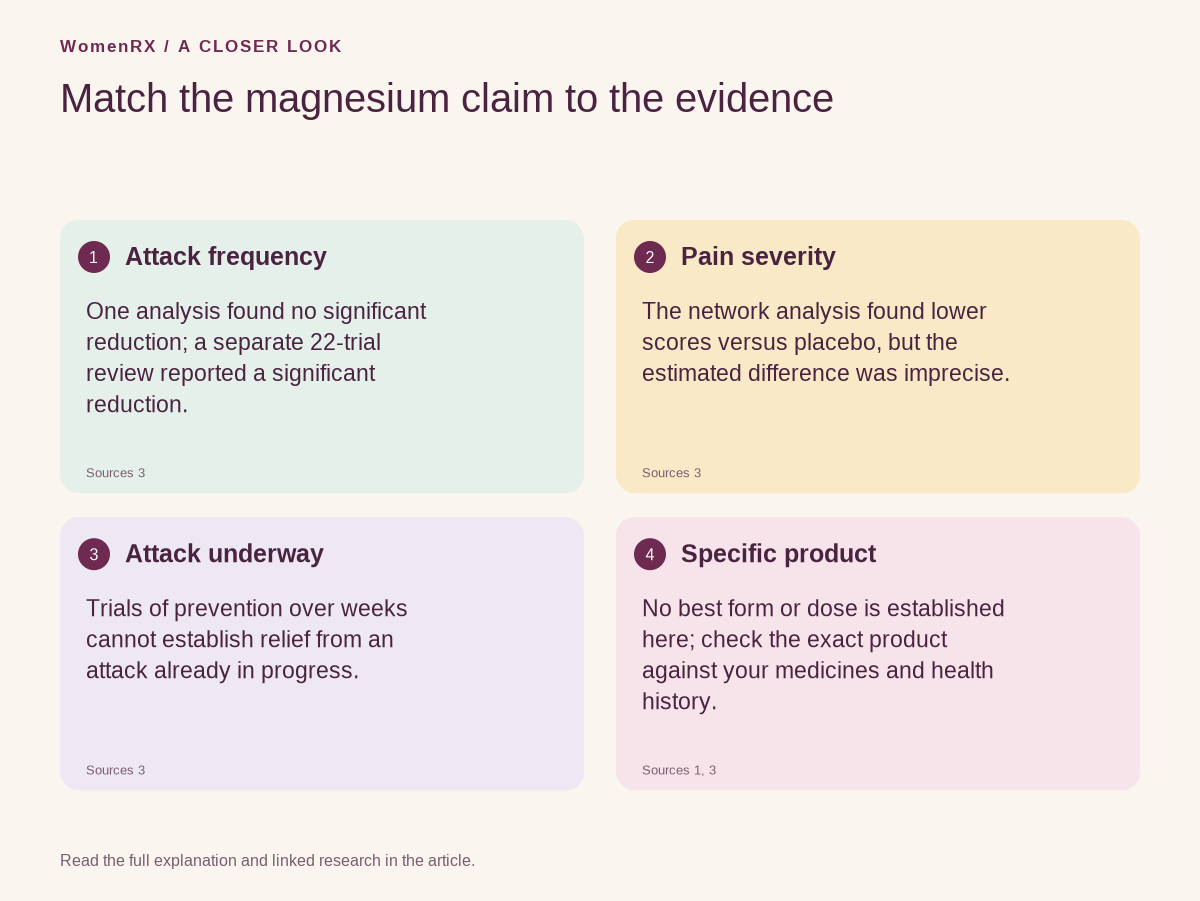
Match the magnesium claim to the evidence
Attack frequency: One analysis found no significant reduction; a separate 22-trial review reported a significant reduction.3
Pain severity: The network analysis found lower scores versus placebo, but the estimated difference was imprecise.3
Attack underway: Trials of prevention over weeks cannot establish relief from an attack already in progress.3
Specific product: No best form or dose is established here; check the exact product against your medicines and health history.13
Read the figure as text
A quick check of which migraine questions the findings answer and where analyses differ.- Attack frequency: One analysis found no significant reduction; a separate 22-trial review reported a significant reduction.3
- Pain severity: The network analysis found lower scores versus placebo, but the estimated difference was imprecise.3
- Attack underway: Trials of prevention over weeks cannot establish relief from an attack already in progress.3
- Specific product: No best form or dose is established here; check the exact product against your medicines and health history.13
Sources you can check
- Migraine | MedlinePlusAccessed 2026-09-25Return to first citation
- Migraine - NHSAccessed 2026-09-25Return to first citation
- Nutritional supplements for migraine prevention: evaluating evidence sufficiency and effect modifiers through network meta-analysis, trial sequential analysis, and meta-regression.Peng J, Zhou L, Chen Y, Li J, Zhang R. · Frontiers in nutrition · 2026Return to first citation
- Sex-specific management of migraine a systematic review and consensus statement from the European Headache Federation (EHF).Braca S, Casillo F, Moreira S, Ekizoglu E, Bjork MH, Szewczyk AK, Van Dycke A, Uluduz D, Coppola G, Deligianni C, Lampl C, Tronvik E, Amin FM, Versijpt J, Ryliškienė K, Rio MSD, Ho... · The journal of headache and pain · 2026Return to first citation
- Oral preventive medications for migraine in adults aged 18-65: a network meta-analysis.Wu J, Wu J, Zhang J, Liu B, Song X, Wu Y, Tian F, Ding Y, Wang P. · Frontiers in pharmacology · 2025Return to first citation