Magnesium for Migraine Prevention: When Is It Worth Discussing?
Magnesium may help prevent migraine for some people, but mixed results and pregnancy plans can change the decision.
Magnesium is a possible migraine preventive, though research on reducing attack frequency is mixed. The prevention studies don’t establish whether taking oral magnesium during an attack will relieve it. If your attacks cluster around periods, that pattern is worth identifying; if you’re planning pregnancy, safety deserves a separate discussion before you try a supplement. 1 5 6 7
What the prevention studies actually show
Magnesium is usually studied for a forward-looking goal: fewer future migraine attacks. An NIH summary found that three of four small, short-term, placebo-controlled trials reported modest reductions in attack frequency. It also reports that an American Academy of Neurology and American Headache Society guideline judged magnesium probably effective for migraine prevention. That’s a reason to consider it, not a promise that it will work for you. 1
A newer analysis makes the decision less clear-cut. Across trials of nutritional supplements in adults with migraine, a 2026 network meta-analysis did not find a statistically significant reduction in migraine frequency with magnesium compared with placebo. It did report a reduction in pain severity. Those are different outcomes: attacks that still happen but hurt less aren’t the same as attacks prevented. Many comparisons in the analysis were indirect, and it did not report a women-specific result. 5
One randomized trial offers another useful comparison. Over three months, adults assigned magnesium alone improved less on the measured migraine outcomes than groups receiving sodium valproate alone or with magnesium. It doesn’t tell us which individual will respond to magnesium, and it isn’t a reason to replace an existing preventive treatment without discussing the change. 4
These are prevention findings. They don’t answer a different question: whether taking oral magnesium once an attack starts relieves that attack. Migraine care can involve both medicines used for symptoms during an attack and treatments intended to prevent future ones. 1 2
If attacks seem tied to your period
Not every woman’s migraine follows her cycle. Some people have attacks only around menstruation; others have attacks around their period and at other times. Menstrual migraine attacks are often longer and more severe than attacks at other times. 3 7
To see which description fits, note the first day of each period and the days migraine attacks occur, including attacks between periods. A migraine diary can make a recurring pattern easier to spot. That distinction matters because a menstrual-migraine treatment discussion may include relief during an attack, short-term prevention around a predictable period, or ongoing prevention. 3 7
A review of menstrual-migraine treatments reports statistically significant short-term prevention findings involving magnesium. That doesn’t establish that everyone whose attacks cluster around a period will benefit, or that results from short-term, cycle-focused prevention apply to daily prevention. Bring the timing pattern to the conversation rather than assuming a period-linked migraine calls for a magnesium supplement. 7
Pregnancy plans change the safety question
If you’re pregnant or trying to become pregnant, don’t treat a supplement as automatically safer because it’s a nutrient. A systematic review covering pregnancy, pregnancy planning, postpartum, and breastfeeding found no evidence addressing how well preventive treatments work in those circumstances. It also reported a possible association between oral magnesium and fetal or child adverse effects. That does not establish that magnesium caused those effects, but it makes pregnancy plans relevant before choosing a preventive approach. 6
For adults more generally, the magnesium amounts typically studied for migraine prevention exceed the usual upper intake limit for magnesium from supplements. Soft stools or diarrhea have also been reported in a trial. Rather than copying a research regimen, ask how a proposed supplement would fit with your health history and current migraine care. 1
Questions that can make the decision easier
Start with the goal: are you hoping for fewer attacks, less severe attacks, or better relief when one begins? Ask whether your symptoms fit migraine, whether your period record suggests a predictable pattern, and how magnesium would fit alongside any treatment you already use. If pregnancy is possible or planned, say so before deciding on prevention. 2 5 6 7
A blood test isn’t a simple shortcut to the answer. Serum magnesium is commonly measured, but it does not accurately reflect total-body magnesium or levels in specific tissues. A result alone can’t tell you whether magnesium will prevent your migraine. 1
Which magnesium question are you asking?
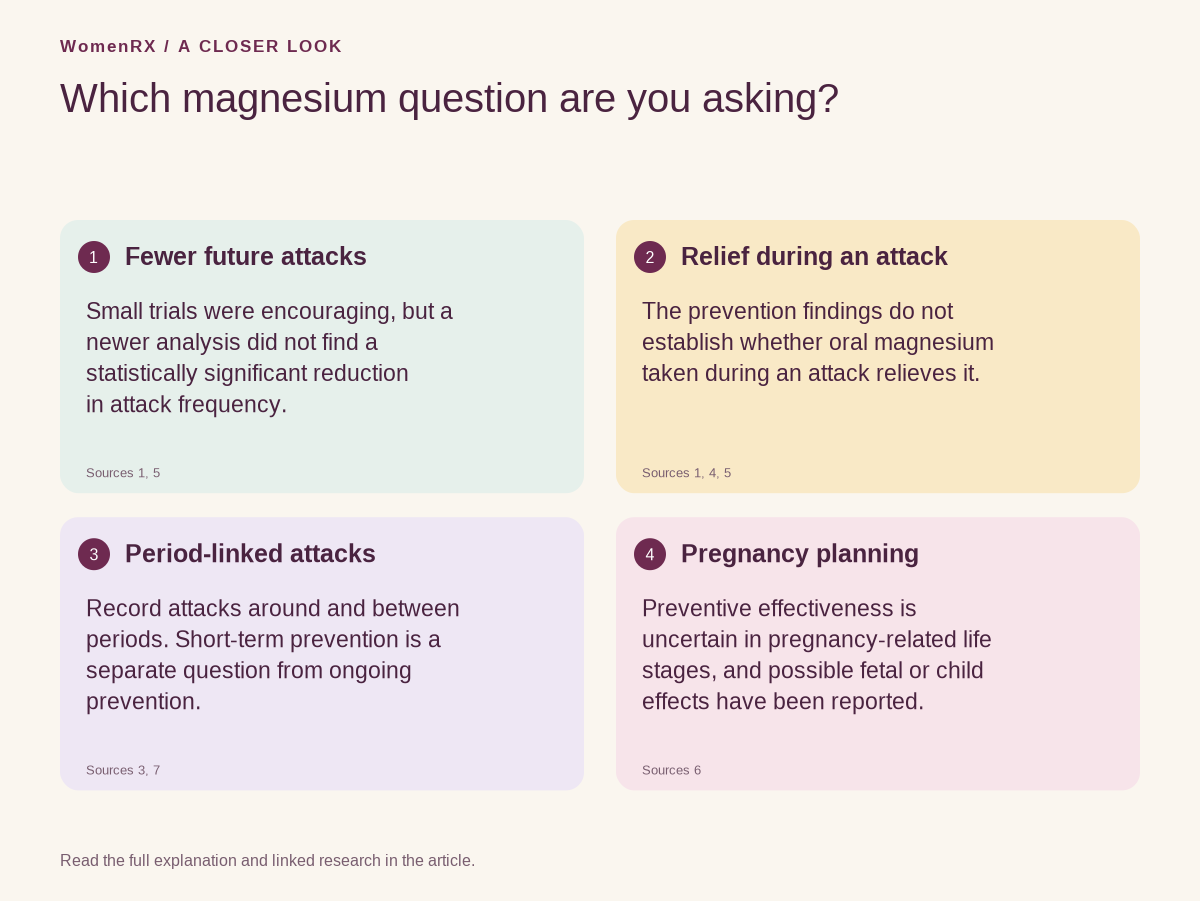
Fewer future attacks: Small trials were encouraging, but a newer analysis did not find a statistically significant reduction in attack frequency.15
Relief during an attack: The prevention findings do not establish whether oral magnesium taken during an attack relieves it.145
Period-linked attacks: Record attacks around and between periods. Short-term prevention is a separate question from ongoing prevention.37
Pregnancy planning: Preventive effectiveness is uncertain in pregnancy-related life stages, and possible fetal or child effects have been reported.6
Read the figure as text
The answer depends on your treatment goal and whether menstrual timing or pregnancy is part of the decision.- Fewer future attacks: Small trials were encouraging, but a newer analysis did not find a statistically significant reduction in attack frequency.15
- Relief during an attack: The prevention findings do not establish whether oral magnesium taken during an attack relieves it.145
- Period-linked attacks: Record attacks around and between periods. Short-term prevention is a separate question from ongoing prevention.37
- Pregnancy planning: Preventive effectiveness is uncertain in pregnancy-related life stages, and possible fetal or child effects have been reported.6
Sources you can check
- Magnesium - Health Professional Fact SheetAccessed 2026-09-25Return to first citation
- Migraine | MedlinePlusAccessed 2026-09-25Return to first citation
- Migraine - NHSAccessed 2026-09-25Return to first citation
- Comparative study of magnesium, sodium valproate, and concurrent magnesium-sodium valproate therapy in the prevention of migraine headaches: a randomized controlled double-blind trial.Khani S, Hejazi SA, Yaghoubi M, Sharifipour E. · The journal of headache and pain · 2021Return to first citation
- Nutritional supplements for migraine prevention: evaluating evidence sufficiency and effect modifiers through network meta-analysis, trial sequential analysis, and meta-regression.Peng J, Zhou L, Chen Y, Li J, Zhang R. · Frontiers in nutrition · 2026Return to first citation
- Management of primary headaches during pregnancy, postpartum, and breastfeeding: A systematic review.Saldanha IJ, Cao W, Bhuma MR, Konnyu KJ, Adam GP, Mehta S, Zullo AR, Chen KK, Roth JL, Balk EM. · Headache · 2021Return to first citation
- Menstrual Migraine and Treatment Options: Review.Maasumi K, Tepper SJ, Kriegler JS. · Headache · 2017Return to first citation