Migraine Remedies: What’s Worth Trying Without a Prescription?
Exercise, behavioral therapies, and a few supplements have support for migraine prevention, while herbal products raise different evidence and safety questions.
If you’re looking beyond medication, start by separating prevention from attack relief. Regular exercise, psychological therapies, and acupuncture have supportive evidence for prevention; magnesium, riboflavin, and coenzyme Q10 are also studied for that purpose. Feverfew’s results are less consistent, and butterbur raises liver-safety concerns. None of these general prevention findings establishes a specific benefit for cycle-linked attacks. 1 2 3 4
What job do you need the remedy to do?
A migraine attack can bring throbbing pain, nausea, and sensitivity to light or sound. Some attacks arrive at predictable times, including before a period. 1 If you’re shopping for something to help right now, a claim about preventing future attacks doesn’t answer your question. The nonprescription approaches below are chiefly discussed as ways to reduce future migraine or its impact, not as dependable ways to stop an attack in progress. 1 4
There’s no sound head-to-head ranking of every approach here. A more useful order is by what the evidence supports and what you’d need to weigh before trying it: non-drug practices, preventive supplements, then herbs with less consistent findings or a notable safety concern.
Non-drug care: more than avoiding triggers
Regular exercise and lifestyle changes are among the prevention approaches identified in a review of non-drug migraine care. Psychological therapy and acupuncture have also been studied as additions to preventive care for episodic migraine. Another review discusses relaxation training and biofeedback as behavioral techniques that may help people cope with stress and function better. Acupuncture is a separate treatment, not a type of behavioral therapy. 4 6
These options ask for different kinds of commitment. For example, exercise is something you may be able to build into your week, while acupuncture involves arranging treatment and psychological therapy may involve learning and practicing techniques. If stress seems to accompany your attacks, a behavioral approach could be especially worth exploring. That doesn’t mean stress is the sole cause of your migraine or that changing your routine will prevent every attack.
This is also a different safety conversation from buying a bottle of capsules: instead of assuming that a product’s ingredients are suitable for you, you’re considering whether an activity or course of care fits your circumstances. Non-drug care can be part of a broader migraine plan rather than a test of whether you can manage without medication. 4 5
Supplements: promising for prevention, not interchangeable
Riboflavin (vitamin B2) and coenzyme Q10 may help prevent migraine, according to MedlinePlus. It discusses magnesium as an option when magnesium levels are low. A review also identifies preventive clinical support for all three. That makes them more reasonable to investigate for prevention than a product promoted only with a vague “migraine relief” claim. It does not establish which supplement works best, whether combining them helps, or whether one will stop an attack that has already started. 1 4
The distinction matters when comparing packages on a shelf. Ask whether the claim is about fewer future attacks or relief during an attack, and whether the evidence concerns that ingredient rather than the particular blend being sold. Check the exact ingredients against medicines and other supplements you already take, especially if you’re pregnant or could become pregnant. General evidence of preventive benefit isn’t an ingredient-specific safety assessment in pregnancy. 1 5
Herbs deserve a closer look, not a blanket “natural” label
Feverfew has produced inconsistent migraine-prevention findings: some studies suggesting benefit have not been replicated. Butterbur presents a different problem. A review identifies liver-toxicity concerns, and MedlinePlus cautions that it may not be safe for long-term use. Those concerns make butterbur a poor choice to treat casually as just another preventive supplement. 1 3
For feverfew, the question is whether uncertain benefit is worth trying a particular product. For butterbur, the safety concern comes to the front. Neither herb becomes reliably effective or safe simply because it’s plant-derived. 1 3
If attacks cluster around your period
Menstrual migraine means attacks just before or during a period; they can be longer and more severe than attacks at other times. 2 That pattern gives you a more specific question than “Does this prevent migraine?” Ask whether an approach has been shown to help cycle-linked attacks, rather than assuming a general prevention finding applies equally to them. It’s a distinction worth keeping in view, not a reason to dismiss every preventive option.
Pregnancy calls for its own decision. Non-drug and behavioral care are often central to migraine management during pregnancy, but that does not establish the safety of magnesium, riboflavin, coenzyme Q10, feverfew, or butterbur for an individual pregnancy. Check a specific product and your circumstances with your pregnancy care team before using it. 5
If attacks are frequent or severe, you don’t have to choose between nonprescription approaches and effective migraine care. Preventive medication may also be part of the conversation. 1
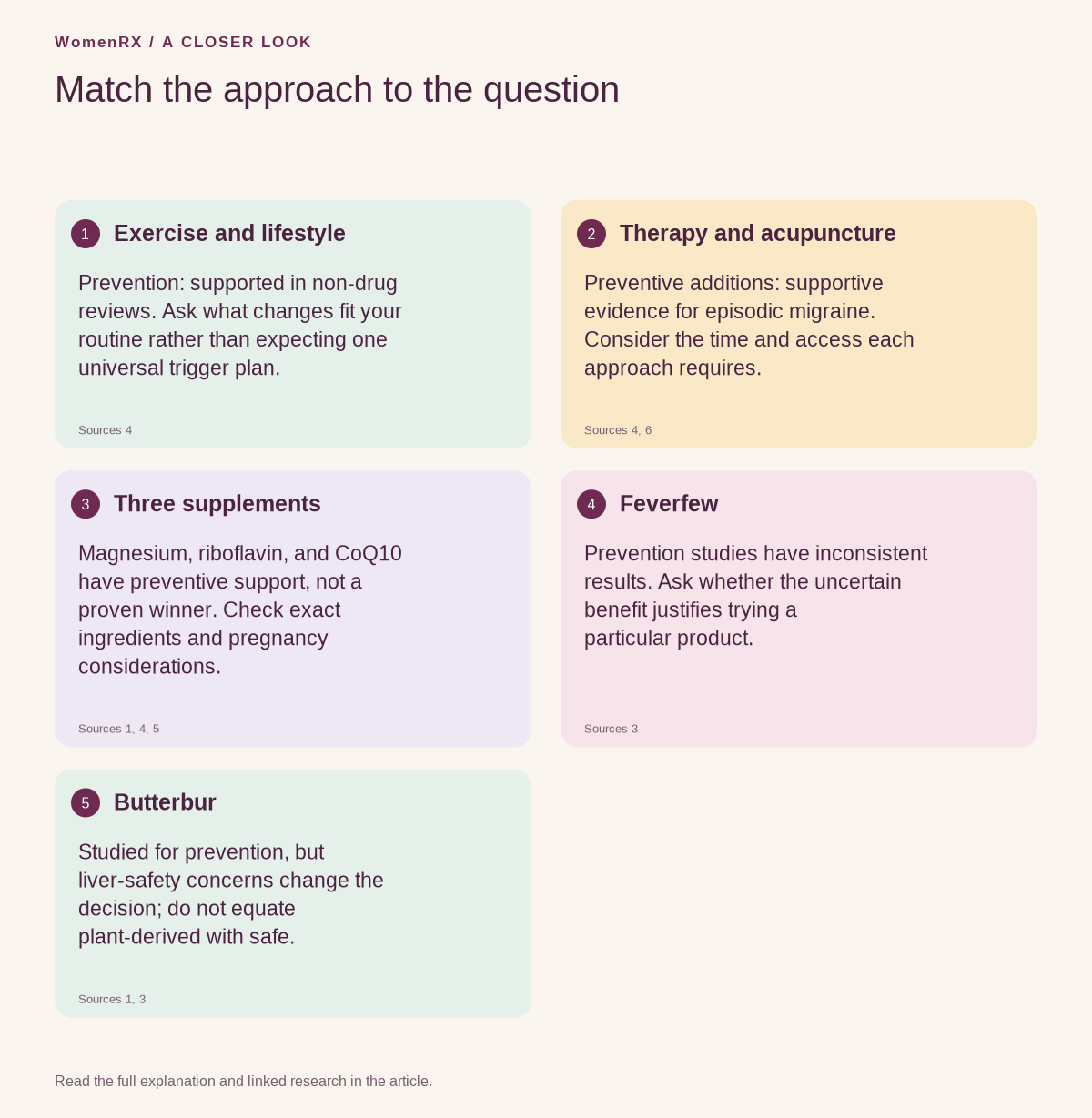
Match the approach to the question
Exercise and lifestyle: Prevention: supported in non-drug reviews. Ask what changes fit your routine rather than expecting one universal trigger plan.4
Therapy and acupuncture: Preventive additions: supportive evidence for episodic migraine. Consider the time and access each approach requires.46
Three supplements: Magnesium, riboflavin, and CoQ10 have preventive support, not a proven winner. Check exact ingredients and pregnancy considerations.145
Feverfew: Prevention studies have inconsistent results. Ask whether the uncertain benefit justifies trying a particular product.3
Butterbur: Studied for prevention, but liver-safety concerns change the decision; do not equate plant-derived with safe.13
Read the figure as text
The clearest comparison is by intended use, strength of support, and the next safety or fit question.- Exercise and lifestyle: Prevention: supported in non-drug reviews. Ask what changes fit your routine rather than expecting one universal trigger plan.4
- Therapy and acupuncture: Preventive additions: supportive evidence for episodic migraine. Consider the time and access each approach requires.46
- Three supplements: Magnesium, riboflavin, and CoQ10 have preventive support, not a proven winner. Check exact ingredients and pregnancy considerations.145
- Feverfew: Prevention studies have inconsistent results. Ask whether the uncertain benefit justifies trying a particular product.3
- Butterbur: Studied for prevention, but liver-safety concerns change the decision; do not equate plant-derived with safe.13
More questions, answered
Can a preventive supplement help once a migraine has started?
Evidence that a supplement may help prevent attacks doesn’t show that it will stop one already underway. Riboflavin and coenzyme Q10, for example, are described as possible preventive options. Match any product claim to the job you need it to do. 1
Sources you can check
- Migraine | MedlinePlusAccessed 2026-09-25Return to first citation
- Migraine - NHSAccessed 2026-09-25Return to first citation
- Bridging Gaps in Migraine Management: A Comprehensive Review of Conventional Treatments, Natural Supplements, Complementary Therapies, and Lifestyle Modifications.Abo-Elghiet F, Elosaily H, Hussein DK, El-Shiekh RA, A'aqoulah A, Yousef EM, Selim HMRM, El-Dessouki AM. · Pharmaceuticals (Basel, Switzerland) · 2025Return to first citation
- [Non-drug therapies in the treatment of migraine].Tóth M. · Ideggyogyaszati szemle · 2026Return to first citation
- Integrative migraine management within a healthcare system Part 1: Overview and conventional approaches.Bonakdar RA, Sweeney M, Simi J, Garvey CA, Jackson C. · The American journal of medicine · 2026Return to first citation
- Non-pharmacological approaches for migraine management: a mini-review.Singh V, Kumar A, Ray S, Chakravarty K, Lall N, Joshi D. · Frontiers in pain research (Lausanne, Switzerland) · 2026Return to first citation