Endometriosis and Fertility: What Shapes Your Options?
Endometriosis can make conception harder, but it doesn’t mean pregnancy is out of reach; the details of your disease and treatment history matter.
Endometriosis is linked with difficulty getting pregnant, but its effect varies. It can involve the ovaries and fallopian tubes; ovarian endometriomas, inflammation, and changes to pelvic anatomy may affect reproductive function, though they don’t tell you whether a particular person’s tubes are blocked or whether they’ll conceive. Age, ovarian-reserve findings, and prior surgery also shape the discussion. 2 6
Endometriosis can affect fertility, but a diagnosis does not tell you whether you’ll conceive or which treatment is right for you. The practical question is how your particular disease, age, ovarian reserve, symptoms, and pregnancy timeline fit together. Endometriosis may involve the ovaries or fallopian tubes, and it is recognized as one possible cause of infertility. 2 3
How endometriosis may interfere with conception
There isn’t just one route from endometriosis to difficulty conceiving. Disease can occur around the ovaries and fallopian tubes, and pelvic inflammation or changes in anatomy may affect reproductive function. Ovarian endometriomas are a particular concern for ovarian function: a review reports lower ovarian-reserve measures and fewer eggs retrieved during IVF among women with endometriomas. These findings describe associations and don’t establish what will happen for one person. 2 6
Endometriosis involving a fallopian tube doesn’t, by itself, prove that the tube is blocked or that egg transport is impaired. The location of disease is one part of the picture; testing and the full fertility history help clarify what’s affecting conception. 2 3
Start with the kind of disease and your pregnancy goal
Endometriosis ranges from disease outside the ovaries to ovarian endometriomas, which are cysts associated with endometriosis. Those situations raise different questions. With an endometrioma, for example, the discussion may include the cyst itself, the planned approach to any surgery, and how much ovarian tissue could be affected. Endometriosis can also be found in different pelvic locations. 2 4 6
Your timeline matters, too. Age is relevant to fertility, and a US reference defines infertility as not becoming pregnant after a year of frequent, unprotected sex, or after six months for someone age 35 or older. If you have diagnosed or suspected endometriosis and are considering pregnancy, you can discuss your goals and timeline before deciding whether to wait, investigate further, or consider treatment. 3
What ovarian-reserve results can add
Anti-Müllerian hormone (AMH) and antral follicle count (AFC) are ovarian-reserve measures used in fertility assessment. They can add context, especially when an endometrioma or prior ovarian surgery is part of your history. They are not, on their own, a complete account of your fertility. In one observational study of women with endometriomas who had surgery, age and AMH were associated with spontaneous pregnancy afterward. That finding describes a group-level association, not a reliable personal prediction. 5 6
This is one reason to discuss reserve results in context: your age, the presence and history of endometriomas, previous procedures, and your plans for pregnancy all matter. In particular, tell the care team about prior ovarian surgery. It can change how the possible benefits and costs of another procedure are considered. 4 5
Surgery has a trade-off, not a universal answer
Surgery may enter the discussion when other treatments aren’t working, endometriosis is extensive, or it affects your ability to have children. Troublesome symptoms matter to that decision, but they don’t, by themselves, tell you what your chances of conceiving are. For ovarian endometriomas at least 3 cm in size, a 2026 systematic review and meta-analysis compared cystectomy with ablative techniques. Cystectomy showed a trend toward less recurrence, while ablation was associated with a smaller decline in AFC. The analysis found no statistically significant difference between techniques in overall pregnancy, spontaneous conception, or ART/IVF pregnancy outcomes. 2 4
Those results don’t prove the approaches are identical, or answer whether surgery is better than no surgery before fertility treatment. They do show why the choice of procedure can involve competing priorities: recurrence and ovarian-reserve measures did not point in the same direction, and the measured fertility outcomes did not clearly favor one technique. The review included 12 studies, with only four to six contributing to each outcome analysis, so the comparison has limits. 4
If surgery is being discussed, useful specifics include whether the disease involves an ovary, what procedure is proposed, whether you have had ovarian surgery before, and how the plan fits your pregnancy timing. The goal is not simply to remove visible disease; it is to weigh symptom and disease concerns against possible effects on ovarian reserve and the next step toward pregnancy. 2 4
Waiting, evaluation, or assisted reproduction
Expectant management, meaning trying to conceive without immediate surgery or assisted reproduction, may be part of a discussion. If pregnancy is a current goal, how long you’ve already been trying and your age help frame whether to keep trying or pursue an evaluation. The usual US definition of infertility uses a year of frequent, unprotected sex, or six months at age 35 or older. That definition isn’t a prediction of how long conception will take with endometriosis. An evaluation can look beyond endometriosis, since fertility concerns can involve either partner. 3
An ovarian endometrioma changes the conversation, particularly if you’ve already had ovarian surgery. Rather than treating removal of the cyst as an automatic step toward pregnancy, you can weigh what surgery is meant to address against its possible effect on ovarian-reserve measures. The comparison of surgical techniques in endometriomas at least 3 cm does not tell us whether having surgery, continuing to try, or moving to assisted reproduction offers the best chance of pregnancy for a particular person. 4 6
IVF is one form of assisted reproductive technology: eggs are retrieved, combined with sperm to create embryos, and an embryo is transferred. It may be discussed as one option, but endometriosis alone does not make IVF inevitable. If ovarian reserve is diminished, decisions about ovarian surgery and fertility treatment may need to be considered together. One retrospective study of women age 40 or younger with endometriosis and diminished reserve compared IVF/ICSI stimulation protocols. It informs a narrower question about protocols for people already undergoing treatment, not whether IVF is preferable to trying to conceive or having surgery. 1 7
A useful discussion starts with your own priorities: whether pregnancy is a current goal, how soon you hope to try, whether an ovary has been operated on, and what the proposed treatment is expected to address. Those details help make the choice more specific than “endometriosis means infertility” or “surgery is always necessary.”
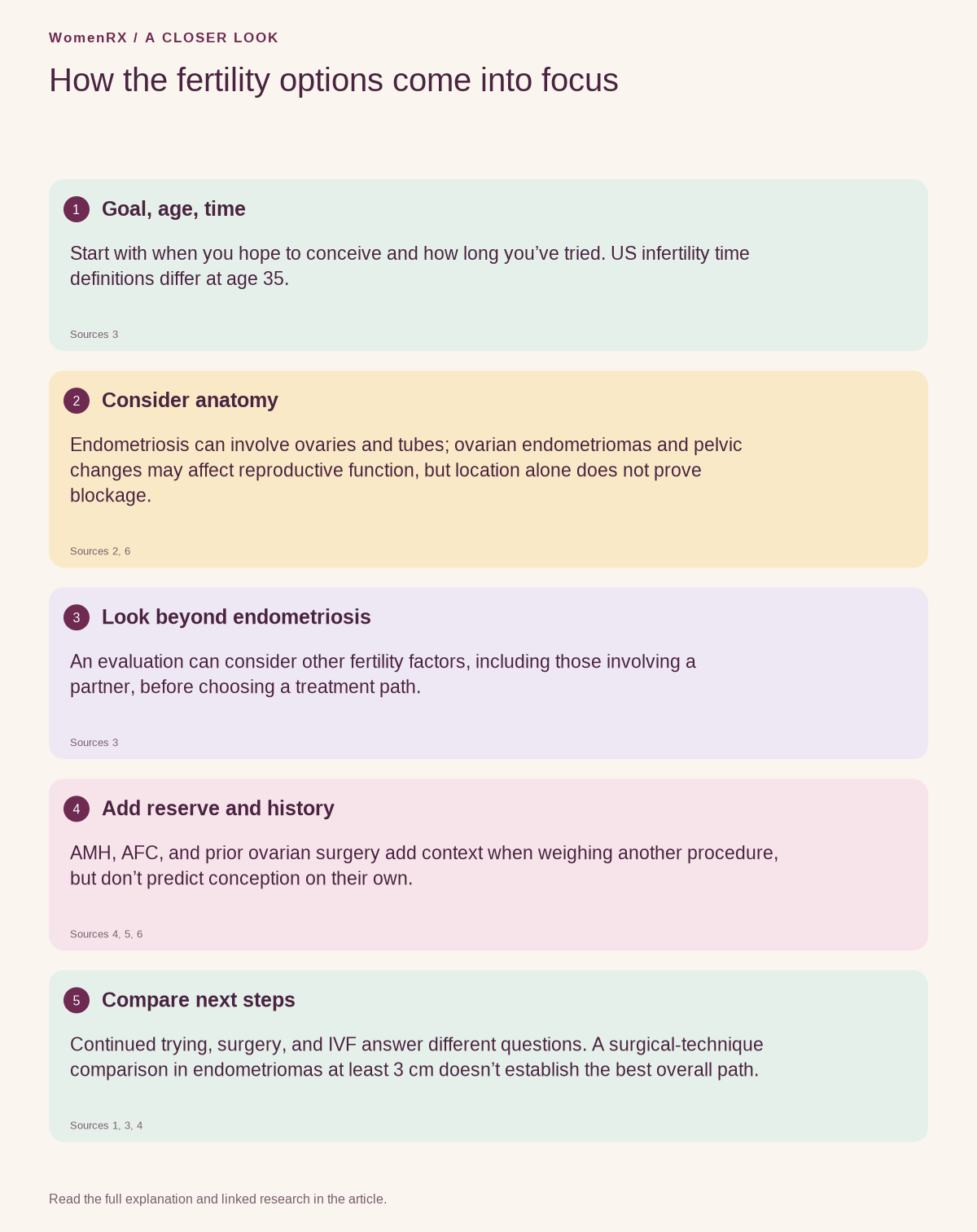
How the fertility options come into focus
Goal, age, time: Start with when you hope to conceive and how long you’ve tried. US infertility time definitions differ at age 35.3
Consider anatomy: Endometriosis can involve ovaries and tubes; ovarian endometriomas and pelvic changes may affect reproductive function, but location alone does not prove blockage.26
Look beyond endometriosis: An evaluation can consider other fertility factors, including those involving a partner, before choosing a treatment path.3
Add reserve and history: AMH, AFC, and prior ovarian surgery add context when weighing another procedure, but don’t predict conception on their own.456
Compare next steps: Continued trying, surgery, and IVF answer different questions. A surgical-technique comparison in endometriomas at least 3 cm doesn’t establish the best overall path.134
Read the figure as text
Read these steps in order: each adds context to a discussion of continued trying, evaluation, surgery, or assisted reproduction, rather than dictating a treatment.- Goal, age, time: Start with when you hope to conceive and how long you’ve tried. US infertility time definitions differ at age 35.3
- Consider anatomy: Endometriosis can involve ovaries and tubes; ovarian endometriomas and pelvic changes may affect reproductive function, but location alone does not prove blockage.26
- Look beyond endometriosis: An evaluation can consider other fertility factors, including those involving a partner, before choosing a treatment path.3
- Add reserve and history: AMH, AFC, and prior ovarian surgery add context when weighing another procedure, but don’t predict conception on their own.456
- Compare next steps: Continued trying, surgery, and IVF answer different questions. A surgical-technique comparison in endometriomas at least 3 cm doesn’t establish the best overall path.134
More questions, answered
Does a low AMH mean I can’t get pregnant?
No. AMH is one ovarian-reserve measure, not a yes-or-no answer about whether you can conceive. In one study of women with endometriomas after surgery, higher preoperative AMH was associated with spontaneous pregnancy, but that group-level finding does not determine an individual’s chances. 5 6
Should an endometrioma be removed before IVF?
Not automatically. A comparison of surgical techniques in women with endometriomas at least 3 cm does not establish whether surgery is better than no surgery before IVF. The discussion should account for your symptoms, ovarian-reserve findings, previous ovarian surgery, and fertility plan. 4
Sources you can check
- Assisted Reproductive Technology | IVF | MedlinePlusAccessed 2026-09-25Return to first citation
- Endometriosis - NHSAccessed 2026-09-25Return to first citation
- Infertility | Infertility Treatments | MedlinePlusAccessed 2026-09-25Return to first citation
- Balancing ovarian preservation and recurrence risk: A systematic review and meta-analysis of cystectomy versus ablative methods in endometrioma management.Romeo P, Tassone A, Bonanno L, Vizzielli G, Restaino S, Ronsini C, Chiantera V, Granese R, Cianci S. · European journal of obstetrics, gynecology, and reproductive biology · 2026Return to first citation
- Preoperative serum anti-Müllerian hormone level is a potential predictor of ovarian endometrioma severity and postoperative fertility.Dong Z, An J, Xie X, Wang Z, Sun P. · European journal of obstetrics, gynecology, and reproductive biology · 2019Return to first citation
- The Impact of Endometriosis on Ovarian Reserve: A Systematic Review.Christina NLL, Tjahyadi D, Anwar R, Rachmawati A, Rafi MA. · International journal of women's health · 2026Return to first citation
- A retrospective cohort study comparing controlled ovarian stimulation protocols for IVF/ICSI in women with endometriosis and diminished ovarian reserve.Zhang F, Chen Y, Lv C, Ni F, Yan L, Song J. · Frontiers in endocrinology · 2026Return to first citation