Black Cohosh for Menopause: Weighing Benefit and Safety
Black cohosh may help some menopause symptoms, but findings differ across studies and liver-injury reports deserve attention.
Black cohosh isn’t a reliably established treatment for hot flashes or night sweats. A 2023 menopause society statement does not recommend herbal remedies for these symptoms, while a later systematic review found moderate-certainty evidence that black cohosh may help. Preparations vary, and products labeled black cohosh have been implicated in serious liver injury. Check the exact product, your medicines, and any liver history before deciding. 2 4 5 7
If hot flashes are interrupting your day or night, a bottle labeled “menopause support” can look like a straightforward option. Black cohosh is sold for that purpose, but the decision isn’t just whether an herb works. It’s whether the evidence applies to the preparation in your hand and whether its possible benefit is worth the safety questions for you.
Why reasonable sources reach different conclusions
The North American Menopause Society’s 2023 position statement does not recommend supplements or herbal remedies for vasomotor symptoms, the clinical term for hot flashes and night sweats. A systematic review published in 2026 reached a more encouraging but still qualified conclusion: it rated evidence for black cohosh’s effect on vasomotor or menopause symptoms as moderate certainty, while describing the evidence for complementary therapies overall as limited. These are different assessments, not a promise that a particular bottle will relieve your symptoms. 2 5
The details of the studies matter. A 2024 review describes differences in black cohosh preparations, doses, results, and ways of measuring symptoms. Another 2026 review reported no measurable effects in two trials involving black cohosh and dong quai. Taken together, the findings don’t support treating every preparation, or every supplement containing black cohosh, as interchangeable. 4 6
A study of a combination product is especially easy to misread. In a 90-day randomized trial, postmenopausal women taking black cohosh with soy isoflavones and SDG lignans reported greater improvements in menopause symptom scores than women taking placebo. Because the ingredients were tested together, the trial cannot tell you whether black cohosh alone produced any of that improvement. 3
What the liver reports mean for your decision
Products labeled as black cohosh have been implicated in cases of acute liver injury. Some reported cases were severe enough to involve liver transplantation or death. Reports like these identify a serious concern, but they don’t tell us how often injury happens or establish the risk of an individual product. If you’ve had liver problems, bring that history into the conversation before using black cohosh. 7
The combination trial reported few adverse events over its 90 days of treatment. That finding is useful for understanding that trial, but it cannot settle longer-term safety or the concern raised by serious liver-injury reports. A review of black cohosh research also identifies long-term safety as an area needing better study. 3 4 7
Make the product review specific
Rather than asking whether black cohosh in general is safe for you, bring the bottle or a clear photo of its full label to a pharmacist or clinician. These questions turn a broad claim into a more useful discussion:
- Which plant and preparation is listed? Black cohosh may appear under the botanical name Actaea racemosa or Cimicifuga racemosa. Study results may not transfer neatly between different preparations. 4 7
- What else is in it? A multi-ingredient product cannot be judged by a study of black cohosh alone, and a combination trial cannot establish what black cohosh contributed. 3
- What medicines and other supplements am I taking? Show the complete list alongside the exact label so the discussion is about what you would actually use.
- Does my liver history change the decision? Liver-injury reports make this especially relevant if you’ve had liver problems. 7
- What symptom am I trying to treat? Evidence about hot flashes should not be assumed to answer a different question, such as vaginal dryness. The menopause society’s 2022 hormone therapy statement discusses separate treatment approaches for bothersome vaginal and urinary symptoms. 1 2
If your main goal is relief from hot flashes and you’d rather avoid hormone therapy, there are other nonhormonal options with stronger support in the 2023 position statement. They include cognitive behavioral therapy, clinical hypnosis, and certain prescription treatments. That gives you a useful comparison: an uncertain benefit from a specific supplement versus options the statement recommends for the symptom you want to change. 2
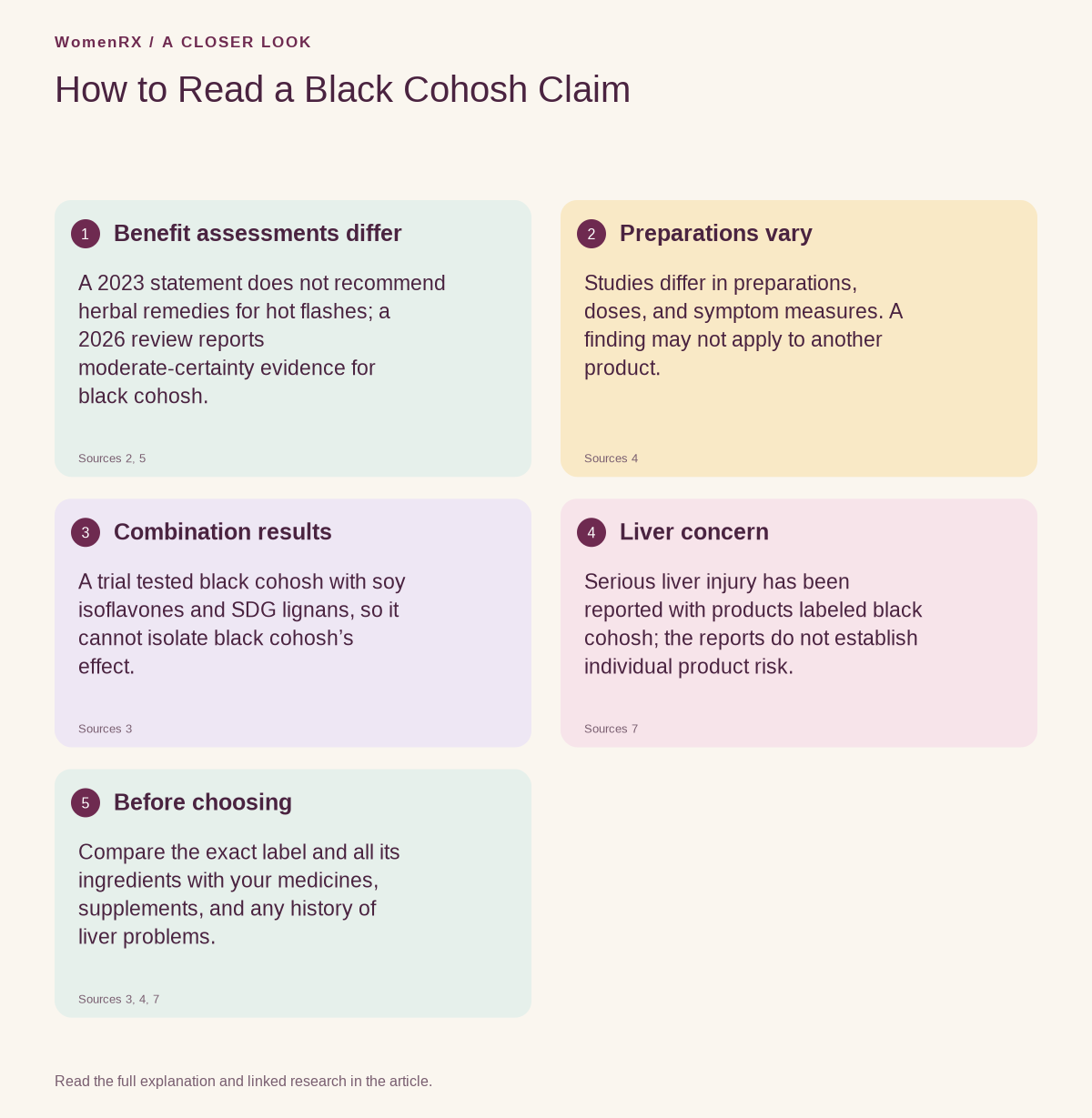
How to Read a Black Cohosh Claim
Benefit assessments differ: A 2023 statement does not recommend herbal remedies for hot flashes; a 2026 review reports moderate-certainty evidence for black cohosh.25
Preparations vary: Studies differ in preparations, doses, and symptom measures. A finding may not apply to another product.4
Combination results: A trial tested black cohosh with soy isoflavones and SDG lignans, so it cannot isolate black cohosh’s effect.3
Liver concern: Serious liver injury has been reported with products labeled black cohosh; the reports do not establish individual product risk.7
Before choosing: Compare the exact label and all its ingredients with your medicines, supplements, and any history of liver problems.347
Read the figure as text
Separate findings about symptom relief from what they can tell you about a particular product and its safety.- Benefit assessments differ: A 2023 statement does not recommend herbal remedies for hot flashes; a 2026 review reports moderate-certainty evidence for black cohosh.25
- Preparations vary: Studies differ in preparations, doses, and symptom measures. A finding may not apply to another product.4
- Combination results: A trial tested black cohosh with soy isoflavones and SDG lignans, so it cannot isolate black cohosh’s effect.3
- Liver concern: Serious liver injury has been reported with products labeled black cohosh; the reports do not establish individual product risk.7
- Before choosing: Compare the exact label and all its ingredients with your medicines, supplements, and any history of liver problems.347
Sources you can check
- The 2022 hormone therapy position statement of The North American Menopause Society.“The 2022 Hormone Therapy Position Statement of The North American Menopause Society” Advisory Panel. · Menopause (New York, N.Y.) · 2022Return to first citation
- The 2023 nonhormone therapy position statement of The North American Menopause Society.Menopause (New York, N.Y.) · 2023Return to first citation
- Assessing the combined effects of Black Cohosh, Soy Isoflavones, and SDG Lignans on menopausal symptoms: a randomized, double-blind, placebo-controlled clinical trial.Pokushalov E, Ponomarenko A, Garcia C, Kasimova L, Pak I, Shrainer E, Romanova A, Kudlay D, Johnson M, Miller R. · European journal of nutrition · 2025Return to first citation
- Exploring the Efficacy and Safety of Black Cohosh (Cimicifuga racemosa) in Menopausal Symptom Management.Hedaoo K, Badge AK, Tiwade YR, Bankar NJ, Mishra VH. · Journal of mid-life health · 2024Return to first citation
- Complementary therapies for management of menopausal symptoms: a systematic review to inform the update of the International Menopause Society recommendations on women's midlife health.Maunder A, Mardon AK, Rao V, Torkel S, Metri NJ, Liu J, Yang G, Giese N, Mantzioris E, Abdul Jafar NK, Rodrigues de Souza GE, Al-Kanini I, Romero L, Panay N, Pedder H, Ee C. · Climacteric : the journal of the International Menopause Society · 2026Return to first citation
- The Effectiveness of Non-Soy Oral Herbal Supplements for Menopausal Symptoms: A Systematic Review.Jing G, Keane CM, Reynolds CM. · Nutrients · 2026Return to first citation
- Black Cohosh2012Return to first citation