Could Black Cohosh Help Your Menopause Symptoms?
Black cohosh has been studied most for hot flashes, but newer and older evidence reviews reach different conclusions, and product and safety questions remain.
Black cohosh has been studied mainly for hot flashes and other menopause symptoms, but guidance and evidence reviews don’t agree on how helpful it is. A 2026 review reports moderate-certainty evidence, while earlier reviews and 2023 menopause guidance were less supportive. Products vary, most safety studies were short, and research has not established whether a specific product carries a particular liver risk. 1 3 5
If hot flashes or night sweats are the symptoms you hope to ease, black cohosh is more relevant to that question than to a broad promise of “menopause support.” Still, the findings don’t point to a dependable benefit for every woman, and results from one preparation may not apply to another.
Hot flashes are the main focus, but guidance differs
A 2012 Cochrane review included 16 randomized trials with 2,027 women. The studies differed in their black cohosh preparations, design, duration, and results, so the reviewers concluded there wasn’t enough evidence to support or oppose using it for menopause symptoms. A 2016 review summarized by the NIH Office of Dietary Supplements found no significant association with fewer vasomotor symptoms, such as hot flashes, or better self-reported symptom ratings. 1
The picture is not entirely one-sided. A 2026 systematic review reported moderate-certainty evidence that black cohosh may improve vasomotor or menopause symptoms, while noting that overall evidence for complementary therapies remains limited and further research is needed. Its abstract doesn’t give a product-specific estimate of benefit. The North American Menopause Society’s 2023 position statement, in contrast, did not recommend supplements and herbal remedies for vasomotor symptoms. These assessments give different practical signals; neither establishes that every product works or predicts how much relief an individual woman will get. 3 5
Don’t treat every menopause symptom as the same outcome
Hot flashes and night sweats are the symptoms most directly connected to the research. Some trials also measured broader menopause ratings or symptoms such as vaginal dryness, but inconsistent results across symptoms don’t establish that black cohosh treats a particular concern. A finding about hot flashes, for example, shouldn’t be taken as proof that it will help vaginal dryness or mood changes. 1
It also matters whether a study tested black cohosh alone. A 2025 trial reported improved symptom ratings with a combination of black cohosh, soy isoflavones, and SDG lignans in postmenopausal women. Because the ingredients were combined, the result can’t show what black cohosh alone contributed. 4
Why the product matters
Black cohosh preparations vary in chemical composition, and researchers haven’t established its active ingredients or mechanism of action. That makes it difficult to assume that a result from one extract applies to a different extract or a multi-ingredient blend. A product label can help you identify what’s in the bottle, but a familiar herb name alone doesn’t show that the product matches one studied in a trial. 1
If you’re considering a product, look at its full ingredient list and note whether it is a single-ingredient product or a blend. Bring that information to a clinician or pharmacist if you want to discuss whether it makes sense for your particular symptom and health situation. The available findings don’t support ranking products or naming a “best” one.
What safety research can and can’t tell you
In clinical trials, the most commonly reported side effects were mild, temporary stomach upset and rash. Most studies lasted six months or less, so they don’t establish long-term safety. 1
Liver concerns deserve a careful, specific conversation rather than either dismissal or alarm. A 2025 plant-chemistry study identified compounds in black cohosh and proposed that one might contribute to liver toxicity. That is a proposed mechanism from laboratory and plant research, not a clinical finding showing that people who take black cohosh supplements develop liver injury or indicating how often that might happen. 7
If liver safety is a concern for you, discuss the exact product and its ingredients with a clinician or pharmacist before deciding whether to use it. The research summarized here does not establish a liver-risk estimate for a particular product. Don’t assume that results from short-term studies settle questions about longer use. 1 6 7
Put the option beside treatments with clearer support
If hot flashes are disrupting your sleep or daily life, you have other options to discuss. The 2023 North American Menopause Society statement lists cognitive behavioral therapy, clinical hypnosis, and certain prescription treatments among nonhormonal options supported by its evidence review. Menopause hormone therapy remains the most effective treatment for vasomotor symptoms, though its risks and benefits depend on individual factors and should be considered individually. 2 3
A practical way to weigh black cohosh is to name the symptom you want to address, check whether the product is a single extract or a blend, and weigh a possible benefit against uncertain product-specific and long-term safety information. That’s more useful than assuming one supplement will address every change that can come with menopause.
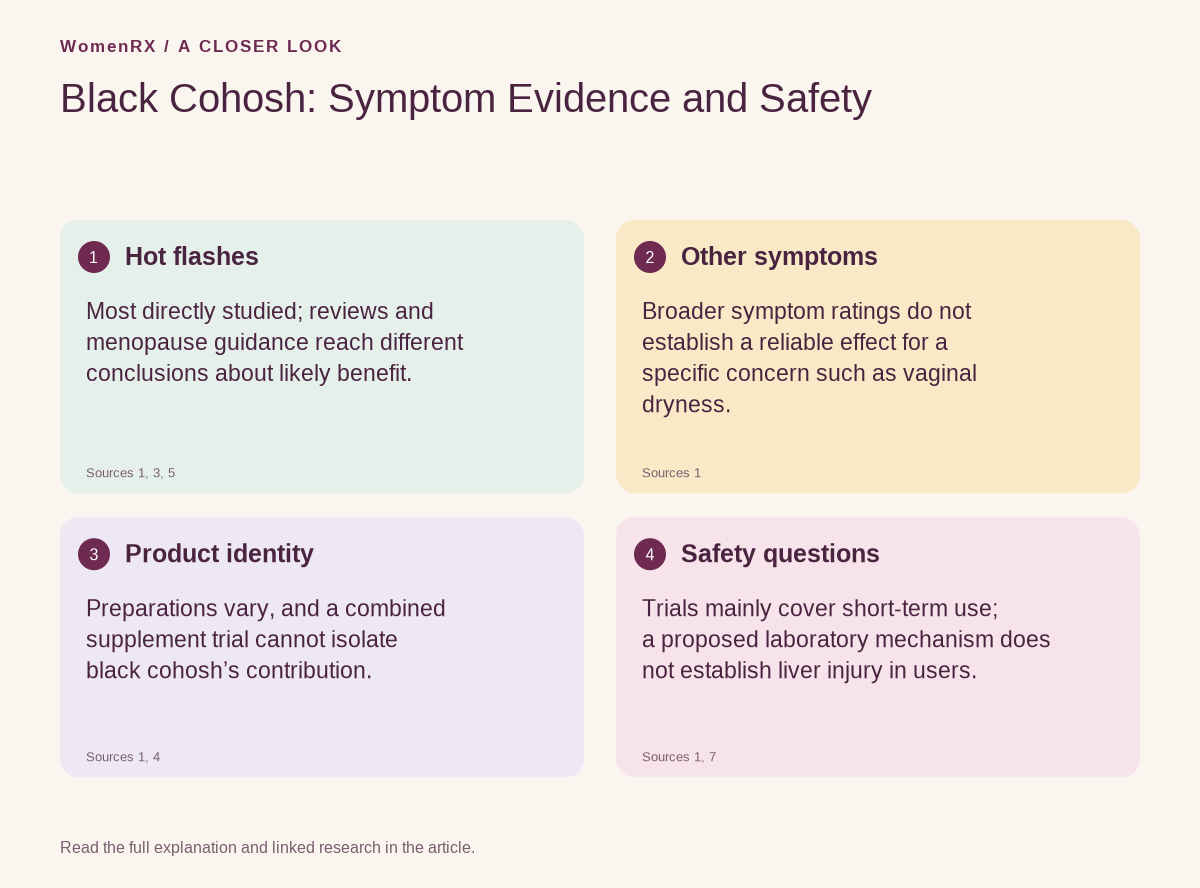
Black Cohosh: Symptom Evidence and Safety
Hot flashes: Most directly studied; reviews and menopause guidance reach different conclusions about likely benefit.135
Other symptoms: Broader symptom ratings do not establish a reliable effect for a specific concern such as vaginal dryness.1
Product identity: Preparations vary, and a combined supplement trial cannot isolate black cohosh’s contribution.14
Safety questions: Trials mainly cover short-term use; a proposed laboratory mechanism does not establish liver injury in users.17
Read the figure as text
A quick comparison of the symptoms studied, why product identity matters, and what safety findings do and don’t establish.- Hot flashes: Most directly studied; reviews and menopause guidance reach different conclusions about likely benefit.135
- Other symptoms: Broader symptom ratings do not establish a reliable effect for a specific concern such as vaginal dryness.1
- Product identity: Preparations vary, and a combined supplement trial cannot isolate black cohosh’s contribution.14
- Safety questions: Trials mainly cover short-term use; a proposed laboratory mechanism does not establish liver injury in users.17
Sources you can check
- Black Cohosh - Health Professional Fact SheetAccessed 2026-09-25Return to first citation
- The 2022 hormone therapy position statement of The North American Menopause Society.“The 2022 Hormone Therapy Position Statement of The North American Menopause Society” Advisory Panel. · Menopause (New York, N.Y.) · 2022Return to first citation
- The 2023 nonhormone therapy position statement of The North American Menopause Society.Menopause (New York, N.Y.) · 2023Return to first citation
- Assessing the combined effects of Black Cohosh, Soy Isoflavones, and SDG Lignans on menopausal symptoms: a randomized, double-blind, placebo-controlled clinical trial.Pokushalov E, Ponomarenko A, Garcia C, Kasimova L, Pak I, Shrainer E, Romanova A, Kudlay D, Johnson M, Miller R. · European journal of nutrition · 2025Return to first citation
- Complementary therapies for management of menopausal symptoms: a systematic review to inform the update of the International Menopause Society recommendations on women's midlife health.Maunder A, Mardon AK, Rao V, Torkel S, Metri NJ, Liu J, Yang G, Giese N, Mantzioris E, Abdul Jafar NK, Rodrigues de Souza GE, Al-Kanini I, Romero L, Panay N, Pedder H, Ee C. · Climacteric : the journal of the International Menopause Society · 2026Return to first citation
- Efficacy and safety of Actaea racemosa for relieving climacteric complaints.Curtis S, Moore A, Breakspear I. · Menopause (New York, N.Y.) · 2026Return to first citation
- On the Biosynthesis of Bioactive Tryptamines in Black Cohosh (Actaea racemosa L.).Spiering MJ, Parsons JF, Eisenstein E. · Plants (Basel, Switzerland) · 2025Return to first citation