Can Adenomyosis Be Cured or Managed Naturally?
Heat may ease pain, but feeling better doesn't show that adenomyosis has reversed; treatment choices depend on your symptoms and pregnancy plans.
Heat may ease period or pelvic pain, but that relief isn't evidence that adenomyosis has been reversed. Medical options focus on symptom control; the IUS is specifically described as making periods lighter and less painful. Hysterectomy is definitive treatment, but it means you can't carry a future pregnancy. The right tradeoffs depend on your symptoms, priorities, and pregnancy plans. 1 3 6

Relief and reversal are different goals
Adenomyosis occurs when tissue similar to the uterine lining grows into the muscle of the uterus. It can cause heavy bleeding, painful periods, or pelvic pain, though some people have no symptoms. 1 4
The distinction that helps with treatment decisions is symptom relief versus changing or removing the disease. Heat may make cramps more manageable, and medical treatments can help with symptoms. Feeling better doesn't show that adenomyosis has been reversed. Current treatment options are mainly aimed at symptom control. 1 4 A review describes GnRH antagonists as suppressive rather than curative, with symptoms often returning after treatment stops. 6
Comfort measures still have a place. A heat pad or wrapped hot-water bottle may help with period or pelvic pain. If it helps, that tells you about your pain, not whether adenomyosis has changed. 1
What different approaches can offer
Supportive care for cramps. A heat pad or hot-water bottle wrapped in a towel on your abdomen may help period or pelvic pain. It's a way to ease discomfort; pain relief by itself doesn't tell you whether the condition has changed. 1
Medicines for bleeding or pain. NHS guidance lists the hormonal IUS, other hormonal contraception, NSAIDs, and tranexamic acid as treatment options. It specifically says the IUS thins the uterine lining, making periods lighter and less painful; it lists the other hormonal options without describing their effects. GnRH antagonists are another emerging medical option, but evidence specific to adenomyosis remains limited and they are considered symptom-suppressing, not curative. 1 2 6
Procedures for persistent symptoms. For selected people whose symptoms have not improved enough with other treatment, procedures may be considered. A 2026 systematic review of observational studies included 1,701 people treated with uterine artery embolization for adenomyosis that had not responded to treatment; 1,301 of 1,701 (76.4%) had significant improvement in bleeding, pain, or bulk-related symptoms at short- or mid-term follow-up. These results describe selected patients in nonrandomized studies, not a guaranteed outcome or proof that embolization cures adenomyosis. 5
Hysterectomy. Removing the uterus is described as definitive treatment for adenomyosis for people who have completed childbearing. It is major, life-altering surgery and isn't suitable if you want to carry a future pregnancy. 3 4
Let your priorities shape the choice
If heavy bleeding is the main problem, ask which options are intended to address it and what tradeoffs or follow-up they involve. If pain is the main problem, distinguish a comfort measure like heat from treatment intended to control symptoms over time. You don't have to choose the most intensive option just because you have a diagnosis; the impact of symptoms and your preferences matter. 1 7
Pregnancy plans can change the decision. Some hormone treatments are contraceptive, and treatments differ in how they fit with fertility goals. If you want to become pregnant, are trying now, or want to preserve that option, make that part of the discussion before settling on a treatment. Procedures that preserve the uterus are not automatically proven to preserve fertility or make pregnancy risk-free; some uterus-preserving surgery carries risks for subsequent pregnancies. 4 7
Current symptom impact and pregnancy goals can help shape the choice; don't assume that comfort measures alone will be enough if bleeding or pain remains disruptive. 7
When to reconsider the plan
A plan deserves another look if pain or bleeding is getting worse, treatment isn't helping enough, or symptoms are interfering with daily life. Heavier or increasingly painful periods and pelvic pain are recognized adenomyosis symptoms; persistent or changing symptoms are a reason to revisit what else might be contributing and whether the current approach still matches your goals. 1
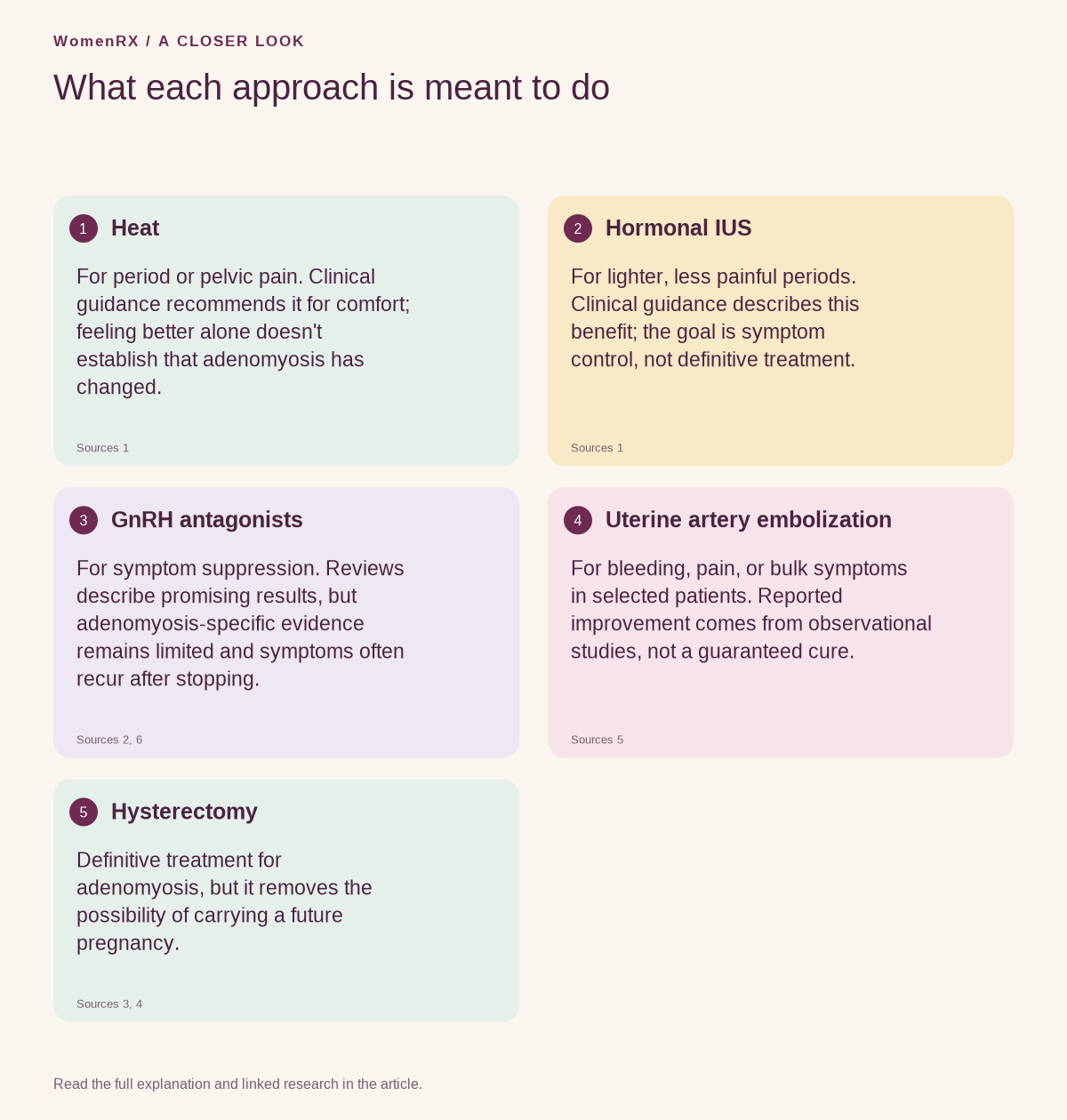
What each approach is meant to do
Heat: For period or pelvic pain. Clinical guidance recommends it for comfort; feeling better alone doesn't establish that adenomyosis has changed.1
Hormonal IUS: For lighter, less painful periods. Clinical guidance describes this benefit; the goal is symptom control, not definitive treatment.1
GnRH antagonists: For symptom suppression. Reviews describe promising results, but adenomyosis-specific evidence remains limited and symptoms often recur after stopping.26
Uterine artery embolization: For bleeding, pain, or bulk symptoms in selected patients. Reported improvement comes from observational studies, not a guaranteed cure.5
Hysterectomy: Definitive treatment for adenomyosis, but it removes the possibility of carrying a future pregnancy.34
Read the figure as text
Compare the symptom each approach addresses with the kind and limits of evidence behind it. Comfort, symptom control, and definitive treatment are different goals.- Heat: For period or pelvic pain. Clinical guidance recommends it for comfort; feeling better alone doesn't establish that adenomyosis has changed.1
- Hormonal IUS: For lighter, less painful periods. Clinical guidance describes this benefit; the goal is symptom control, not definitive treatment.1
- GnRH antagonists: For symptom suppression. Reviews describe promising results, but adenomyosis-specific evidence remains limited and symptoms often recur after stopping.26
- Uterine artery embolization: For bleeding, pain, or bulk symptoms in selected patients. Reported improvement comes from observational studies, not a guaranteed cure.5
- Hysterectomy: Definitive treatment for adenomyosis, but it removes the possibility of carrying a future pregnancy.34
More questions, answered
Can heat reverse adenomyosis?
Heat may ease period or pelvic pain. Feeling less pain doesn't, by itself, tell you whether adenomyosis has changed. 1
Does a uterus-preserving procedure mean I can safely get pregnant afterward?
Not necessarily. Preserving the uterus and preserving fertility are not the same promise. Some uterus-preserving surgery carries risks for later pregnancy, so reproductive plans need to be part of the treatment discussion. 4 7
Sources you can check
- Adenomyosis - NHSAccessed 2026-09-25Return to first citation
- Role of oral gonadotropin-releasing hormone antagonists in the management of uterine adenomyosis: a narrative review.Donnez J, Donnez O, Taylor HS, Petraglia F, Horne AW, Becker CM, Renner SP, Rius M, Bestel E, Stratopoulou CA, Dolmans MM. · Reproduction & fertility · 2026Return to first citation
- AdenomyosisConsoli RJ, Carlson K. · 2026Return to first citation
- Spatial transcriptomics uncovers the hybrid molecular identity, ciliated phenotype, and immune signature of adenomyosis lesions.Maclean A, Johnson E, Rushworth C, Hill CJ, Caamaño Gutiérrez E, Hapangama DK. · Science advances · 2026Return to first citation
- Uterine artery embolization for the treatment of symptomatic adenomyosis: a systematic review.Ini' C, Timpanaro C, Foti PV, Tiralongo F, Farina R, Libra F, Castiglione DG, Vacirca F, Milazzotto R, Spatola C, Lo Greco MC, Messina G, David E, Palmucci S, Basile A. · CVIR endovascular · 2026Return to first citation
- GnRH antagonists for the treatment of fibroids and adenomyosis, current evidence and future perspectives.Ferrero S, Gazzo I, Perrone U, Olcese F, Ottonello S, Rosato FP, Vellone VG, Barra F. · Expert opinion on pharmacotherapy · 2026Return to first citation
- Treatment selection for adenomyosis based on imaging findings and patient characteristics.Kobayashi H. · International journal of gynaecology and obstetrics: the official organ of the International Federation of Gynaecology and Obstetrics · 2026Return to first citation