Testosterone for Postmenopausal Low Desire: When Might It Help?
Track the change you want, then agree on a review point that treats study timelines as clues, not promises.
Testosterone may improve sexual desire for some postmenopausal women, but the studies don’t establish a guaranteed result or a standard response deadline. Before starting, choose the change you hope to notice, such as more desire or less distress about low desire. A review around three months is a practical checkpoint to discuss, not a proven rule for everyone. 1 3
Start with what “helping” means to you
Before treatment, choose one or two changes you’d actually welcome. Maybe you want to feel more interested in sex, find it easier to initiate or respond to intimacy, or feel less bothered by low desire. You might jot down how things feel now so you have a starting point to compare with later. This isn’t a test you need to pass; it’s a way to make the review about your experience.
Studies have measured different aspects of sexual function, including desire, satisfaction, initiation, and sexual activity. A small placebo-controlled trial in postmenopausal women reporting decreased desire found improvement in several sexual-function areas in the testosterone group. Another trial in a selected group of menopausal women found improvements in desire, frequency, receptivity, and initiation. Those findings show why it can help to define your own goal, but they don’t predict which change any one woman will notice. 1 3
Frequency can be worth tracking if it matters to you, but it doesn’t have to be the main measure. For example, you could note whether desire or satisfaction has changed and whether the issue feels less troubling, even if your sexual activity hasn’t changed.
Make the first review a checkpoint, not a deadline
The research doesn’t establish one standard timeline for noticing a benefit. In a small trial of selected menopausal women who had undergone hysterectomy and were already using estrogen, each treatment period lasted three months. Another study assessed sexual-function scores at six and 12 weeks, but it tested vaginal testosterone in postmenopausal women with vaginal atrophy. That study’s treatment and participants differ from testosterone therapy aimed at low desire, so its timing shouldn’t be treated as a universal schedule. 2 3
A review around three months is a reasonable point to discuss with the prescriber before starting. Think of it as a chance to compare your experience with your starting point, not a promise that you should feel a certain way by then. If the result is hard to interpret, agree on whether and when to reassess rather than assuming you need to continue for a fixed length of time.
One separate trial followed women with a history of hysterectomy for 24 weeks, using testosterone injections. That’s a research assessment period in a specific study, not evidence that everyone needs six months to respond. 4
Consider your experience separately from lab results
Some studies measured testosterone levels as well as sexual-function outcomes. In a placebo-controlled trial of 47 postmenopausal women with decreased desire, testosterone levels increased in the treatment group along with improvement in some reported sexual-function areas. The study also reported variability in hormone concentrations, which complicated evaluation of the compounded medication. A change in a blood result and a change in the experience you’re treating are separate pieces of information to discuss at review. 1
So, “Did the number change?” isn’t the only question. Consider whether the change you wanted happened and whether it feels worthwhile to you. If a lab result changes but your desire or distress doesn’t, that difference is part of the assessment too. 1 4
Keep expectations tied to the symptom being treated
The studies here focus on sexual desire or sexual-function measures in selected postmenopausal groups. They don’t establish testosterone as a treatment for low energy, mood, or weight. In one small trial, testosterone improved measured sexual outcomes but did not change mood, energy, or weight during the study period; that result is limited to the participants and timeframe studied. 3
Before starting, ask the prescriber to agree with you on what you’ll track and when you’ll review it. At that point, compare your experience with your starting point, consider any lab results in context, and discuss whether the change you’ve noticed is meaningful enough to continue or whether the plan needs reassessment.
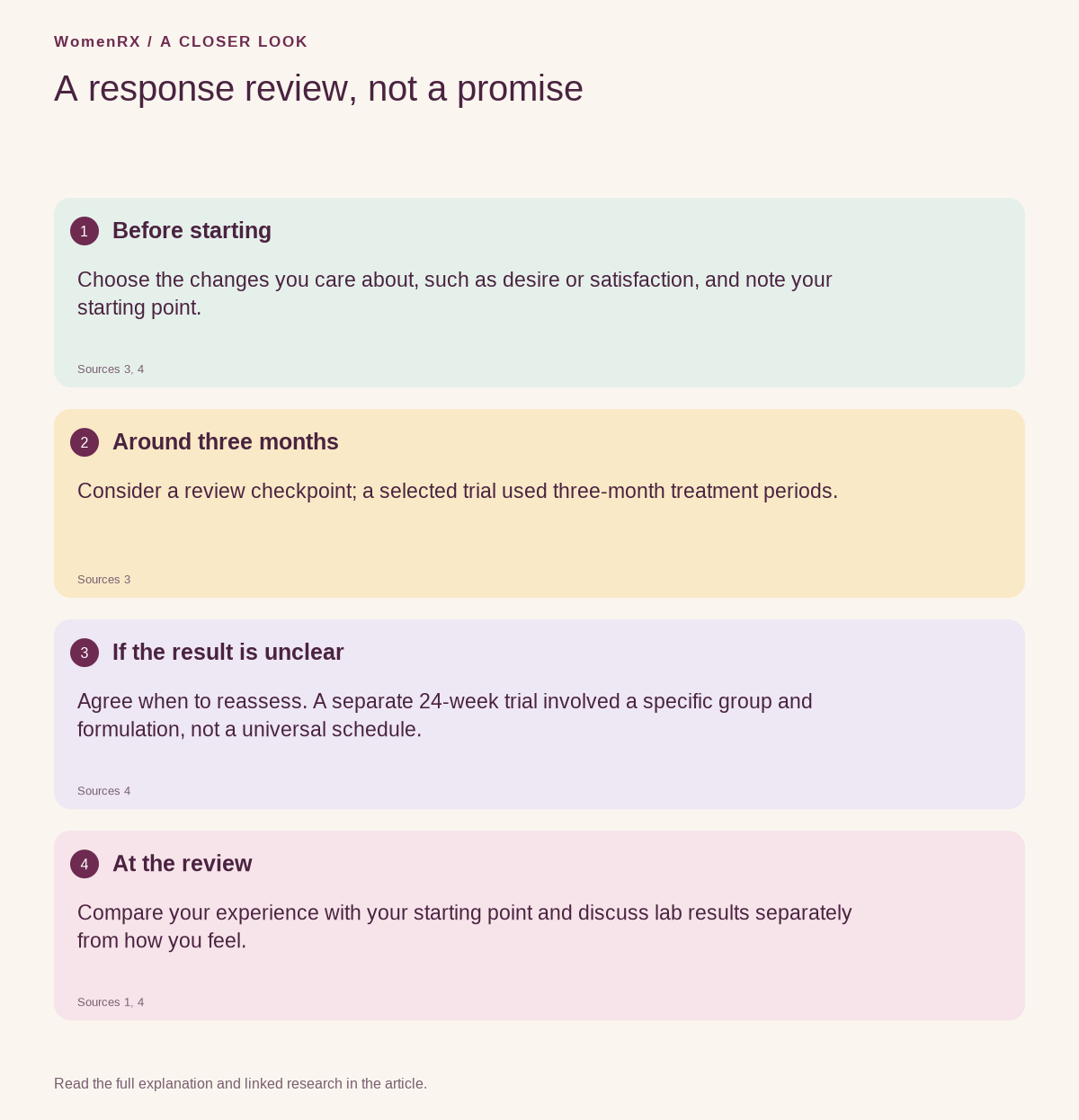
A response review, not a promise
Before starting: Choose the changes you care about, such as desire or satisfaction, and note your starting point.34
Around three months: Consider a review checkpoint; a selected trial used three-month treatment periods.3
If the result is unclear: Agree when to reassess. A separate 24-week trial involved a specific group and formulation, not a universal schedule.4
At the review: Compare your experience with your starting point and discuss lab results separately from how you feel.14
Read the figure as text
Use these stages to plan a discussion about your own experience. Study assessment points are not guaranteed response milestones.- Before starting: Choose the changes you care about, such as desire or satisfaction, and note your starting point.34
- Around three months: Consider a review checkpoint; a selected trial used three-month treatment periods.3
- If the result is unclear: Agree when to reassess. A separate 24-week trial involved a specific group and formulation, not a universal schedule.4
- At the review: Compare your experience with your starting point and discuss lab results separately from how you feel.14
More questions, answered
Should I track how often I have sex?
Only if that’s meaningful to you. Studies have measured frequency, but desire, satisfaction, or whether low desire is troubling you may better reflect the change you hoped for. 3 4
Does a higher testosterone blood level mean treatment is working?
Not by itself. Trials have measured hormone levels and sexual-function outcomes separately, so discuss the lab result alongside whether the experience you’re treating has changed. 1 4
Sources you can check
- Effect of transdermal testosterone on postmenopausal sexual desire: placebo-controlled randomized clinical trial.Ceccatto Andrade VP, Araujo Júnior E, Callado GY, Ceccatto Andrade G, Kulak Junior J. · European journal of obstetrics, gynecology, and reproductive biology · 2026Return to first citation
- Efficacy of vaginally applied estrogen, testosterone, or polyacrylic acid on sexual function in postmenopausal women: a randomized controlled trial.Fernandes T, Costa-Paiva LH, Pinto-Neto AM. · The journal of sexual medicine · 2014Return to first citation
- A double-blind, randomized, placebo-controlled trial of the effect of testosterone cream on the sexual motivation of menopausal hysterectomized women with hypoactive sexual desire disorder.El-Hage G, Eden JA, Manga RZ. · Climacteric : the journal of the International Menopause Society · 2007Return to first citation
- Testosterone dose-response relationships in hysterectomized women with or without oophorectomy: effects on sexual function, body composition, muscle performance and physical function in a randomized trial.Huang G, Basaria S, Travison TG, Ho MH, Davda M, Mazer NA, Miciek R, Knapp PE, Zhang A, Collins L, Ursino M, Appleman E, Dzekov C, Stroh H, Ouellette M, Rundell T, Baby M, Bhatia N... · Menopause (New York, N.Y.) · 2014Return to first citation